
European equities closed modestly higher on Monday as investors digested key signals from the Munich Security Conference and positioned ahead of a busy week of corporate earnings. With US markets closed for the Presidents Day holiday, trading volumes were lighter, but sector rotation helped stabilise sentiment following recent volatility. Financial stocks led gains across the region as artificial intelligence disruption fears eased, while mixed economic data continued to highlight the uneven pace of recovery across Europe and parts of Asia.
Key Takeaways:
- European Markets Rise as Banks Rebound and Earnings Impress: European equities closed modestly higher as financial stocks staged a strong recovery from last week’s AI-driven selloff. The STOXX 600 rose 0.13% to 618.52, led by Spain’s IBEX with a 1% gain, while the FTSE 100 added 0.27% to 10,474 and the CAC 40 advanced 0.10% to 8,320. Italy’s FTSE MIB climbed 0.09% to 45,473 and Switzerland’s SMI gained 0.41% to 13,656, offsetting a 0.43% decline in Germany’s DAX to 24,807. Banks rose 1.4% and insurance stocks added 0.7%, easing fears around AI disruption, while technology and luxury sectors fell 1.0% and 1.9% respectively. Earnings momentum remained supportive, with 60% of European companies beating expectations so far and forecast earnings declines narrowing to 1.1% from around 4% earlier in the month.
- Eurozone Output Contracts While Switzerland Rebounds: Eurozone industrial production fell 1.4% month-on-month in December, reversing a 0.3% rise in November and marking the first contraction since August, driven largely by weakness in Germany. On a year-on-year basis, output growth slowed to 1.2% from 2.5%, tempering expectations of a rapid recovery despite anticipated fiscal stimulus. In contrast, Switzerland’s economy expanded 0.2% in the final quarter of 2025, rebounding from a 0.5% contraction in Q3. Full-year growth reached 1.4%, faster than in 2024 but still below long-term averages, as the economy absorbed earlier tariff-related headwinds.
- Asian Markets Consolidate on Holidays and Weak Japan Data: Asian equities consolidated recent gains amid Lunar New Year-thinned trading, with markets in China, South Korea, and Taiwan closed. Japan underperformed after disappointing GDP data, with the Nikkei 225 slipping 0.1% to around 56,900 and the TOPIX falling 0.2% to 3,810. Japan’s economy grew just 0.2% annualised in Q4 and 0.1% quarter-on-quarter, undershooting forecasts and raising concerns over domestic demand durability. Elsewhere, India’s Sensex rose 0.79% to 83,277.15 and the Nifty 50 gained 0.83% to 25,682.75, snapping a two-session losing streak despite unemployment rising to 5.0%. Australia’s ASX 200 added 0.3% to 8,943 on strong corporate earnings, while New Zealand’s NZX 50 edged 0.1% lower as services sector activity softened.
- Oil Prices Rise Ahead of US–Iran Nuclear Talks: Oil prices advanced around 1% as investors weighed the implications of upcoming US–Iran talks against expectations of higher OPEC+ supply. Brent crude settled 90 cents higher at $68.65 a barrel, while WTI traded at $63.75, up 86 cents, although it did not settle due to the US Presidents Day holiday. Fears of supply disruption linked to Middle East tensions helped underpin prices, even as Lunar New Year holidays in China, South Korea, and Taiwan dampened trading activity. Both benchmarks posted weekly declines last week, with Brent down about 0.5% and WTI lower by 1%. Meanwhile, Russian crude shipments to China are set to hit a record in February at an estimated 2.07 million barrels per day, as refiners snapped up discounted cargoes.
FX Today:
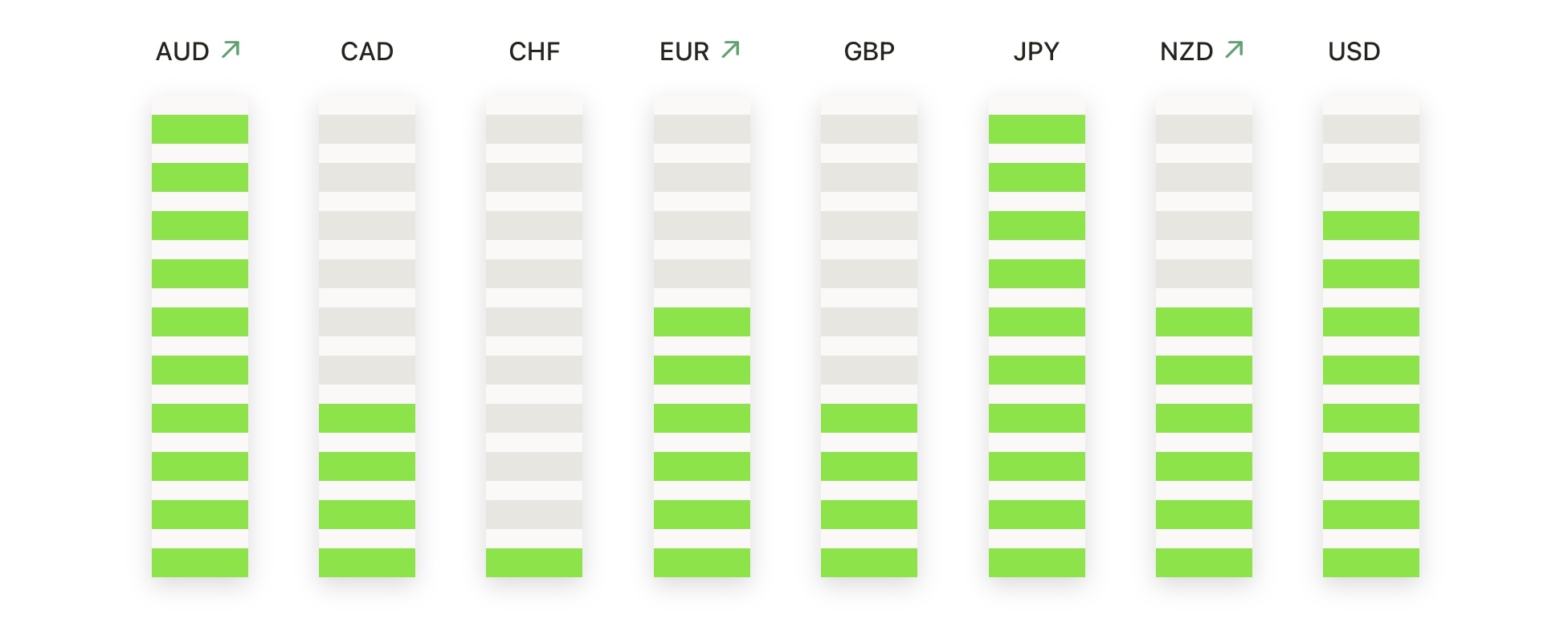
- EUR/USD Pulls Back From Recent Highs: EUR/USD closed at 1.1854, down 0.13%, after trading between a high of 1.1873 and a low of 1.1854. The session produced a red candle that closed near the low, reflecting mild profit-taking following the recent advance. Despite the pullback, price remains comfortably above the 50-day SMA at 1.1760, the 100-day SMA at 1.1689, and the 200-day SMA at 1.1635, all of which continue to slope higher. The broader trend remains firmly constructive, defined by a sequence of higher highs and higher lows since early December. Immediate resistance remains at the prior session high near 1.1920, followed by the psychological 1.2000 level. Initial support is seen at 1.1854, with stronger underlying support at the 50-day SMA. As long as the pair holds above the mid-1.18 area, the correction appears orderly rather than trend-threatening.
- GBP/USD Consolidates After Recent Rally: GBP/USD finished at 1.3631, down 0.18%, within a 1.3662 to 1.3626 range. The red daily candle signalled consolidation and mild profit-taking after the recent strong upside move. Price continues to trade well above the 50-day SMA at 1.3514, the 100-day SMA at 1.3398, and the 200-day SMA at 1.3439, preserving the broader bullish structure. The pair has maintained a pattern of higher highs and higher lows since mid-November, with momentum cooling rather than reversing. Resistance is located near 1.3700 and the recent peak around 1.3850. Initial support rests at 1.3626, followed by the 50-day SMA, which remains a key technical floor.
- USD/CAD Attempts to Stabilise After Steep Decline: USD/CAD closed at 1.3635, up 0.15%, after trading between 1.3603 and 1.3625. The green candle reflected a tentative stabilisation attempt following an extended decline, though the broader bias remains bearish. Price continues to trade below the 50-day SMA at 1.3736, the 100-day SMA at 1.3873, and the 200-day SMA at 1.3817, reinforcing the dominant downtrend defined by a sequence of lower highs and lower lows since mid-November. Resistance is seen near the 1.3700 psychological level and the descending 50-day SMA, while initial support rests at 1.3603, with the recent multi-month low around 1.3480 remaining the key downside reference. On the macro front, Canadian housing starts fell sharply in January, dropping 15% month-on-month to an annualised pace of 238,049 units, underscoring softer domestic demand and adding context to the pair’s recent volatility.
- USD/CHF Edges Higher After Extended Decline: USD/CHF ended the session at 0.7693, up 0.27%, trading between 0.7653 and 0.7705. The modest rebound followed a prolonged period of heavy selling, though the broader technical picture remains decisively bearish. Price continues to trade well below the 50-day SMA at 0.7875, the 100-day SMA at 0.7898, and the 200-day SMA at 0.8007, all of which are pointing lower. The prevailing downtrend remains defined by persistent lower highs and lower lows since mid-January. Immediate resistance is seen near 0.7705 and then around 0.7780, while support remains at 0.7653 and the multi-month low near 0.7600. Any further upside currently appears corrective rather than structural.
- USD/JPY Rebounds Toward Medium-Term Resistance: USD/JPY closed at 153.47, up 0.55%, after trading between 152.58 and 153.63. The green candle reflected a recovery following the recent sharp pullback from multi-year highs. Price remains above the rising 200-day SMA at 150.49, preserving the longer-term bullish bias, but continues to trade below the 100-day SMA at 154.57 and the 50-day SMA at 156.07. This configuration points to a transition from a strong uptrend into a consolidation phase. Resistance is concentrated at the 100-day and 50-day SMAs, while initial support sits near 152.50. A sustained break below that level would expose the 200-day SMA as the next key downside area.
- AUD/USD Consolidates Near Multi-Month Highs: AUD/USD finished at 0.7075, up 0.09%, after trading between 0.7054 and 0.7097. The session produced a small-bodied green candle, signalling consolidation after the recent surge to multi-month highs. Price remains firmly above the 50-day SMA at 0.6797, the 100-day SMA at 0.6684, and the 200-day SMA at 0.6589, all of which continue to rise sharply. The broader trend remains decisively bullish, underpinned by a clear pattern of higher highs and higher lows since early December. Resistance is located near the recent swing high around 0.7140, with the 0.7150 level just beyond. Initial support is seen at 0.7054, followed by the 0.7000 region.
Market Movers:
- Moderna Rallies on Upbeat Revenue Outlook: Moderna shares climbed 5% after the biotech group delivered stronger-than-expected full-year guidance, forecasting revenue growth of up to 10% from 2025 levels, well above the 5.9% consensus.
- Roku Gains on Revenue Beat and Optimistic Outlook: Roku rose more than 8% after reporting Q4 net revenue of $1.39 billion, exceeding the $1.35 billion consensus. The company forecast full-year revenue of $5.50 billion, ahead of the $5.34 billion estimate.
- Pinterest Slides on Weak Revenue Guidance: Pinterest tumbled more than 16% after posting Q4 revenue of $1.32 billion, slightly below forecasts. The company’s Q1 revenue guidance of $951 million to $971 million also fell short of the $980.9 million consensus.
- DraftKings Drops on Disappointing Full-Year Outlook: DraftKings shares fell more than 13% after the company projected full-year revenue of $6.5 billion to $6.9 billion, well below market expectations of $7.32 billion.
- Ryan Specialty Holdings Sinks After Revenue Miss: Ryan Specialty Holdings declined more than 12% after reporting Q4 total revenue of $751.2 million, missing the $774.7 million consensus estimate.
With US markets closed, European equities found support from a rebound in financial stocks and improving earnings momentum, allowing the region to close modestly higher despite mixed macro signals. Asia-Pacific markets were more subdued as holiday-thinned trade and weak Japanese data tempered risk appetite, while India and Australia showed relative resilience. Oil prices firmed ahead of US–Iran talks amid lingering supply concerns, and crypto markets consolidated after recent volatility, leaving investors focused on earnings updates, sector rotation, and incoming economic data as global markets move into the rest of the week.