US equities edged higher on Wednesday as the Supreme Court’s review of President Trump’s tariff authority led markets to reassess the likelihood of existing import duties being altered. The possibility of a shift in tariff scope supported industrial and manufacturing names, while a rebound in AMD helped stabilise the AI segment after recent valuation-driven pressure. Strong labour and services-sector data added further support, though rising Treasury yields capped the market’s advance.
Key Takeaways:
- Dow Strengthens as Investors Reprice Tariff Risk: The Dow gained 225.76 points or 0.48% to 47,311.00 as justices’ pointed questions raised the odds that elements of the current tariff regime could be curtailed, lifting trade-sensitive names.
- S&P 500 Climbs on Chips and Cyclicals: The S&P 500 added 0.37% to 6,796.29, with semiconductors and industrials offsetting lingering valuation caution in megacap tech. Breadth improved versus Tuesday’s sell-off, but leadership stayed narrow as investors weighed margins and guidance.
- Nasdaq Rebounds as AMD Leads AI Snapback: The Nasdaq advanced 0.65% to 23,499.80 after AMD flipped from an early decline to finish higher, pulling up peers including Broadcom and Micron. Oracle also recovered, while Palantir and Super Micro Computer remained under pressure as investors reassessed stretched AI multiples.
- Europe Closes Higher as Growth Pulse Firms: European equities reversed early losses, with the Stoxx 600 up about 0.25% and the FTSE 100 gaining 0.64% to 9,777.08 as US strength filtered through. Germany’s DAX added roughly 0.4% to 24,049, Italy’s FTSE MIB rose 0.4% to 43,438 and France’s CAC 40 edged 0.08% higher to 8,074. Eurozone composite PMI rose to 52.5 in October, a 29-month high, with services at 53.0 and employment growth at a 16-month high. Spain led at 56.0, Germany improved to 53.9, and Italy and Ireland printed 53.1 and 53.7 respectively, while France lagged at 47.7. UK PMIs also firmed, with services at 52.3 and the composite at 52.2, beating flash estimates and pointing to healthier demand.
- Asia Declines as AI Valuation Pressure Deepens: Asian markets were broadly weaker, led by Japan’s Nikkei, which closed down 2.5% at 50,212.27 following a sharp early-day decline driven by losses in AI-linked names such as SoftBank. South Korea also came under pressure, with the Kospi falling more than 2% to 4,004.42 and the Kosdaq down 2.66% to 901.89, as Samsung Electronics and SK Hynix retreated. Hong Kong’s Hang Seng was little changed at 25,935.41, while China’s CSI 300 edged 0.19% higher to 4,627.26 with services activity remaining in expansionary territory. Australia’s ASX 200 slipped 0.13% to 8,802. Indonesia’s economy continued to grow steadily, expanding 5.04% year-on-year in Q3 and 1.43% quarter-on-quarter, consistent with recent trend performance. Meanwhile, Thailand’s consumer prices declined 0.76% year-on-year in October, marking a seventh consecutive monthly fall.
- Crude Oil Dips Amid Oversupply Concerns: Brent settled at $63.52 down 1.43% and WTI at $59.60 fell 1.59% after US crude inventories rose by 5.2 million barrels to 421.2 million. A sharper-than-expected 4.7 million-barrel gasoline draw signalled firm demand and limited losses. OPEC+ confirmed a 137,000 bpd increase in December and a pause on further hikes in early 2026, while Kazakhstan’s output eased but remained above quota.
- Treasury Yields Move Higher: Treasury yields rose as investors responded to stronger US economic data and renewed uncertainty around the future scope of the current tariff regime. The 10-year yield moved to 4.159%, while the 2-year reached 3.634% and the 30-year advanced to 4.74%. The move reflected a recalibration of expectations for the Federal Reserve’s policy path, with markets weighing the durability of recent economic momentum.
- US Private Payrolls Beat Expectations and ISM Services Strengthens: US private payrolls increased by 42,000 in October, outperforming forecasts and reversing September’s decline, signalling ongoing resilience in hiring conditions. The ISM services index also improved to 52.4, supported by stronger new orders at 56.2, pointing to steady expansion in the largest sector of the economy. Together, the data highlighted continued underlying demand despite valuation and rate uncertainty.
FX Today:
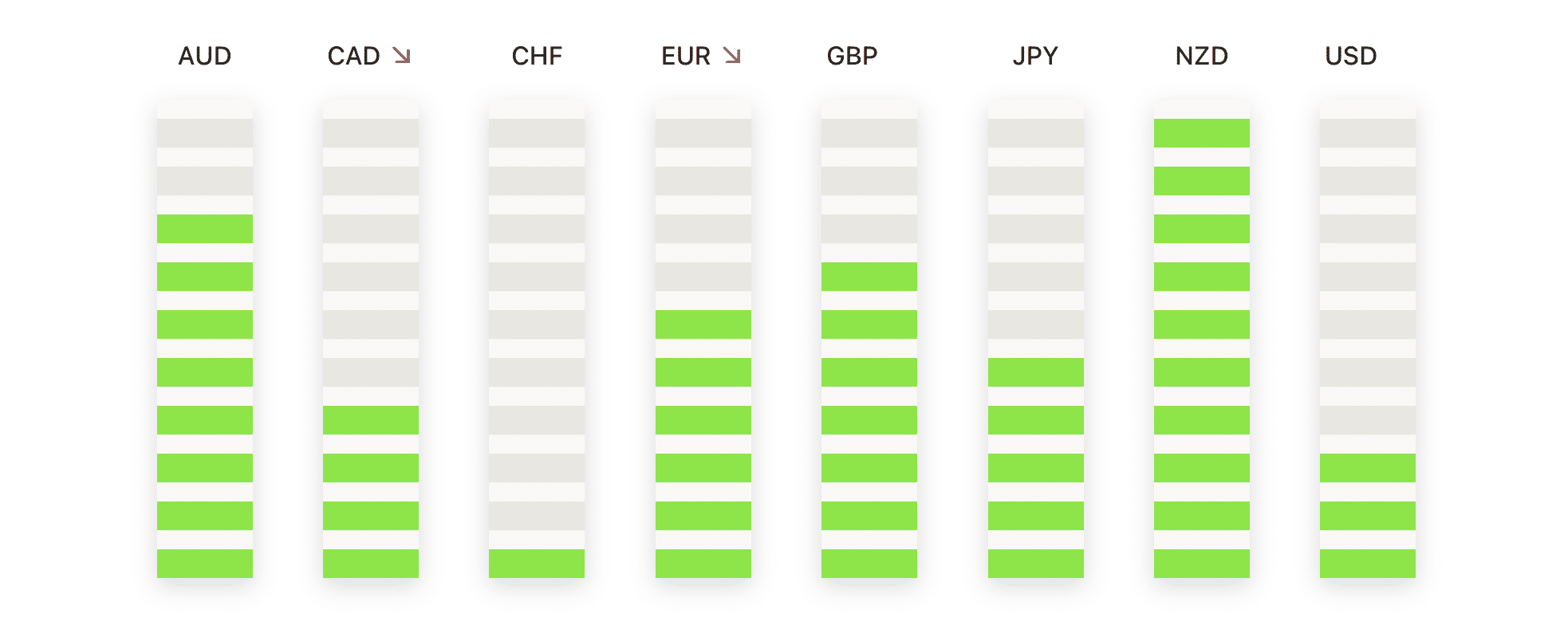
- EUR/USD Attempts to Stabilise Near Support: EUR/USD closed at 1.1488, up 0.06%, after trading between 1.1498 and 1.1488. The pair remains under pressure below the 50-day SMA at 1.1673 and the 100-day SMA at 1.1664, maintaining a short-term bearish tone. However, it continues to hold above the rising 200-day SMA at 1.1333, which provides a longer-term support base. The recent sequence of lower highs suggests rallies may remain limited unless the pair can close firmly above the mid-1.16 area. Immediate resistance is at 1.1498, while a break below 1.1488 would bring the 1.14 region into focus. A sustained return above the 50-day SMA would be needed to signal any meaningful shift.
- GBP/USD Seeks a Floor After Sharp Decline: GBP/USD closed at 1.3050, up 0.23%, after trading between 1.3053 and 1.3010. The pair remains decisively below the 50-day SMA at 1.3409 and the 100-day SMA at 1.3451, as well as below the 200-day SMA at 1.3257, confirming a clear bearish structure. The recovery attempt is modest and comes after a series of lower highs and lower lows. Initial resistance sits at 1.3053, followed by the 200-day level at 1.3257. A break below 1.3010 would re-open downside momentum. For a shift in sentiment, GBP/USD would need to reclaim and hold above the 200-day average.
- USD/JPY Extends Rally Toward Recent Highs: USD/JPY closed at 154.11, up 0.29%, after moving between 154.35 and 152.95. The pair remains firmly supported by rising moving averages, with the 50-day SMA at 148.83, the 100-day at 148.38 and the 200-day at 147.71. The uptrend remains intact, with higher lows and continued buying on dips. Resistance is located at 154.35, the recent peak, which if broken would open the way to new multi-year highs. Support at 152.95 should limit near-term pullbacks. The broader bias stays bullish while price holds above the 50-day average.
- AUD/USD Attempts to Hold Above Key Support: AUD/USD closed at 0.6505, up 0.25%, after trading between 0.6512 and 0.6458. The pair remains below the 50-day SMA at 0.6561 and the 100-day SMA at 0.6536, keeping the short-term tone cautious. However, it continues to hold just above the 200-day SMA at 0.6445, which has acted as an important support reference. Resistance is seen at 0.6512 and then at the 100-day average. A break below 0.6458 would expose the 200-day level. A close above 0.6561 would be needed to signal a more constructive turn.
- Gold Rebounds to Regain Upward Momentum: Gold closed at $3,983, up 1.30%, after trading between $3,990 and $3,929. The move restored upside momentum following a brief pullback, with the metal comfortably above the 50-day SMA at $3,854, the 100-day at $3,601 and the 200-day at $3,351. Buyers stepped in near recent support, keeping the broader uptrend intact. Resistance is near $3,990, ahead of the recent peak around $4,300. A close below the 50-day SMA would be needed to suggest a deeper correction, but for now demand remains firm.
- Silver Strengthens as Buyers Reassert Control: Silver closed at $48.11, up 2.07%, after trading between $48.26 and $46.89. The metal continues to trade well above rising moving averages, with the 50-day SMA at $45.90, the 100-day at $41.71 and the 200-day at $37.28. The strong rebound suggests renewed bullish interest following a brief consolidation. Initial resistance is at $48.26, with scope to retest the cycle high near $54.00 if momentum holds. Support is seen at $46.89, with the 50-day average acting as the key trend anchor.
Market Movers:
- Chipmakers Lead Market Rebound: Seagate Technology rallied more than 11% to top the S&P 500, while Micron gained over 9%. Marvell, Lam Research and Western Digital advanced more than 6%, and ON Semiconductor, Qualcomm and Applied Materials climbed over 4%, helping stabilise the semiconductor and AI-linked segment.
- Lumentum Surges on Strong Outlook: Lumentum jumped more than 23% after Q1 adjusted EPS came in at $1.10, above consensus, with Q2 guidance of $1.30 to $1.50 also ahead of expectations, signalling improving margin and demand dynamics.
- Unity Software Rises on Better Revenue Guidance: Unity gained more than 18% after reporting Q3 revenue of $470.6 million, above estimates, and guiding Q4 revenue to $480–$490 million.
- Zimmer Biomet Slides on Earnings Miss: Zimmer Biomet fell more than 15% after Q3 net sales of $2.00 billion came in below expectations, weighing on the medical devices complex.
- Pinterest Drops on Cautious Guidance: Pinterest fell over 21% after forecasting Q4 revenue, slightly below market expectations, raising concerns around advertising momentum.
- Kratos Weakens on Revenue Outlook: Kratos declined more than 14% after guiding Q4 revenue to $320–$330 million, short of estimates and prompting concerns over defence contract timing.
- Super Micro Computer Extends Pullback: Super Micro fell over 11% after reporting Q1 net sales of $5.02 billion, missing expectations and reinforcing volatility in high-growth AI hardware suppliers.
Wednesday’s gains reflected a more constructive tone, supported by tariff speculation, semiconductor strength and resilient US economic data. However, with market leadership remaining narrow and yields moving higher, investors may wait for clearer policy signals before committing to a more sustained move in either direction.