US equities climbed on Friday, with the Dow Jones Industrial Average and S&P 500 closing at record highs to cap a strong week fuelled by the Federal Reserve’s first rate cut since December. Investors looked past concerns over valuations and volatility, focusing instead on policy support and strong corporate momentum. The Nasdaq also advanced, led by strength in Apple and Tesla, while small-caps gave back some gains after hitting fresh highs earlier in the session.
Key Takeaways:
- Dow at Record High: The Dow added 172.85 points, or 0.37%, to finish at 46,315.27, a new all-time closing high. The index rose 1% for the week, buoyed by the Fed’s policy easing and renewed strength in blue-chip names.
- S&P 500 Extends Gains: The S&P 500 gained 0.49% to close at 6,664.36, advancing 1.2% for the week. Investors welcomed the Fed’s quarter-point cut, though Fed Chair Jerome Powell characterised the move as a “risk management cut” rather than the start of a full easing cycle.
- Nasdaq Leads Weekly Performance: The Nasdaq Composite climbed 0.72% to 22,631.48, ending the week up 2.2% as momentum in technology stocks continued. Apple jumped 3.2% as its latest iPhone launched globally, while Tesla added 2.2%.
- European Markets Mixed as Trade and Data Drive Sentiment: European equities ended unevenly, with the Stoxx 600 down 0.04% and the FTSE 100 losing 0.72% on the week to 9,216.67 as exporters and energy names lagged. Germany’s DAX slipped 0.15% to 23,639.41, while France’s CAC 40 closed marginally lower on Friday but managed a 0.3% weekly rise after swings tied to budget debates. Italy’s FTSE MIB was nearly flat at 42,312. Spain stood out as the INE revised 2024 GDP growth up to 3.5% from 3.2% and S&P lifted the sovereign rating to A+. Trade-sensitive stocks struggled, with Maersk down 5.9% and Kuehne + Nagel off 9.1%, while Germany’s producer prices dropped 2.2% year-on-year, deeper than forecast. UK retail sales rose 0.5% in August, outpacing estimates, led by clothing and department stores, though the three-month trend remained soft.
- Asian Markets Reverse Early Gains as Policy Caution Prevails: Japan’s Nikkei 225 fell 0.57% to 45,045.81 after the Bank of Japan kept rates unchanged at 0.5%, even as core inflation eased to 2.7%, its lowest since last November. The Topix also slipped 0.35%, while Japan’s two-year yield climbed to 0.885%, the highest since 2008. Australia’s ASX 200 added 0.32% to 8,773.5, while South Korea’s Kospi lost 0.46% to 3,445.24 as foreigners sold 117.4 billion won of shares; the Kosdaq gained 0.7% to 863.11, leaving the Kospi up 44.12% year-to-date. Hong Kong’s Hang Seng was flat at 26,545.1 and China’s CSI 300 held at 4,501.92, with focus on Zijin Gold’s HK$25 billion IPO due later this month. India’s Nifty 50 shed 0.38%, though Adani Enterprises climbed more than 4% after regulators cleared the group of misconduct allegations.
- Oil Prices Weaken Despite Weekly Gains: Brent crude settled 1.1% lower at $66.68 a barrel and WTI fell 1.4% to $62.68, though both benchmarks recorded a second weekly advance. A surprise 4 million-barrel increase in US distillate inventories raised fresh demand concerns, offsetting optimism from the Fed’s rate cut. Analysts also flagged steady supply from producers and refinery maintenance as near-term headwinds.
- US Treasury Yields Climb to Two-Week Highs: The 10-year yield rose to 4.127%, the 2-year edged to 3.572% and the 30-year advanced to 4.745%, their highest levels since early September. The rise in long-dated yields contrasted with the Fed’s quarter-point cut, as investors weighed inflation risks, fiscal pressures and debt issuance. Weekly jobless claims eased after a spike last week, tempering fears of mounting layoffs.
FX Today:
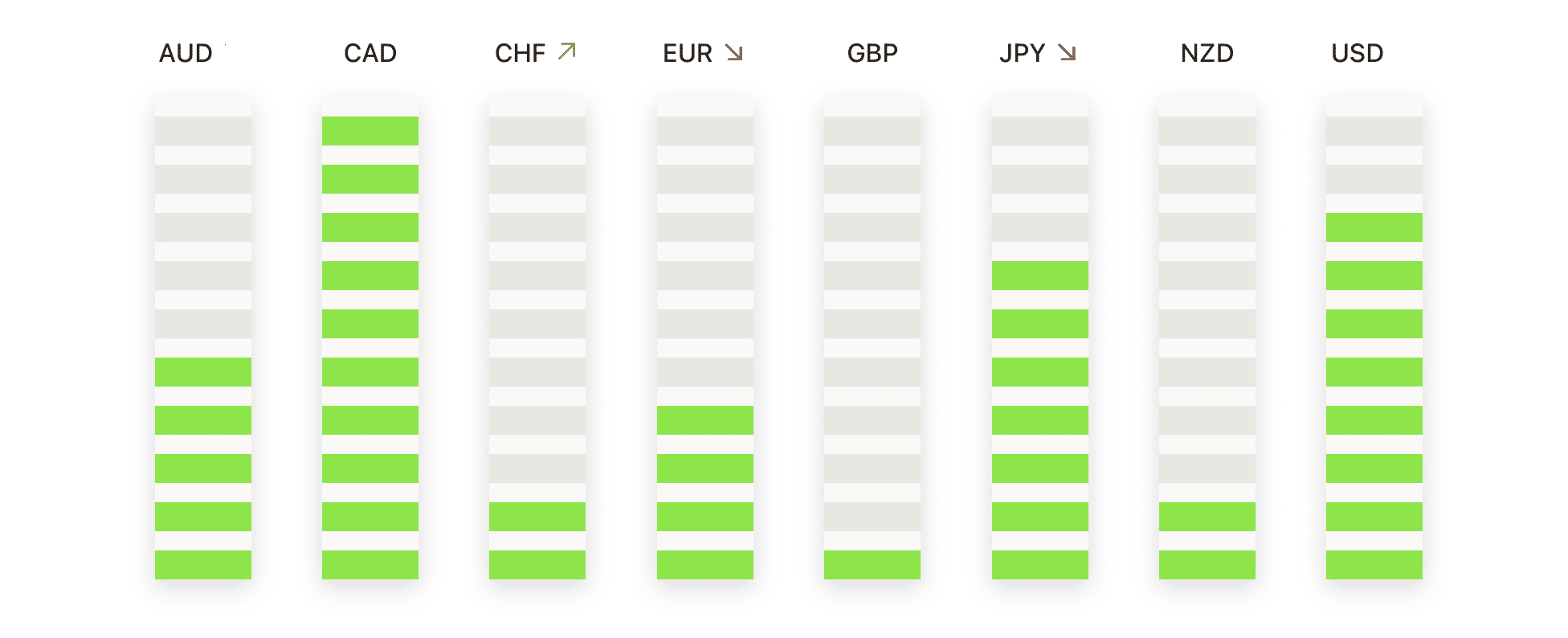
- EUR/USD Extends Decline as Sellers Maintain Pressure: EUR/USD closed at 1.1724, down 0.38%, after trading between 1.1793 and 1.1729. The move extended the retreat from this week’s push toward 1.1900, with repeated failures around 1.1850–1.1900 reinforcing overhead supply. The pair remains supported by the 50-day average at 1.1667, the 100-day at 1.1566 and the 200-day at 1.1120, all rising to preserve the medium-term uptrend that has held since late July. The sequence of higher lows remains intact, but momentum has softened as price sits beneath the 20-day average at 1.1749. Immediate support is now at 1.1700 and then the 50-day average at 1.1667, while resistance is seen first at 1.1800. A daily close back above 1.1800 would be needed to refocus 1.1900 and reassert bullish control.
- GBP/USD Drops Back as Sellers Challenge Support Zone: GBP/USD settled at 1.3470, down 0.62%, after trading between 1.3560 and 1.3463. The pair ended just above the 50-day average at 1.3465 but below the 100-day at 1.3481, highlighting this narrow cluster as a pivotal inflection zone. Since July, repeated failures above 1.3700 have capped progress, keeping the broader structure range-bound. Sellers now control the near term with immediate focus on 1.3450–1.3460 and then 1.3400 if pressure deepens. Resistance is layered at 1.3550 and 1.3650, but only a decisive daily close back over the 100-day average at 1.3481 would stabilise the outlook and reopen the path higher.
- USD/CHF Rebounds off Lows but Downtrend Holds: USD/CHF closed at 0.7956, up 0.44%, after trading between 0.7902 and 0.7969. Buyers stepped in close to the 0.7850 floor seen earlier in the week, but the pair remains capped beneath the 50-day average at 0.8019, the 100-day at 0.8089 and the 200-day at 0.8367, keeping the wider bearish sequence of lower highs intact. Support remains at 0.7900 and 0.7850, with demand concentrated at the recent base, while resistance sits at 0.8000 and then 0.8050. Unless price breaks decisively above the 50-day average, rallies are likely corrective within the ongoing downtrend.
- AUD/USD Extends Pullback as Momentum Shifts Lower: AUD/USD finished at 0.6592, down 0.29%, after trading between 0.6612 and 0.6586. The decline adds to the reversal from this week’s peak near 0.6700, with price now struggling to sustain upside traction. The pair remains supported above the 50-day average at 0.6533, the 100-day at 0.6509 and the 200-day at 0.6455, keeping the broader structure underpinned by higher lows since mid-August. Near-term risk, however, has tilted lower, with support at 0.6560 and then the 50-day average at 0.6533. Resistance lies at 0.6620 initially, followed by 0.6680, with a recovery through 0.6620 needed to restore bullish momentum.
- Silver Extends Rally toward Fresh Highs: Silver closed at $42.94, up 2.74%, after swinging between $41.66 and $43.07 in a strong continuation move. The market remains firmly supported above the 50-day average at $39.13, the 100-day at $36.86 and the 200-day at $34.05, all rising to reinforce the bullish structure. Successive higher lows since mid-August underpin the breakout, with buyers now targeting resistance at $43.50 and then $44.00. On the downside, support comes in at $42.00 and $41.00, both levels expected to act as demand zones to maintain the trend.
- Gold Advances toward $3,700 as Uptrend Accelerates: Gold gained 1.05% to close at $3,681 after trading between $3,632 and $3,685. The rally continues to build momentum above the 50-day average at $3,433, the 100-day at $3,376 and the 200-day at $3,250, all trending higher to confirm the strength of the move. Successive higher lows since mid-August reinforce confidence in the breakout above 3,600, with bulls eyeing resistance at $3,700 and then $3,750 if momentum extends. First support lies at $3,650, followed by $3,600, with both levels expected to act as key demand areas.
Market Movers:
- Apple Jumps on iPhone Launch: Apple gained 3.2% as its latest iPhone went on sale globally, lifting megacaps. Tesla rose 2.2%, while Alphabet and Microsoft advanced more than 1%. Nvidia, Amazon and Meta also ended higher.
- Oracle Rises on Meta Cloud Deal Talks: Oracle climbed over 4% after reports it is in discussions with Meta Platforms on a potential $20 billion cloud computing agreement.
- FedEx Gains on Earnings Beat: FedEx rose more than 2% after reporting Q1 adjusted EPS of $3.83, ahead of the $3.59 consensus.
- Warner Bros Discovery Advances on Bid Speculation: Warner Bros Discovery gained over 2% after CNBC reported Paramount Skydance could make a takeover offer in the $22 to $24 per share range.
- CoreWeave Climbs on Fresh Coverage: CoreWeave gained more than 3% after Loop Capital Markets initiated coverage with a buy rating and a $165 price target.
- Scholastic Sinks on Wider Loss: Scholastic dropped more than 12% after posting a Q1 adjusted loss per share of $2.52, larger than the expected $2.44, weighing on investor sentiment.
- Hess Midstream Slumps on Spending Outlook: Hess Midstream fell more than 10% after saying it expects lower capital spending in 2026 and 2027.
- Lennar Falls on Revenue Miss: Lennar slid more than 4% after reporting Q3 revenue of $8.81 billion, below the $9.05 billion forecast, and guiding Q4 new orders below expectations.
- Intel Declines on Broker Downgrade: Intel dropped more than 3% after Citigroup cut its rating to sell from neutral and lowered its price target to $29.
Markets closed the week on a mixed note globally, but Wall Street’s record finishes underscored renewed optimism following the Fed’s policy shift. European and Asian trade reflected caution around policy and political signals, while commodities extended decisive moves. With equities stretched by valuation metrics and yields creeping higher, investors may face a period of consolidation, though the prevailing trend remains underpinned by confidence in policy support and corporate strength.