Equities tumbled on Friday as escalating military action between Israel and Iran sparked a broad risk-off move across global markets. The Dow Jones Industrial Average dropped more than 700 points, its worst day in months, while the S&P 500 and Nasdaq also posted sharp losses. Investors fled to safe-haven assets amid fears of a broader regional war, sending oil prices up over 7% and gold to a two-month high. Despite a rebound in US consumer sentiment, geopolitical risks overwhelmed economic data. Travel and tech stocks led the declines, while defence and energy shares rallied as traders assessed the impact of rising conflict on inflation, supply chains, and risk appetite.
Key Takeaways:
- Dow Suffers Worst Day in Months on Geopolitical Shock: The Dow Jones Industrial Average plunged 769.83 points, or 1.79%, to finish at 42,197.79 on Friday. It marked the index’s steepest one-day loss since April as markets reacted to Israel’s surprise airstrikes on Iran. The Dow ended the week down 1.3%.
- S&P 500 Drops Below 6,000 as Risk-Off Mood Deepens: The S&P 500 sank 1.13% to close at 5,976.97, falling back below the psychological 6,000 mark. Stocks that had powered the recent rally reversed sharply as investors sought safety amid growing war concerns. The index posted a weekly loss of 0.4%.
- Nasdaq Retreats as Tech Momentum Stalls: The Nasdaq Composite declined 1.30% to finish at 19,406.83, with heavyweights like Nvidia, Meta, and Apple all losing ground. Tech sentiment weakened amid surging oil prices and Middle East tensions, erasing earlier optimism from cooling inflation data. The Nasdaq lost 0.6% for the week.
- Europe Ends Sharply Lower on Middle East Tensions: European stocks finished firmly in negative territory on Friday as Israel’s airstrikes on Iran sparked fears of broader conflict and market volatility. Germany’s DAX dropped 1.1% to 23,516, marking a one-month low and a 3.2% weekly decline. France’s CAC 40 lost 1.04%, while Italy’s FTSE MIB slumped 1.28%, dragged by industrials and consumer names. The pan-European Stoxx 600 fell 1% overall, led by travel and auto stocks. The UK’s FTSE 100 outperformed slightly, rising 0.14% to close at 8,850.63, lifted by gains in energy. Meanwhile, French inflation eased to 0.7% year-on-year in May, aided by falling energy and service prices, while eurozone trade surplus narrowed to €9.9 billion in April from €37.3 billion previously.
- Asia Closes Broadly Lower Amid Oil Spike and Iran Strike: Asia-Pacific equities closed lower across the board as markets responded to Israeli military strikes on Iran and soaring oil prices. Japan’s Nikkei 225 shed 0.89% and the Topix dropped 0.95% despite upbeat domestic data showing a 0.3% monthly rise in tertiary industry activity. South Korea’s Kospi lost 0.87% and the Kosdaq tumbled 2.61%, even as ICT exports surged 9.6% year-on-year in May to $20.9 billion. China’s CSI 300 slid 0.72% while Hong Kong’s Hang Seng dropped 0.59%, weighed down by weakness in property and tech sectors. India’s Sensex declined 0.79% and the Nifty 50 fell 0.64% amid rising geopolitical risk, while Australia’s ASX 200 slipped 0.21%. Regional losses reflected caution over potential oil supply disruptions and spillover effects from the escalating conflict.
- Oil Soars Over 7% on Supply Risk After Israel’s Attack: Oil prices surged on Friday as Israel’s airstrikes on Iran fuelled fears of disruptions to Middle East supply. US crude jumped $4.94, or 7.26%, to settle at $72.98 a barrel, while Brent climbed $4.87, or 7.02%, to $74.23. Prices hit their highest levels since March 2022. Traders worried that retaliation from Iran or wider regional escalation could imperil crude exports, especially as Iranian output stood at 3.3 million barrels per day in April. Crude extended gains in after-hours trading as Iran launched missiles in response.
- Treasury Yields Rise Amid Inflation Fears from Oil Surge: US Treasury yields edged higher as the market priced in rising inflation risk due to spiking energy prices. The 10-year yield climbed over 5 basis points to 4.411%, while the 2-year yield rose to 3.954%, up by 4.5 basis points.
- Consumer Sentiment Rebounds Sharply in June: The University of Michigan’s preliminary consumer sentiment index jumped to 60.5 in June, far above expectations for 54. The reading marked a 15.9% gain from May, with current conditions and future expectations improving across the board. Inflation expectations also declined, with the one-year outlook falling 1.5 percentage points to 5.1%.
FX Today:
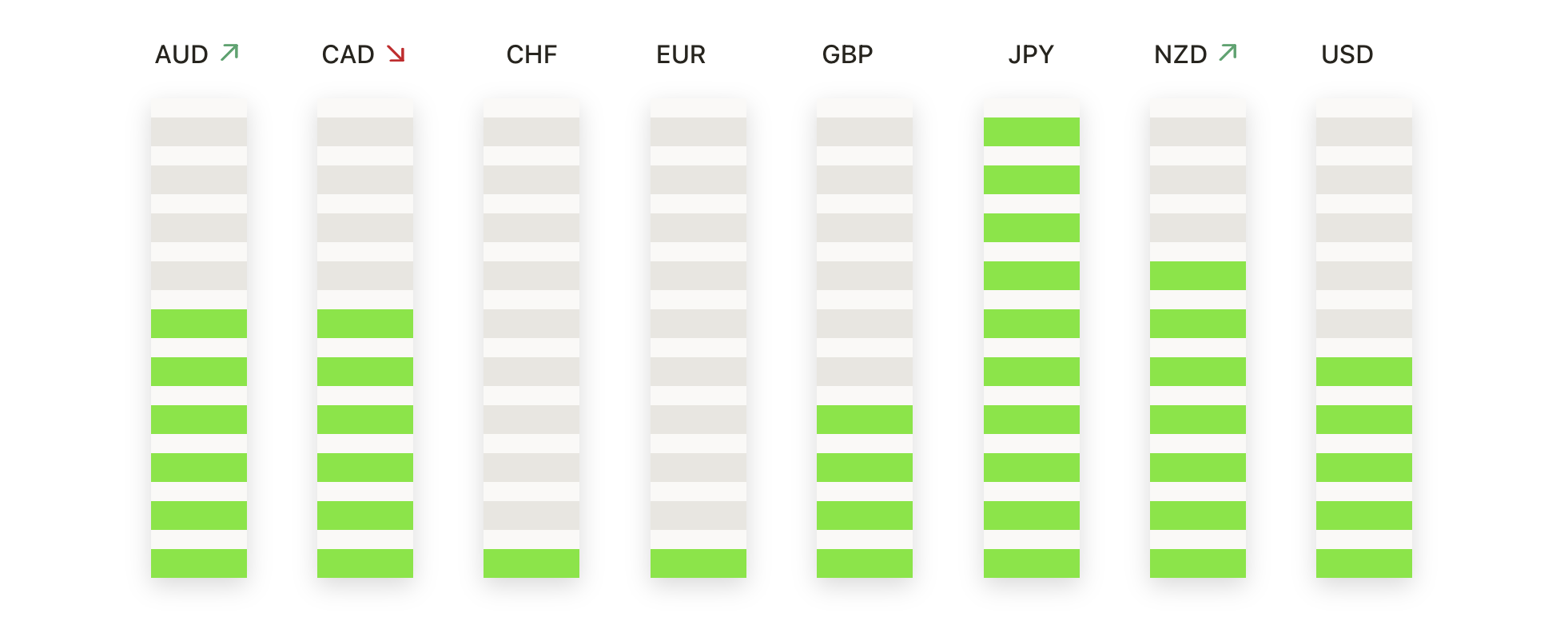
- EUR/USD Reverses From New Highs After Brief Surge: The EUR/USD pair closed at 1.1542 on Friday, falling 0.33% after reaching an intraday high of 1.1614. The pair dipped as low as 1.1488 before bouncing slightly into the close, breaking a three-day win streak and signalling waning bullish momentum. Despite the decline, the euro remains up over 3.5% from early June lows, supported by its position above the 50-day SMA at 1.1316. Immediate support now stands in the 1.1480–1.1500 range, while stronger downside pressure would need to clear 1.1450 to threaten the current trend. On the upside, resistance remains near the 1.1600–1.1620 zone, and a decisive close above it would likely open the way to challenge 1.1700.
- GBP/USD Slides Modestly but Holds Bullish Structure: The GBP/USD pair closed at 1.3566 on Friday, slipping 0.36% after hitting an intraday high of 1.3632 before retreating late in the session. Friday’s low reached 1.3516, testing the 1.3550 support region for the first time this week. Despite the decline, the structure remains bullish, with the 50-day SMA rising at 1.3338 and the 200-day positioned lower at 1.2920. The broader trend remains intact above 1.3450, which serves as the key level for short-term buyers. Upside resistance continues to cap movement around 1.3650–1.3700, while a break through that area would bring the March 2022 peak at 1.3750 into focus.
- USD/JPY Bounces Slightly but Remains in Downtrend: The USD/JPY pair ended the week at 144.01, up 0.37% after rebounding from a session low of 142.79. The recovery came after a two-day decline, but the move stalled below the 50-day SMA at 144.12, reinforcing the bearish tone. The day’s high reached 144.48 but lacked follow-through as sellers capped gains near resistance. The pair remains well below the 100-day and 200-day SMAs, positioned at 147.33 and 149.37 respectively, maintaining the larger downward bias. The descending price structure continues to show lower highs and lower lows, with momentum still tilted to the downside. A close below 143.00 would expose the 141.50 level, while a strong move above 145.00 is required to challenge the existing bearish setup.
- NZD/USD Fails at Resistance and Drops Toward 0.6000: The NZD/USD pair finished at 0.6014 on Friday, down 0.90% after once again failing to hold gains above the 0.6070 level. The intraday range stretched from 0.5995 to 0.6069, but the close below 0.6050 confirmed another rejection from the upper boundary of the recent consolidation band. The pair is now testing the 50-day SMA at 0.5930, which forms the next key support area. A break below this level would likely expose the 100-day SMA at 0.5816 and suggest growing downside risk. To the upside, resistance remains entrenched in the 0.6050–0.6100 zone.
- Gold Breaks Higher, reclaims $3,400 in Strong Finish: Gold closed at $3,429 on Friday, climbing 1.31% after finally breaking above the $3,400 barrier with conviction. Safe-haven flows helped drive the rally, and price now stands at its highest level since late April. Support has now shifted higher to the $3,400–$3,385 zone, while deeper support remains at $3,360. As long as gold stays above the rising 50-day SMA at $3,281, the medium-term uptrend remains intact. A move through $3,447 would put April’s peak above $3,480 back on the radar, while failure to hold above $3,380 could invite short-term consolidation.
Market Movers:
- Oil and Defence Stocks Surge on Israel-Iran Conflict: Shares of energy and defence companies rallied Friday as investors positioned for extended geopolitical risk. Exxon Mobil (XOM) rose 2.1% and Chevron (CVX) added 0.7% alongside a 7% spike in oil prices. Lockheed Martin (LMT) jumped 3.7%, Northrop Grumman (NOC) advanced 4.0%, and RTX Corp (RTX) gained 3.6% on expectations of increased defence demand.
- Travel Stocks Slide Amid War Fears and Oil Spike: Booking Holdings (BKNG), Expedia Group (EXPE), Hilton Worldwide (HLT), and Marriott International (MAR) all fell by around 3% as investors grew wary of a prolonged Middle East conflict.
- Airline Stocks Tumble on Fuel Cost Pressures: Airline shares dropped sharply as higher crude prices threatened margins. American Airlines (AAL) and United Airlines (UAL) both fell more than 4%, while Delta Air Lines (DAL) slipped 3.8% and Southwest Airlines (LUV) declined 2.7%.
- Visa and Mastercard Sink on Stablecoin Threat: Visa (V) and Mastercard (MA) both dropped more than 4% after a Wall Street Journal report revealed that major retailers including Amazon and Walmart are exploring stablecoin solutions to bypass traditional credit card fees.
- Boeing Extends Losses After Fatal Crash: Boeing (BA) fell nearly 2% on Friday, adding to Thursday’s 5.14% plunge, as scrutiny intensified following the fatal crash of a Boeing 787 Dreamliner jet in India that killed more than 240 people.
Friday’s steep sell-off marked a decisive shift in market tone as investors reacted to the escalating Israel-Iran conflict, driving oil and gold sharply higher and triggering broad declines in equities. Defensive names offered some protection, but risk-heavy areas like tech and travel saw outsized declines. Treasury yields climbed as traders braced for potential inflationary spillover from rising energy costs. While consumer sentiment showed unexpected resilience, its influence was muted by the unfolding conflict. In the days ahead, markets will remain tightly tethered to Middle East developments, with positioning likely to shift rapidly on any signs of further escalation or diplomatic resolution.