Crypto affiliate programs have become a central mechanism through which trading platforms, exchanges, and financial service providers grow their user base. Within these programs, two primary compensation structures define how affiliates earn: Cost Per Acquisition (CPA) and revshare (revenue share).
Each model reflects a different relationship between affiliate activity, platform economics, and the timing of compensation. Understanding the differences between CPA and revshare is relevant for professional traders, introducing brokers (IBs), and institutional participants who engage with or evaluate affiliate commission models as part of a broader business plan or financial operation.
Role of Affiliate Programs in the Crypto Ecosystem
Crypto affiliate programs operate as structured customer acquisition channels, and the quality of the affiliate program often determines the long-term sustainability of the partnership. Platforms offering trading services, spot exchanges, derivatives products, or financial infrastructure rely on affiliate networks to reach qualified users across diverse geographic and demographic segments. The commission structures within these programs are not arbitrary — they are designed to align incentive distribution with platform monetization objectives and long-term growth targets.
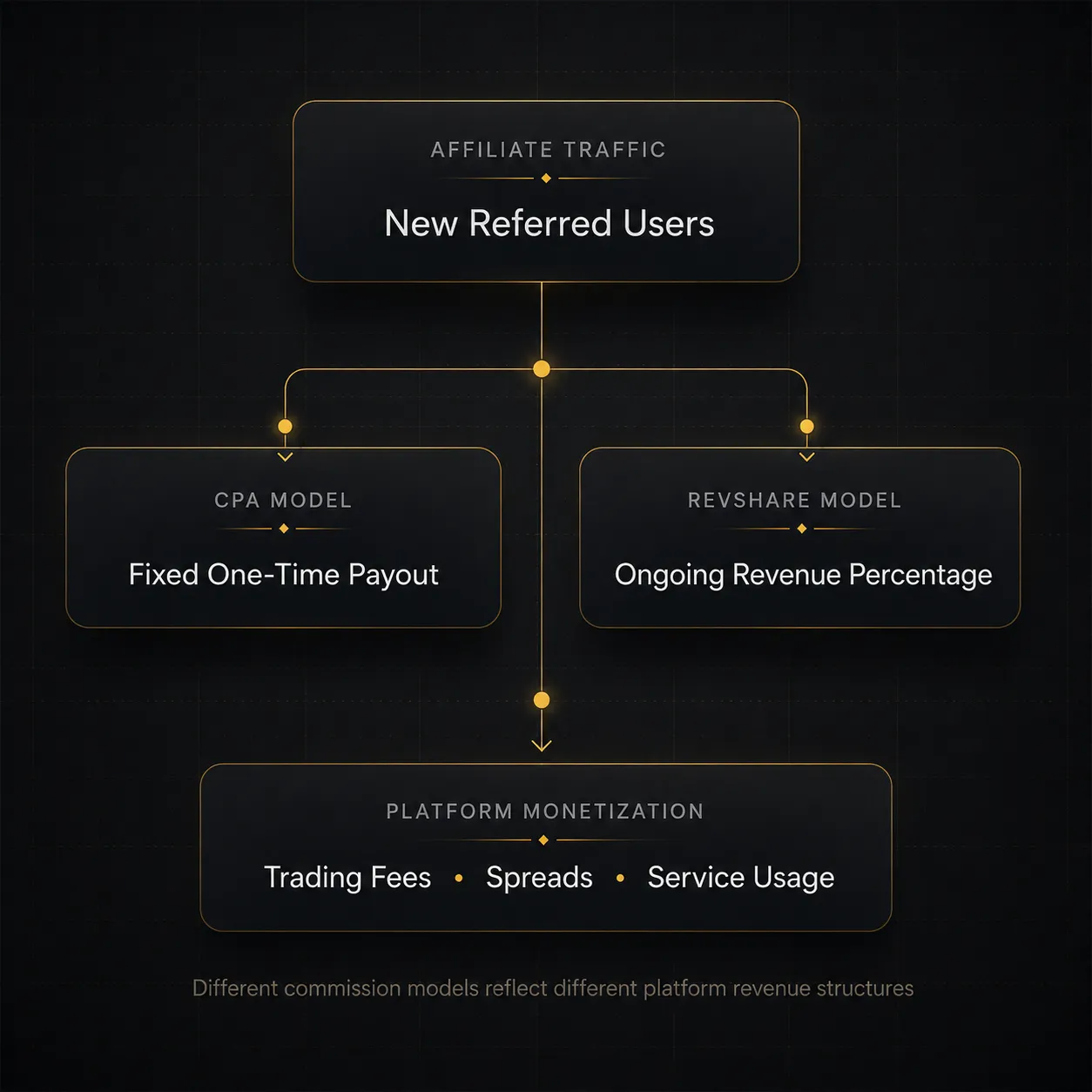
Affiliate program structures in the crypto space may vary significantly by platform type. A centralized exchange generating income through spot trading fees may structure its affiliate commission differently from a CFD and forex brokerage that monetizes through spreads and overnight financing. Understanding the underlying monetization model of the platform is often considered foundational when evaluating which affiliate payout model may be structurally appropriate for a given business plan or marketing strategy.
Basic Definition: CPA Model
Cost Per Acquisition (CPA) — sometimes referred to as cost per action — is a fixed commission structure in which an affiliate receives a one-time payment each time a referred user completes a qualifying action. In crypto affiliate programs, qualifying actions may include account registration, identity verification, first deposit completion, or a defined level of initial trading activity. The CPA model is characterized by its predictability: the commission amount is typically agreed upon in advance and remains independent of the referred user’s subsequent behavior on the platform. Best CPA offers in the crypto space are generally associated with platforms that define clear qualification criteria and maintain reliable payment schedules.
Basic Definition: Revshare Model
Revshare is a recurring commission model in which an affiliate receives an ongoing percentage of the income generated by referred users over a defined period. In crypto platforms, this income may be calculated from trading fees, spreads, or service usage charges attributed to the referred user’s activity. Unlike CPA, revshare creates a structural dependency between affiliate earnings and continued user engagement, meaning commission flows persist as long as the referred user remains active. For many participants, revshare is commonly associated with passive income potential, particularly when a large base of active referred users generates consistent platform fee income over time.
CPA Model Mechanics in Crypto Affiliate Programs
The CPA model in crypto affiliate marketing is defined by its event-driven payout architecture. Commission is triggered by a discrete qualifying action rather than by ongoing platform usage. This structural characteristic makes CPA programs relatively straightforward to administer and audit, which may explain their prevalence across crypto exchanges, brokerage services, and CPA networks operating across multiple verticals. Marketing efforts focused on driving high volumes of qualifying registrations are typically central to CPA-based affiliate operations.
Commission Trigger Events in CPA Structures
Common CPA trigger events include first-time deposits (FTDs), Know Your Customer (KYC) verification completions, or reaching a minimum trading volume threshold within a defined onboarding window. Some programs operating across mobile environments may also define cost per install (CPI) as a trigger event, particularly for exchange platforms with dedicated mobile app offerings. Platforms may define trigger events differently depending on their regulatory environment, geographic focus, or fraud prevention framework.
- First-time deposit completion after identity verification
- Reaching a minimum trading volume threshold within 30 days of registration
- Account activation through multi-step onboarding including compliance screening
- Mobile app installation combined with verified account creation, applicable in cost per install frameworks
- Platform-specific engagement milestones such as executing a first trade in a product or service category
Fixed Payout Characteristics
CPA commissions are structured as a fixed monetary amount per qualifying referral. This amount is agreed upon contractually — often referred to as a CPA deal — between the affiliate and the platform and does not fluctuate based on user behavior after the qualifying event. The fixed nature of CPA payouts means affiliate income from CPA programs can be modeled with relatively high accuracy, provided referral volumes and the quality of your traffic remain consistent over time.
Eligibility Criteria Variations
Different crypto platforms apply varying definitions of a qualifying user. Geographic restrictions may exclude users from high-risk jurisdictions. Verification requirements may mandate full KYC before the CPA event is counted. Some programs require a minimum deposit amount or a minimum number of executed trades within an eligibility window before commission is released. These variations mean that CPA rates across platforms are not directly comparable without accounting for qualification depth and the specific CPA deals on offer.
Revshare Model Mechanics in Crypto Affiliate Programs
Revshare programs distribute ongoing commissions based on the trading and financial activity of referred users within the platform ecosystem. This affiliate revenue model is structurally more complex than CPA because commission generation is continuous rather than event-driven. Platforms using revshare typically maintain attribution tracking systems that record referral relationships over extended periods, sometimes indefinitely. The mechanics of revshare models are closely tied to the platform’s internal accounting framework for fee attribution, and the revshare percentage offered to affiliates often reflects the platform’s own margin structure.
Ongoing Commission Distribution Logic
In a revshare program, the affiliate receives a defined percentage of the net income generated by each referred user during each attribution period, typically calculated monthly. Calculations may account for platform operating costs, bonuses paid to users, or chargebacks, depending on the program terms. In iGaming affiliate contexts, this figure is sometimes referred to as net gaming revenue (NGR), a concept that has migrated into certain crypto trading affiliate programs operating in hybrid verticals.
- Trading fee income attributed to referred users calculated at the end of each monthly cycle
- Spread income from derivatives or CFD and forex activity may be included depending on platform structure
- Service fees including withdrawal or conversion fees may contribute to the earnings base in some programs
- Some revshare models apply a percentage of the trading volume generated by referred users rather than net platform income
Income Sources in Crypto Platforms
The earnings base used for revshare calculations in crypto platforms may include spot trading fees charged as a percentage of transaction value, derivatives trading fees calculated from notional contract value, financing or overnight swap charges on leveraged positions, and platform service fees for premium features. In CFD and forex affiliate programs, commission structures often apply a percentage of the trading volume or spread income rather than a share of net platform profit, which distinguishes crypto-native revshare structures from forex affiliate programs operating on similar principles.
Duration of Revshare Attribution
Attribution periods in revshare programs may range from a fixed term of twelve to twenty-four months to indefinite lifetime attribution. Platforms with indefinite attribution offer the strongest structural alignment between affiliate and platform — a revshare affiliate’s long-term commission potential grows as the referred user base becomes more active. Fixed-term revshare deals limit this alignment but may offer higher initial revshare rates as compensation for the shorter earning window.
Key Differences: CPA vs Revshare in Crypto Affiliate Marketing
The structural differences between CPA and revshare programs are most visible in payout timing, dependency on user behavior, and the predictability of commission income over time. The differences between CPA and revshare are not simply a matter of payment frequency — they reflect fundamentally different risk and reward distributions between the affiliate and the platform. A comparative analysis across key dimensions is presented below.
| Dimension | CPA Model | Revshare Model |
|---|---|---|
| Payout Timing | One-time, post-qualification | Recurring, activity-dependent |
| Commission Certainty | High (fixed amount per CPA deal) | Variable (depends on user activity) |
| Dependency on User Retention | None after qualification | Directly correlated |
| Long-Term Earning Potential | Capped per referral | Uncapped, scales with user activity |
| Administrative Complexity | Lower | Higher |
| Income Predictability | Higher short-term | Higher long-term if user base is stable |
| Passive Income Potential | Low | Potentially high with active referral base |
Payout Timing Structure
CPA programs release commission after a single qualifying event, meaning the affiliate’s earning cycle from that referral is complete within a defined post-registration period. Revshare programs distribute commissions on a recurring schedule — typically monthly — with amounts dependent on the actual income generated by referred users during that period. This fundamental difference in payout timing shapes the cash flow profile of each affiliate revenue model significantly.
Dependency on User Activity
CPA commissions are structurally independent of what a referred user does after the qualifying action is completed. Revshare commissions are entirely dependent on continued user engagement. A referred user who becomes inactive generates no ongoing revshare commission regardless of the volume of activity they produced at the time of acquisition. This structural characteristic is one of the primary differences between CPA and revshare when evaluated as long-term affiliate income frameworks.
Predictability of Commission Flow
Commission flow predictability differs meaningfully between the two models. CPA income can be modeled from referral volume data with reasonable accuracy when the quality of your traffic is consistent. Revshare income is subject to variability driven by market conditions, platform fee structures, and individual user trading behavior. In volatile market environments where trading volume may spike or collapse, revshare earnings may exhibit significantly higher variance than CPA-based income — a characteristic that is particularly pronounced in crypto markets relative to more stable CFD and forex verticals.
Advantages and Limitations: CPA Model
The CPA model offers structural characteristics that may be particularly relevant for affiliates operating with defined acquisition cost frameworks or for platforms seeking to control customer acquisition spend with precision. According to affiliate industry data, CPA structures are prevalent in financial services affiliate programs — including forex affiliate programs and crypto exchanges — because they align acquisition costs directly with verified user onboarding events and reward marketing efforts focused on qualified traffic generation.
Fixed Compensation Structure Characteristics
The primary structural advantage of CPA is the certainty of payout per qualifying referral. Once the qualification criteria are met, the commission amount is fixed and not subject to retroactive adjustment based on user behavior. This characteristic allows affiliates to calculate acquisition economics precisely, which may be particularly relevant for those operating at scale with defined marketing budgets and structured business plans.
- Predictable income per qualifying referral, independent of post-acquisition user behavior
- CPA deals can be negotiated based on traffic volume, geographic quality, and referral source type
- Best CPA rates are often accessible to affiliates demonstrating consistently high quality of traffic
- Payment timelines are generally defined contractually, supporting cash flow planning within a structured business plan
Limited Long-Term Exposure
The structural limitation of CPA is the absence of ongoing earnings from referred users. An affiliate who refers a high-value trader generating significant platform income over multiple years does not benefit from that activity beyond the initial CPA payment. This limits the long-term growth potential of CPA programs relative to revshare, particularly for affiliates with strong referral quality and high user retention rates.
Platform Risk Distribution Considerations
CPA structures distribute income risk toward the platform. The platform assumes full exposure to the income potential and retention rate of acquired users, while the affiliate receives a fixed payment regardless of user lifetime value outcomes. This risk distribution may favor affiliates in environments where user quality or platform retention rates are uncertain, and is one reason why CPA is often described as structurally simpler for affiliates prioritizing income stability over long-term growth.
Advantages and Limitations: Revshare Model
Revshare programs introduce a structural dynamic in which affiliate earnings are tied to the ongoing economic performance of referred users. This model is commonly associated with passive income potential and long-term growth, though these outcomes are conditional on sustained user activity and consistent platform fee generation. The quality of the affiliate program — including the reliability of its attribution system, the transparency of its calculations, and the availability of dedicated support — significantly influences the practical value of revshare arrangements.
Ongoing Commission Attribution Structure
Revshare creates a structural mechanism for compounding affiliate income over time. As the base of active referred users grows, the cumulative monthly commission can increase without requiring new referral activity. This characteristic makes revshare programs particularly relevant for affiliates with established, active user networks whose trading behavior generates consistent fee income — and is a key reason why revshare is often associated with passive income in affiliate marketing discussions.
Exposure to Market Activity Variability
Revshare earnings are sensitive to fluctuations in user trading behavior, which in crypto markets can vary substantially based on broader market conditions. During periods of low volatility or reduced market participation, trading volumes on crypto platforms may decline, directly compressing the earnings base from which affiliate commissions are calculated. Revshare rates that appear attractive under high-volume conditions may generate substantially lower income during quieter market periods — a variability dynamic that is less pronounced in traditional online affiliate programs, where net gaming revenue may be more stable.
Long-Term Alignment With Platform Growth
Revshare programs structurally align affiliate incentives with platform growth over time. As a platform expands its user base, improves fee structures, or broadens its product or service offering, the income generated by the affiliate’s referred users may increase correspondingly. This alignment is generally described as one of the structural advantages of the revshare model for affiliates with long time horizons, stable referral networks, and an interest in building a scalable passive income stream rather than optimizing for immediate CPA payouts.
Factors Influencing Commission Model Selection
The selection between CPA or revshare within a crypto affiliate program typically reflects the interaction of platform economics, affiliate operational characteristics, and regulatory environment. Neither model is universally preferable — the relevance of each model depends on factors specific to the platform’s monetization structure, the affiliate’s business plan, and the quality of the affiliate program itself. Flexible commission plans that accommodate both models, or allow switching between them, are increasingly common in competitive crypto affiliate ecosystems.
Business Model Objectives of Platforms
Platforms with high user lifetime values and strong retention metrics may prefer revshare because it caps upfront acquisition cost exposure. Platforms in growth phases may favor CPA to accelerate user acquisition by offering affiliates predictable, immediate compensation for marketing efforts. The availability of flexible commission plans — combining elements of both structures — reflects an effort by platforms to serve a wider range of affiliate business models and partnership structures.
| Platform Type | Typical Preferred Model | Rationale |
|---|---|---|
| High-retention crypto exchange | Revshare | Aligns affiliate incentives with user loyalty |
| Growth-phase brokerage | CPA | Rewards high-volume acquisition marketing efforts |
| CFD and forex platform | Revshare or hybrid | Recurring spread income supports ongoing commission |
| Mobile app-first platform | CPA or cost per install | Optimizes acquisition cost for app-based onboarding |
| Niche or regulated service | CPA | Limits complex attribution in compliance-sensitive markets |
Affiliate Risk Preference Structures
Affiliates with predictable referral pipelines and defined cost-per-acquisition budgets may find CPA structures operationally simpler and more compatible with a structured business plan. Revshare affiliates — sometimes called revshare affiliates — operating content-driven or community-based referral channels with high user retention may find the recurring commission structure more aligned with long-term income objectives. The choice between CPA or revshare is not simply a financial calculation; it also reflects the affiliate’s operational model, traffic sources, and time horizon for income generation.
Geographic and Regulatory Environment Impact
Regulatory restrictions in certain jurisdictions may limit the availability of specific commission models. In regions where financial services affiliate marketing is subject to advertising standards or consumer protection regulations, CPA programs with clearly defined qualification criteria may be structurally easier to operate within compliance frameworks. Revshare programs tied to ongoing trading activity may face additional scrutiny in regulated environments depending on how affiliate compensation is classified relative to financial services licensing requirements.
Hybrid CPA and Revshare Structures in Crypto Affiliates
Hybrid commission models — sometimes referred to as CPA and revshare combined structures — integrate elements of both approaches within a single affiliate marketing program. These models are increasingly common in the crypto brokerage and exchange space, where platforms seek to balance immediate acquisition incentives with long-term engagement alignment. Hybrid structures reflect the evolution of flexible commission plans designed to serve diverse affiliate business models within a single partnership framework.

Dual Commission Layer Design
In a hybrid model, an affiliate may receive a CPA payment upon a referred user completing the qualification event and also receive an ongoing revshare from that user’s subsequent trading activity. The dual-layer structure means affiliates are compensated for both the acquisition event and the long-term value of the referred user, making hybrid arrangements potentially more profitable for affiliates than either pure CPA or pure revshare in certain referral quality scenarios.
Conditional Commission Distribution Frameworks
Some hybrid programs apply different commission types based on the referred user’s behavior stage. A user who completes registration but does not meet minimum deposit criteria might generate only a reduced CPA payment. A user who meets full qualification and maintains active trading may trigger both CPA and revshare components. This conditional structure allows platforms to calibrate acquisition cost against user engagement depth, which is particularly relevant for platforms operating across multiple product or service categories with different user value profiles.
Program Tiering and Flexible Commission Plans
Hybrid programs often incorporate tiered structures where the specific balance between CPA and revshare components varies based on affiliate classification. Higher-tier affiliates — typically defined by referral volume, quality of traffic, or historical partnership performance — may access more favorable hybrid terms, such as higher CPA rates combined with elevated revshare percentages. Flexible commission plans with tiering are commonly used as a retention mechanism within affiliate marketing programs to incentivize consistent referral performance and reward affiliates demonstrating sustained long-term growth in active user volumes.
Risk and Earnings Variability in Affiliate Commission Models
Earnings variability in affiliate commission programs is a function of structural model characteristics as well as external market dynamics. Both CPA and revshare carry distinct risk profiles that may influence income stability over time. For affiliates building a business plan around crypto affiliate income, understanding the variability characteristics of each model is as important as understanding their headline commission rates.
- CPA earnings variability is primarily driven by fluctuations in referral volume and the quality of your traffic rather than post-acquisition user behavior
- Revshare earnings variability reflects both referral volume and the ongoing trading activity of the existing referred user base
- Market volatility can temporarily increase trading volumes on crypto platforms, elevating revshare commission flows
- Periods of low market activity or regulatory restrictions on crypto trading may compress revshare income significantly
- Platform-level changes such as fee reductions, product discontinuations, or shifts in revshare rates can alter commission bases without prior notice to affiliates
- Dedicated support from a platform’s affiliate management team is often cited as a factor that helps affiliates navigate commission structure changes and optimize marketing efforts effectively
Stability of Fixed vs Variable Commission Models
CPA models offer short-term income stability tied to referral volume predictability. Revshare models offer potential long-term income growth but introduce variability tied to market and user behavior dynamics. The income profile of each model is structurally distinct: CPA income resembles a flow of fixed payments per acquisition event, while revshare income resembles a portfolio of variable returns from an active user base — a structure that may support passive income accumulation over time when user engagement remains consistent.
Dependency on Market Activity Levels
Revshare earnings in crypto affiliate programs are sensitive to the same market forces that influence trading volumes on the underlying platform. During high-volatility periods, crypto trading volumes may increase significantly, elevating revshare commissions and making the model particularly profitable for affiliates with large active referral bases. Conversely, market downturns or regulatory actions that reduce platform activity can compress revshare income in ways that CPA income is structurally insulated from — a key practical difference between CPA and revshare when evaluated over full market cycles.
Structural Exposure to Platform Performance
Both CPA and revshare affiliates carry structural exposure to platform performance, though the nature of that exposure differs. CPA affiliates depend on the platform maintaining its qualification framework and fulfilling payment obligations reliably. Revshare affiliates are additionally exposed to changes in the platform’s fee structure, user retention policies, revshare rates, and attribution methodology — all of which can influence commission calculations without changes in referral activity. Platforms that offer dedicated support, transparent reporting, and contractually stable flexible commission plans are generally considered to reduce structural risk for both affiliate types.
Frequently Asked Questions
What is the difference between CPA and revshare models in crypto affiliate programs?
CPA (Cost Per Acquisition, sometimes called cost per action) provides a fixed, one-time commission per referred user who completes a qualifying action such as registration, verification, or first deposit. Revshare provides an ongoing commission calculated as a percentage of the income generated by referred users over time. The core differences between CPA and revshare lie in payout timing, income predictability, and long-term earning potential — CPA is event-driven and immediate, while revshare is activity-dependent and recurring. Affiliates who prioritize income certainty may gravitate toward CPA, while those building toward passive income or long-term growth may find revshare structurally more relevant.
How does CPA commission structure typically work in crypto affiliate marketing?
In a standard CPA structure, an affiliate is assigned a unique tracking link that records referred user activity on the platform. When a referred user completes a defined qualifying event — such as completing KYC verification and making a minimum first deposit — the CPA event is logged and a fixed commission is credited to the affiliate account. The commission amount does not change based on what the referred user does subsequently. Payment is typically processed monthly after the qualifying event has been verified and any fraud review period has elapsed. Best CPA terms are often accessible to affiliates who demonstrate consistent quality of traffic and strong referral volumes within a defined CPA network or direct partnership arrangement.
How is revshare calculated in crypto affiliate programs?
Revshare calculations are based on the net income generated by referred users during a specified attribution period, typically one calendar month. Net income may be defined as trading fees, spread income, or service charges collected from the referred user, minus any applicable platform costs or user bonuses. The affiliate receives a defined revshare percentage of this figure, which is reported and paid on a recurring schedule. Revshare rates may vary based on affiliate tier, program terms, or negotiated revshare deals, and some platforms apply tiered rate structures where higher cumulative income from referred users unlocks elevated revshare percentages — a feature commonly associated with flexible commission plans in competitive crypto affiliate ecosystems.
Can CPA and revshare models be used together in one affiliate program?
Hybrid affiliate programs combining CPA and revshare within a single commission structure are an established feature of the crypto affiliate industry and are increasingly described as the standard offering among platforms targeting professional affiliates and IBs. In a hybrid model, an affiliate may receive a one-time CPA payment upon a referred user completing the qualification criteria and also receive ongoing revshare from that user’s subsequent trading activity. The specific terms of CPA and revshare hybrid arrangements vary by platform and may be negotiable for high-volume or institutional affiliates. These structures are designed to make programs more profitable for affiliates by providing both immediate acquisition income and long-term passive income potential within a single partnership.
What factors influence the choice between CPA and revshare models?
The factors most commonly associated with the choice between CPA or revshare include the affiliate’s referral volume, quality of traffic, time horizon, and operational cost structure, alongside the platform’s monetization model, user retention metrics, and regulatory environment. Affiliates building high-volume, broad-reach acquisition channels through aggressive marketing efforts may find CPA operationally simpler. Revshare affiliates with engaged communities and strong user retention may find the recurring commission structure more aligned with long-term growth objectives. The quality of the affiliate program — including reporting transparency, dedicated support availability, and the stability of revshare rates — is also a meaningful factor when evaluating programs across the crypto, CFD and forex, and online gambling affiliate verticals.
How do crypto platforms define qualifying actions for CPA payouts?
Qualifying action definitions vary by platform and are specified in the affiliate program terms. Common definitions include completion of identity verification, first deposit above a minimum threshold, or execution of a first trade within a defined onboarding window. Some platforms operating mobile app-first environments may define cost per install as a qualifying trigger, particularly for exchange platforms with dedicated mobile onboarding flows. Geographic eligibility restrictions may also apply, with users from certain jurisdictions excluded from qualifying for CPA commission. The specificity of qualification criteria directly influences effective CPA rates and is an important variable when comparing CPA deals across different programs or CPA networks.
What are the main differences in payout timing between CPA and revshare models?
CPA commissions are typically credited after the qualifying event is verified and any fraud review period — commonly 30 days — has elapsed, meaning CPA generates front-loaded income relative to the referral event. Revshare commissions are distributed on a recurring schedule, most commonly monthly, based on income attributed to referred users during the preceding period. This difference in payout timing means that CPA is generally better aligned with short-term cash flow planning, while revshare supports a longer-term passive income model that compounds as the active referral base grows. For affiliates comparing a revshare deal against CPA deals, the time value of the commission flows — not just the headline rates — is often a relevant consideration within a structured business plan.