As an investor or trader, navigating the financial markets often means seeking tools that offer flexibility and the potential for magnified returns. One such instrument that has grown significantly in popularity worldwide is CFD trading, or Contracts For Difference. This article aims to provide an authoritative, transparent, and comprehensive guide to what CFD trading is, how it functions, and the crucial risks involved, ensuring you have the expert knowledge needed to approach this market with caution and confidence.
What Is CFD Trading?

CFD trading allows you to speculate on the rising or falling prices of fast-moving global financial markets, such as shares, indices, commodities, and currencies, without ever owning the underlying asset. It is a derivative product, meaning its value is derived from the performance of the asset it tracks.
Definition Contract For Difference (CFD)
A Contract For Difference is an agreement between two parties—typically the trader and the broker—to exchange the difference in the price of an asset from the moment the contract is opened until it is closed. If you predict the price will rise and it does, the broker pays you the difference. If you predict the price will fall and it does, the broker also pays you the difference. Conversely, if the market moves against your prediction, you pay the broker the difference.
CFDs vs Traditional Stock Investing
The key distinction between CFD trading and traditional stock investing lies in ownership and leverage.
| Feature | CFD Trading | Traditional Stock Investing |
|---|---|---|
| Asset Ownership | You do not own the underlying asset (e.g., the shares). | You take ownership of the physical asset (e.g., the shares). |
| Leverage Use | High leverage is common, magnifying both profits and losses. | Typically low or no leverage, requiring full capital outlay. |
| Directional Trading | Allows for both “going long” (buying) and “going short” (selling). | Primarily profits from the asset increasing in value (buying). |
| Costs | Primary costs are spread, commission (in some cases), and overnight financing fees. | Primary costs are brokerage commission and sometimes stamp duty/taxes. |
CFD trading is generally favored by day traders and those looking for short-term price movement speculation, as it requires less capital upfront. Traditional investing is suited for long-term growth and capital appreciation.
CFD Trading vs Spread Betting
In many jurisdictions, notably the UK, traders have access to both CFDs and spread betting. While both are leveraged derivative products that allow speculation on price movements, their treatment for tax purposes can differ significantly.
- CFDs: Profits are generally subject to Capital Gains Tax, though this depends entirely on individual tax circumstances and jurisdiction.
- Spread Betting: Historically, profits from spread betting have been considered tax-free in the UK (meaning free of Capital Gains Tax and Stamp Duty), as they are treated as gambling winnings.
Both offer exposure to the same markets and carry similar risks, but it is important to consult a tax professional regarding which instrument is more suitable for your financial situation.
Core Principles
The operation of CFD trading rests on three fundamental principles:
- Non-Ownership: You are trading a derivative contract, not the physical asset.
- Leverage: You can control a large position with a relatively small amount of capital, known as margin.
- Flexibility: You can potentially profit from both upward (long) and downward (short) price movements.
How CFD Trading Works
CFD trading is structured to mirror the underlying market. A key part of success in this field is having a clear understanding of the mechanics of opening and closing a position, particularly the crucial role of the spread and leverage.
Going Long vs Going Short
This flexibility is one of the main appeals of CFD trading.
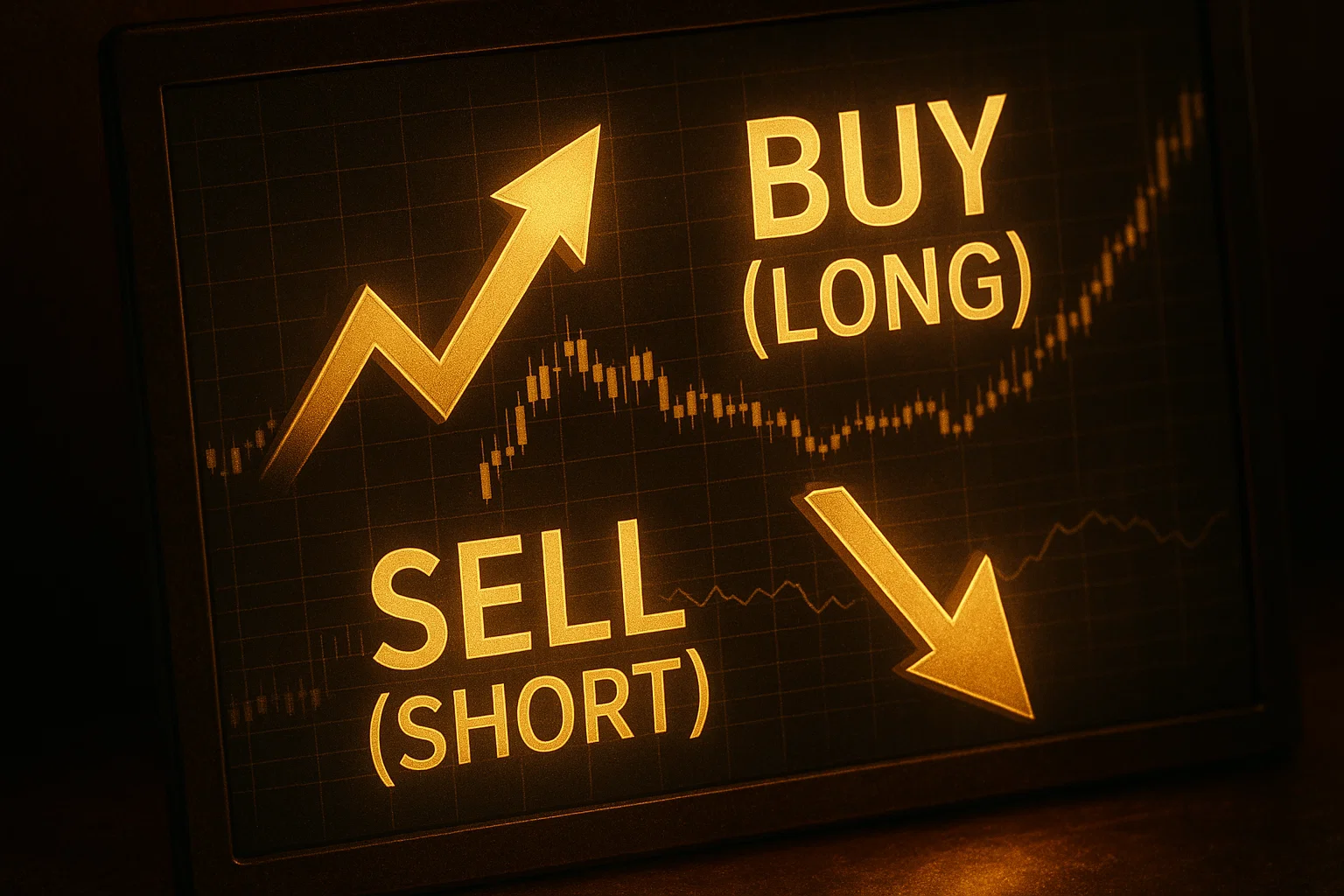
- Going Long (Buy): You open a ‘buy’ position if you anticipate the asset’s price will rise. You profit if the closing price is higher than the opening price.
- Going Short (Sell): You open a ‘sell’ position if you anticipate the asset’s price will fall. You profit if the closing price is lower than the opening price.
This allows traders to employ strategies that are difficult or impractical with traditional stock ownership.
Bid and Ask Spread Explained
In all financial markets, there are two prices quoted: the Bid price and the Ask price (sometimes called the Offer price).
- Bid Price: This is the price at which the broker is willing to buy the asset from you (the price at which you can sell or go short).
- Ask Price: This is the price at which the broker is willing to sell the asset to you (the price at which you can buy or go long).
The Spread is the difference between the Ask price and the Bid price. This spread is one of the primary ways CFD providers earn money. When you open a trade, you immediately incur the cost of the spread, meaning the position must move in your favor by at least the amount of the spread before it can break even.
Mechanics of Transacting in CFDs
When you decide to execute a CFD trade, you are essentially agreeing to the following terms with your broker:
- Trade Size: This determines the size of your position, often measured in lots or contracts (e.g., one share CFD is equivalent to one share of the underlying company).
- Margin: This is the small percentage of the total trade value that you must deposit to open the position. This is the capital you put at risk.
- Leverage: This is the ratio of the total trade value to your required margin. For example, 5 percent margin equals 20:1 leverage.
The transaction involves opening the contract at one price and then closing the contract at a later price. The cash difference is then settled between you and the broker.
Profit and Loss Calculation
The core formula for determining the result of a CFD trade is:
Profit or Loss = (Closing Price – Opening Price) multiplied by Number of Contracts
If the result is positive, you profit. If the result is negative, you incur a loss. This simple equation underscores why leverage is such a potent tool: the profit or loss is calculated on the full size of the position, not just the initial margin you deposited.
Step-by-Step CFD Trade Example
To solidify the understanding of how a CFD trade works in practice, let’s walk through a common scenario involving an index CFD.
Trade Setup and Analysis
Imagine you believe the US 500 Index (S&P 500 equivalent) is temporarily undervalued and will rise.
- Market Price: US 500 is trading at 4500 (Bid) / 4501 (Ask). The spread is 1 point.
- Trade Size: You decide to buy 10 contracts. Each contract has a value of 1 point movement per USD 1.
- Margin Requirement: Your broker requires 5 percent margin (20:1 leverage).
- Total Position Value: 10 contracts multiplied by 4501 points equals USD 45,010.
- Required Margin: 5 percent of USD 45,010 equals USD 2,250.50.
You open a long (Buy) position at the Ask price of 4501.
Opening and Closing Position
After holding the position overnight, the market moves in your favor, and you decide to close the trade. The trade was held for two days, incurring an overnight financing charge of USD 5.00.
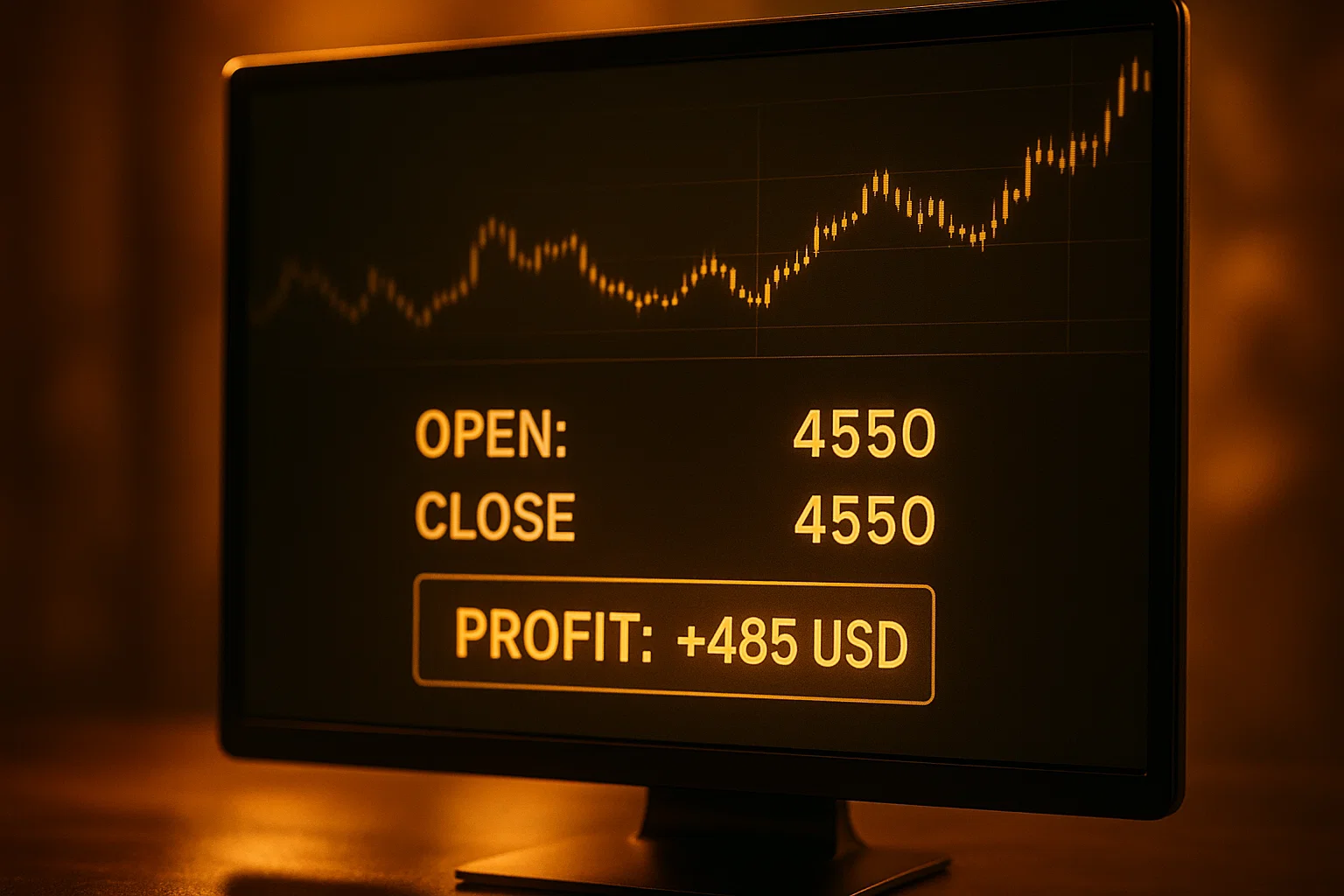
- New Market Price: US 500 is trading at 4550 (Bid) / 4551 (Ask).
- Closing Price: Since you initially bought, you must sell to close the position. You sell at the new Bid price of 4550.
- Opening Price: 4501
Calculating Final Result (Profitable Trade)
Gross Profit: (Closing Price – Opening Price) multiplied by Number of Contracts
Gross Profit = (4550 – 4501) multiplied by 10 contracts equals 490 USD.
Net Profit: Gross Profit – Overnight Financing Charge
Net Profit = 490 USD – 5 USD equals 485 USD.
This result demonstrates a significant return of approximately 21.55 percent (485 USD profit on 2,250.50 USD margin) based on a market move of only 1.09 percent (49 points / 4501 points). This is the power of leveraged CFD trading.
Calculating Final Result (Losing Trade)
Now, consider a scenario where the market moves against you, and you close the trade at a loss. The trade was held for two days, incurring an overnight financing charge of USD 5.00.
- New Market Price: US 500 is trading at 4450 (Bid) / 4451 (Ask).
- Closing Price: You sell at the new Bid price of 4450.
- Opening Price: 4501
Gross Loss: (Closing Price – Opening Price) multiplied by Number of Contracts
Gross Loss = (4450 – 4501) multiplied by 10 contracts equals -510 USD.
Net Loss: Gross Loss + Overnight Financing Charge
Net Loss = -510 USD – 5 USD equals -515 USD.
In this scenario, a loss of 515 USD, based on a single percentage point move against your position, represents a loss of 22.88 percent of your initial margin. This starkly illustrates the amplified risk that comes with leverage.
Advantages of Trading CFDs
Despite the high-risk nature, Contracts For Difference have several characteristics that make them popular instruments for short-term speculation and active trading.
Ability to Profit in Rising and Falling Markets
The core appeal of CFD trading lies in its symmetrical nature. Unlike traditional investing, where profit is typically realized only when an asset’s price increases, CFDs allow you to take a position on a falling market by “going short.” This flexibility means traders can utilize a wider range of market conditions and manage risk more dynamically. For instance, a trader holding a stock portfolio may open a short CFD position on a related index to hedge against a temporary market downturn.
Access to Wide Market Range
CFD providers typically offer a single trading account through which clients can access a vast selection of global markets. This can include:
- Major and minor currency pairs (Forex)
- Global stock indices (e.g., S P 500, FTSE 100)
- Individual company shares
- Commodities (e.g., Gold, Oil)
- Cryptocurrencies (where regulatory permissible)
This broad access allows traders to diversify their strategies and react to economic news across various asset classes without the administrative burden and fees of multiple specialized accounts.
Speculation Without Ownership
Because a CFD is a contract reflecting the price difference, the trader never takes ownership of the underlying asset. This removes complexities associated with physical asset settlement, registration, and, in many cases, certain taxes like Stamp Duty, making the transaction process faster and more streamlined for short-term speculation. However, traders may still receive cash adjustments equivalent to dividends or corporate actions.
Potential Lower Costs
When compared to buying and selling physical shares or other assets, the cost structure of CFD trading can be more attractive for short-term, frequent traders. While costs include the spread, commission (for some assets like shares), and overnight financing, the absence of initial stamp duty (in relevant regions) and the ability to control a large position with a small margin deposit translates to lower capital commitment upfront.
Risks and Disadvantages
It is imperative that anyone considering CFD trading fully acknowledges the significant risks involved. Regulatory bodies, such as the UK’s Financial Conduct Authority (FCA), classify CFDs as high-risk products.
High Risk Warning: Leverage Can Lead to Large Losses
Leverage is the double-edged sword of CFD trading. While it can magnify profits, it amplifies losses at the same rate. This means that a small, unfavorable movement in the market can lead to losses that exceed the initial margin deposit. Data published by regulated CFD providers often includes a stark warning: Approximately 68 percent to 74 percent of retail investor accounts lose money when trading CFDs. This statistic, backed by analyses from financial authorities, suggests that the vast majority of traders fail to manage the inherent risks successfully. As one financial observer noted, “Leverage ensures that when you’re wrong, you’re wrong quickly and completely.”
Assessing Overall Risk
Beyond leverage, CFD trading involves several types of risk:
- Market Volatility: Rapid price movements, especially during key economic announcements, can lead to slippage, where your stop-loss order is executed at a worse price than intended, increasing your actual loss.
- Overnight Financing: CFDs are often intended for short-term trades. Holding a position open overnight incurs a financing charge, which can accumulate rapidly and erode any potential profit, making it expensive to treat CFDs as a long-term investment tool.
- Liquidation Risk (Margin Call): If your account equity falls below a certain level due to losses, your broker may issue a margin call, demanding additional funds to cover the position. If you cannot meet this call, the broker is authorized to automatically close your position at a loss, often resulting in the loss of all initial capital.
Consumer Protection Limitations
The level of consumer protection can vary significantly based on your broker’s location and regulation. CFDs are traded Over-The-Counter (OTC), meaning they are a contract directly between you and the provider, not through a centralized exchange. This exposes you to counterparty risk—the risk that the CFD provider may fail to meet its financial obligations. While many jurisdictions require client funds to be segregated, it is critical to ensure your chosen broker is regulated by a reputable authority and adheres to strict capital requirements.
Why CFDs Are a Short-Term Strategy
Due to the continuous costs associated with holding positions—specifically, the overnight financing charges—CFD trading is structurally ill-suited for a buy-and-hold, long-term investment strategy. The compounding effect of these daily charges quickly makes the trade unprofitable over months or years, regardless of minor market appreciation. CFDs are a speculation tool focused on capitalizing on short-term market momentum and volatility.
Managing Risk
Effective risk management is not optional in CFD trading; it is the most crucial determinant of a trader’s longevity. Given the potential for amplified losses, disciplined risk practices must be integrated into every trade.
Risk Management Strategies
A foundational principle of risk management is never risking more capital than you can comfortably afford to lose. Financial experts suggest a strict rule: only risk a tiny percentage of your total trading capital—perhaps 1 percent to 2 percent—on any single trade.
Other essential strategies include:
- Position Sizing: Calculating the correct number of contracts to trade based on your risk tolerance and account size, ensuring a specific loss does not breach your risk limit.
- Volatilty Analysis: Adjusting position sizes based on the volatility in the markets. Higher volatility suggests tighter stop-loss placements and potentially smaller position sizes to manage the risk of large, rapid movements.
- Discipline: Adhering strictly to a pre-defined trading plan and risk parameters, avoiding emotional decisions driven by greed or fear when markets are moving quickly.
Using CFDs for Hedging
One advanced, less speculative use of CFDs is hedging. Hedging involves opening a position to offset the risk of an existing asset you own.
Case Study in Hedging:
Consider a trader who holds 1,000 shares of Company X but anticipates a temporary, market-wide correction over the next few weeks. They do not want to sell their shares (to avoid transaction costs or losing their long-term position). Instead, they open a short CFD position equivalent to 1,000 shares of Company X. If the share price falls by 10 percent, the loss in their physical share portfolio is largely offset by the profit made on their short CFD trade. Once the market correction passes, the trader closes the CFD position, having used it as a cost-effective insurance policy.
Setting Stop-Loss and Take-Profit Orders
These two order types are the most important tools for mitigating risk and ensuring discipline in CFD trading.
- Stop-Loss Order: An instruction to the broker to automatically close a trade when the market price moves against you and reaches a specific, pre-determined bad price. This is vital for limiting potential losses, especially when market volatility is high. Some brokers offer Guaranteed Stop-Loss Orders (GSLOs) for a small premium, ensuring the trade closes at the exact price requested, even during ‘gapping’ market conditions.
- Take-Profit Order (Limit Order): An instruction to automatically close a trade when the market price moves in your favor and reaches a specific, pre-determined good price. This locks in profits and prevents a winning position from turning into a loss if the market suddenly reverses.
It is best practice to set both a Stop-Loss and a Take-Profit order immediately upon opening any CFD trade.
Frequently Asked Questions (FAQs)
Is CFD Trading Right For Me?
CFD trading may be suitable for experienced, disciplined traders who possess a deep understanding of financial markets, technical and fundamental analysis, and who can afford to risk a significant portion, or all, of their trading capital. It is particularly attractive for those seeking high leverage, the ability to go short, and low entry capital for short-term speculation across diverse asset classes. However, given the high statistics of retail investor losses, it is definitively not suitable for beginners, those who are debt-ridden, or those who cannot commit to a rigorous risk management plan.
What is a CFD Account?
A CFD account is a specialized margin trading account opened with a CFD provider (broker) that allows a trader to execute Contracts For Difference. This account serves as the vehicle for placing leveraged speculative bets on the price movements of various underlying assets. The initial funds deposited into the account act as margin, which is the collateral required to cover potential losses and is typically segregated from the broker’s operating funds to provide an extra layer of client money protection.
Is CFD Trading Legal?
The legality of CFD trading varies globally. It is legal and regulated in many major financial centers, including the United Kingdom, most of Europe, Australia, and Singapore. However, the regulatory landscape is restrictive in other large markets. For example, due to the high-risk nature and potential for magnified losses, CFD trading is banned for retail traders in the United States by the Securities and Exchange Commission (SEC) and the Commodity Futures Trading Commission (CFTC). Always check the regulatory status of the product in your specific jurisdiction.
How Do CFD Providers Make Money?
CFD providers generate revenue primarily through three channels. First, they profit from the spread, which is the small difference between the Bid and Ask price built into the quote. Second, they charge overnight financing fees for any position held open beyond the market close, often calculated as a benchmark interest rate plus a small markup. Third, some providers utilize a business model, often called “B-Book,” where they take the opposing side of a client’s trade without hedging the position. Given that the majority of retail clients lose money when trading CFDs, this B-Book strategy can be a substantial source of profit for the provider.