
Forex affiliate marketing operates as a performance-based partnership model within the broader online trading industry, connecting marketing partners with regulated brokers through structured referral arrangements. Earnings in this space may vary considerably depending on commission model selection, traffic quality, geographic reach, trader activity levels, and the specific conditions offered by individual broker programs.
The models in forex affiliate marketing range from fixed one-time payments to recurring revenue arrangements tied to ongoing client trading behavior. This article examines common earning structures found across the forex industry, explores the variables that commonly influence revenue potential, and discusses the methods partners often use to build long-term success in financial markets.
How Forex Affiliate Programs Typically Operate
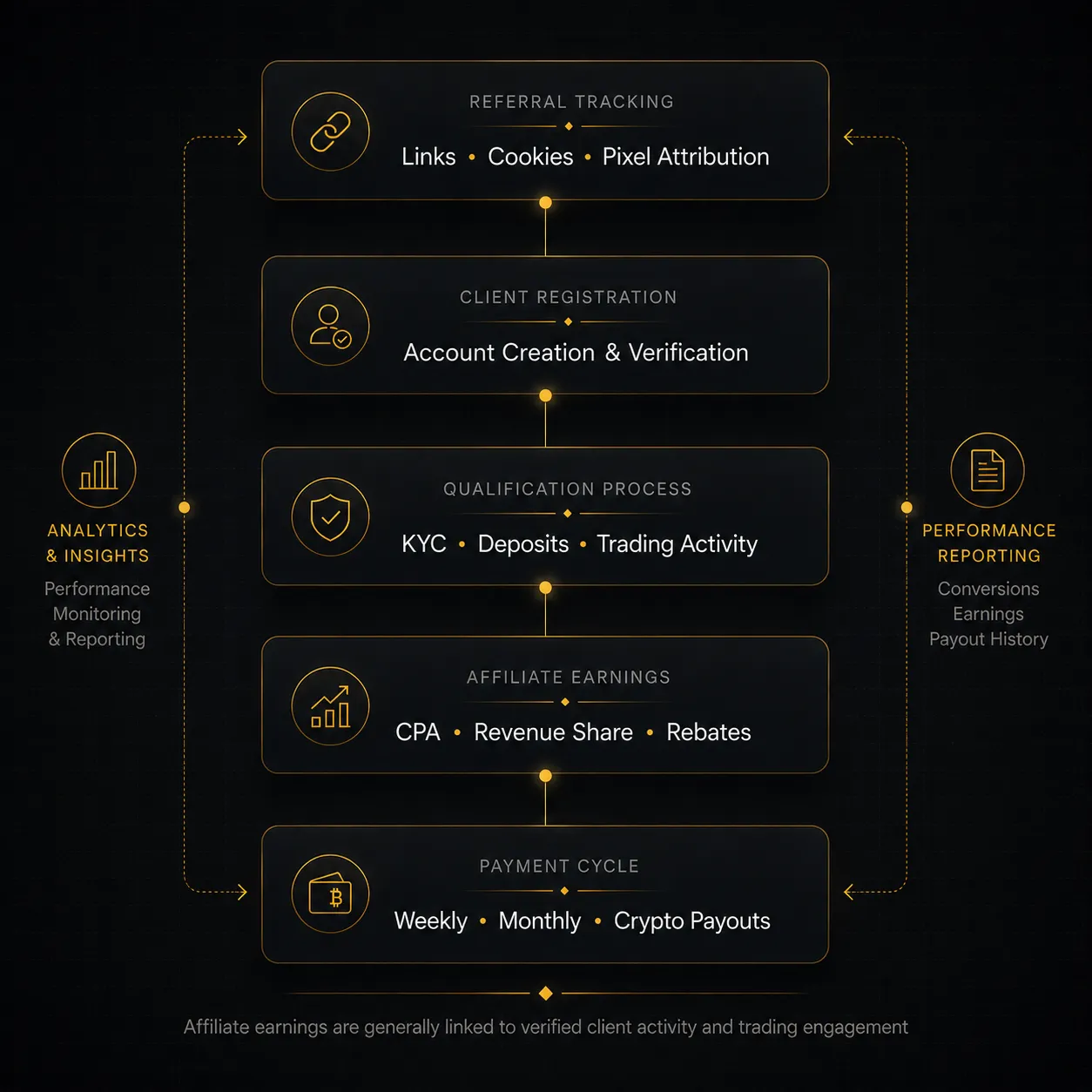
Forex affiliate programs function as structured partnerships between brokers and external marketing partners who refer potential traders to a broker’s platform. The operational mechanics of these programs involve referral tracking infrastructure, client qualification procedures, payout cycles, and performance reporting systems. Understanding how these components interact may help partners and introducing brokers (IBs) better assess the structure of a given program before committing marketing resources.
Referral Tracking Systems
Programs typically rely on unique referral links, browser cookies, and pixel-based tracking technologies to attribute client registrations and subsequent trading activity to the originating partner. When a potential trader clicks a referral link and completes the broker’s registration process, the partner’s account is credited with the referral. Some tracking systems offer multi-touch attribution, while others operate on a last-click model, which may affect how commissions are assigned when a prospect interacts with multiple sources before converting.
Client Qualification Requirements
Many forex brokers apply specific verification standards before commissions are generated. These requirements often include identity verification (KYC compliance), minimum initial deposit thresholds, and a defined period of active trading. For example, a broker may require that a referred client deposit a minimum amount and execute a minimum number of trades before the partner receives a CPA payment. These conditions are typically outlined in the partnership agreement and may differ meaningfully between programs.
Affiliate Payment Cycles
Payout schedules across forex programs commonly follow weekly, biweekly, or monthly cycles, depending on broker policy and the specific terms agreed upon at registration. Some programs apply a minimum withdrawal threshold before releasing funds, which may affect cash flow planning for smaller operations. Payment methods often include bank wire transfers, e-wallet systems such as Skrill or Neteller, and increasingly, cryptocurrency disbursements. The transparency of these schedules is generally considered an important factor when evaluating program quality.
Role of Trading Volume in Earnings
In revenue-share arrangements, the ongoing trading activity of referred clients directly influences long-term income. A client who remains active and continues to execute trades may generate recurring commissions over an extended period, whereas a client who deposits and becomes inactive shortly afterwards may contribute only a single, smaller payment. This dynamic means that in revenue-share models, the quality and engagement level of referred traders can be as significant as the volume of initial referrals.
Forex Affiliate Commission Models
The three primary compensation structures in forex marketing partnerships are Cost Per Acquisition (CPA), Revenue Share, and Hybrid models. Each model may align differently with various traffic sources, audience types, and business objectives. Some brokers also offer tiered systems that reward higher-performing partners with enhanced commission rates. Understanding the types of affiliate compensation structures available is commonly considered a foundational step for anyone looking to choose the right program for their audience and marketing approach.
- CPA (Cost Per Acquisition): A fixed payment per qualified referral, triggered upon meeting defined activity conditions.
- Revenue Share: A recurring percentage of spread or trading revenue generated by referred clients over time.
- Hybrid: A combination of CPA and revenue-share components within a single agreement.
- Tiered Systems: Escalating commission rates or bonuses tied to referral volume or performance milestones.
CPA Forex Affiliate Model
The Cost Per Acquisition model, often referred to as fixed CPA, provides a fixed payment after a referred trader meets specific qualification criteria, such as completing identity verification, making a minimum deposit, and executing an initial trade. Under this structure, the partner receives a fixed payment once those specific criteria are satisfied, regardless of the client’s future trading behavior. CPA commissions in the forex industry have historically ranged from approximately $100 to over $800 per qualified referral, depending on the broker, the trader’s geographic region, and the deposit amount. This model is often described as attractive for affiliates who want predictable, short-term income rather than variable recurring earnings.
Revenue Share Forex Affiliate Model
Under a revenue share model, the partner continues to receive a recurring percentage of the revenue generated by their referred clients’ trading activity, typically calculated as a share of the broker’s spread income or net revenue. Revenue-share percentages commonly range from 10% to 45% of the broker’s earnings from each referred trader, depending on the program. This model may produce long-term, compounding income for partners with a stable base of active traders, though earnings can fluctuate if client activity decreases or market conditions reduce trading volumes. Unlike revenue share, CPA structures do not produce ongoing income once the initial qualification payment has been made.
Hybrid Commission Structures
Brokers offer hybrid arrangements to partners with demonstrated conversion ability, as this structure distributes income risk between both parties. A hybrid payout combines an upfront fixed payment per qualified referral alongside an ongoing percentage of that client’s trading revenue. For marketing partners, the hybrid model may provide a degree of immediate liquidity while preserving the potential for long-term recurring income from an engaged client base. This structure is often described as balancing the predictability of CPA with the compounding potential of revenue share within a single agreement.
Tiered Commission Systems
Some forex programs incorporate tiered structures that increase commission percentages or offer volume-based bonuses as partners generate higher numbers of qualified referrals. For instance, a program might offer a base revenue-share rate of 20% that increases to 30% once a partner refers 50 active traders in a calendar month. These systems generally incentivize scale and may represent a meaningful income lever for partners operating at higher traffic volumes. Affiliates and earn potential in tiered programs is often proportionate to the consistency and quality of their referral output over time.
Factors Affecting Forex Affiliate Earnings
Revenue potential is influenced by a range of interconnected variables that extend beyond the commission model itself. Traffic quality, conversion efficiency, geographic targeting, broker credibility, and the lifetime value of referred clients all commonly contribute to overall earning potential. Earnings may differ substantially between two partners operating under identical commission terms if these underlying factors diverge significantly.
| Factor | Influence on Earnings | Notes |
|---|---|---|
| Traffic Quality | High | Financially motivated audiences tend to convert at higher rates |
| Geographic Region | High | CPA rates often vary by country based on the regulatory environment and trader value |
| Broker Reputation | Medium–High | Client retention and platform quality affect recurring commissions |
| Conversion Rate | High | Registration-to-deposit ratio directly impacts CPA volume |
| Client Lifetime Value | High in revenue share | Active traders generate more recurring income over time |
| Commission Model | Variable | CPA provides short-term predictability; revenue share offers compounding potential |
Traffic Quality
The composition and intent of an audience may significantly affect conversion outcomes. Quality traffic — visitors arriving through targeted financial content, such as forex education articles or broker comparison tools — often demonstrates higher transactional intent than users reached through general-interest advertising. According to industry observations, traffic originating from search-engine-optimized financial content or email lists of engaged trading enthusiasts has historically produced higher registration-to-deposit ratios than broad display advertising campaigns. Success depends, in large part, on the alignment between audience intent and the broker’s offering.
Conversion Rates
Conversion rates describe the proportion of referred visitors who complete a desired action, most commonly registration followed by a qualifying deposit. Landing page design, audience messaging alignment, broker onboarding experience, and regional factors all may influence this ratio. Even modest improvements in conversion efficiency can have a compounding effect on total earnings, particularly for partners operating at scale with consistent traffic volumes.
Geographic Target Markets
Forex partnership payout rates frequently vary by country, reflecting differences in average trader deposit size, regional regulatory requirements, and the competitive intensity of broker acquisition efforts. Programs targeting traders in certain Southeast Asian, Middle Eastern, or Latin American markets may offer different CPA rates than those focused on European or North American audiences. Regional demand for online trading services and local financial literacy levels may also influence the effectiveness of educational content in those markets.
Broker Reputation and Retention
The credibility, regulatory standing, and platform quality of the broker being promoted may have a measurable effect on client retention and, by extension, recurring income. Brokers regulated by recognized authorities such as the Financial Conduct Authority (FCA) or the Australian Securities and Investments Commission (ASIC) may attract a higher-trust client base more likely to remain active over time. Partners promoting brokers with strong customer support and competitive trading conditions may observe higher client lifetime values in revenue-share arrangements.
Client Lifetime Value
In revenue-sharing models, client lifetime value (CLV) describes the total revenue a partner may earn from a single referred trader over their entire active period with the broker. A trader who remains engaged and continues executing trades for two years generates substantially more income than one who trades briefly and becomes inactive. This dynamic means that creating high-quality educational content designed to attract knowledgeable and engaged traders is sometimes associated with stronger long-term revenue-share performance.
Average Forex Affiliate Earnings
Reported earnings span a wide range, reflecting the diversity of partnership types, traffic models, and program structures involved. Industry sources suggest that monthly earnings may range from modest figures for newer or smaller operations to tens of thousands of dollars for established finance publishers and high-volume IBs. These figures should be interpreted with caution, as individual results depend heavily on audience scale, conversion efficiency, and commission model selection.
- Beginner or early-stage partners may generate between $500 and $2,000 per month as initial traffic and audience trust are established.
- Mid-level operations with established niche authority often report monthly earnings in the range of $3,000 to $15,000.
- High-volume operations, including large media networks and SEO-focused finance portals, sometimes report monthly revenues exceeding $50,000.
- Recurring revenue-share income tends to grow more gradually but may provide greater long-term stability than CPA-only models.
Recurring vs One-Time Earnings
CPA models provide a single fixed payment per qualified referral, offering predictable short-term income but no ongoing revenue from that client’s future activity. A revenue share model, by contrast, may generate income that compounds over time as a client base grows and existing traders remain engaged. The practical outcome of each approach depends heavily on trader retention and broker longevity. Partners seeking steady income with lower short-term variability sometimes gravitate toward hybrid structures that combine both characteristics within a single arrangement.
Challenges Influencing Forex Affiliate Profitability
This space operates within a competitive and regulated environment that may present a range of operational and structural challenges. Financial advertising compliance requirements, market saturation in certain content niches, trader retention volatility, and broker-side policy changes are among the factors that may affect the profitability and sustainability of a partnership business over time.
| Challenge | Description | Potential Impact |
|---|---|---|
| Financial Advertising Compliance | Regulatory restrictions on financial promotions | May limit certain content or ad channels in regulated jurisdictions |
| Market Saturation | High competition in broker review and comparison content | May reduce organic traffic and conversion rates |
| Trader Retention Volatility | Fluctuating market conditions may reduce client activity | Affects recurring revenue-share income |
| Broker Policy Changes | Commission terms or minimums may be revised | May alter expected income without prior notice |
Financial Advertising Compliance
Financial promotion regulations in jurisdictions such as the United Kingdom, European Union, and Australia impose specific requirements on how trading services may be advertised to the public. Partners operating in these markets may be required to include risk warnings, avoid performance claims, and ensure that promotional materials meet standards set by authorities such as the FCA or the European Securities and Markets Authority (ESMA). Non-compliance may result in advertising restrictions or removal from broker programs entirely.
Increasing Competition
The broker comparison and review segment of this industry has become increasingly competitive, with established finance publishers, funded media companies, and content networks competing for high-intent search traffic. This saturation may make organic search rankings more difficult to achieve for newer entrants and may increase the cost of paid traffic acquisition across platforms. Differentiated content approaches, niche positioning, and audience specificity are commonly associated with better performance in competitive markets.
Trader Retention Volatility
Recurring income in revenue-share models is sensitive to changes in client activity levels. Periods of low market volatility, unfavorable trading conditions, or shifting trader interest may reduce the trading activity of their referrals, which in turn reduces monthly earnings. This variability is a structural characteristic of revenue-share models that some partners manage by maintaining a diversified portfolio of active referrals across different trader profiles and geographic regions.
Broker Policy Changes
Commission structures, minimum withdrawal thresholds, geographic restrictions, and qualification criteria are subject to revision at various points. Program terms may be updated in response to regulatory changes, market conditions, or internal business strategy shifts. Partners who rely on a single program may face income disruption if terms change unfavorably, which is one reason why partnership diversification is a commonly discussed risk management approach across the industry.
Methods Commonly Associated with Forex Affiliate Growth
Partners who have scaled their earnings over time are often described as operating across multiple traffic channels, maintaining niche content authority, updating educational materials regularly, and working with more than one broker program. These broad business development approaches are commonly referenced in industry discussions, though individual results depend on execution quality and prevailing market conditions.
Multi-Channel Audience Development
Marketing efforts in this space are often distributed across search-engine-optimized websites, YouTube channels covering trading education, email newsletters targeting registered subscribers, and social media platforms serving financially engaged communities. Diversifying across multiple channels may reduce dependence on any single source of traffic and provide more consistent referral volumes over time. Affiliate programs offer ready-made tracking infrastructure and promotional materials that can be deployed across these channels without significant technical investment.
Niche Market Positioning
Specialization within a defined segment of the trading audience — such as beginner forex education, MetaTrader platform tutorials, or region-specific content covering local trading strategies — is commonly associated with higher engagement rates and stronger audience trust. Niche positioning may also reduce direct competition from broader finance publishers, potentially improving organic search visibility in targeted topic areas. Partners who develop subject-matter authority in a specific area may observe higher conversion rates than those operating across broad, general financial topics.
Long-Term Content Strategies
Creating high-quality educational content that addresses the informational needs of traders at various stages of experience is frequently cited as a foundational element of sustainable income in competitive finance niches. Content covering market mechanics, platform comparisons, and risk management concepts may retain audience relevance over extended periods. According to content marketing research, evergreen educational material in financial services often generates referral traffic for substantially longer periods than time-sensitive news or promotional material.
Partnership Diversification
Working with multiple broker programs may broaden monetization opportunities and reduce income concentration risk. Some partners maintain relationships with brokers offering different commission models, allowing them to match referral audiences with the most appropriate program structure. This approach may also provide negotiating leverage when discussing commission terms with individual brokers, particularly for IBs who can demonstrate a consistent track record of directing clients to a broker and generating qualified, active referrals.
Comparing Forex Affiliate Programs
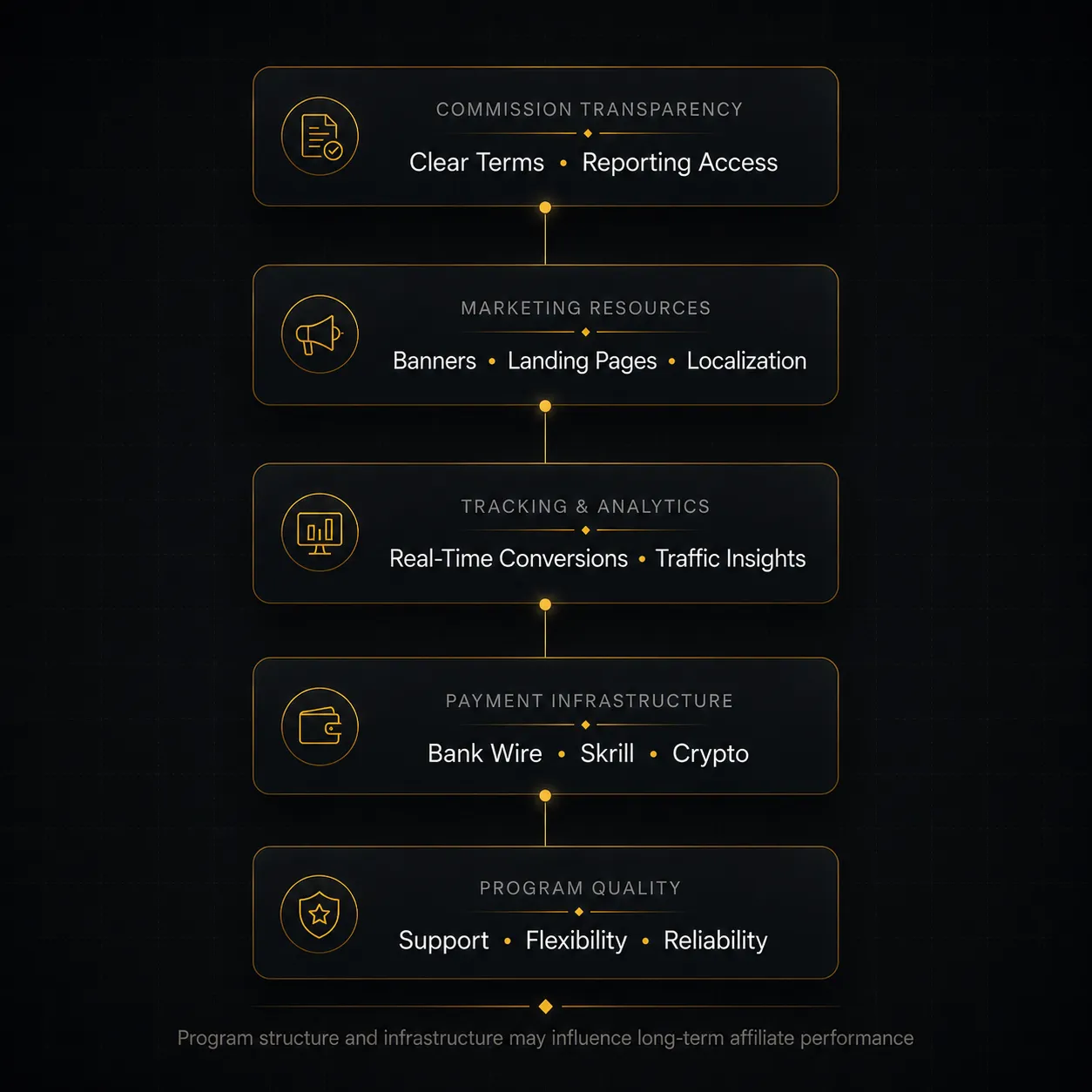
Forex programs may differ in payout structure, commission transparency, available marketing resources, tracking technology, and payment infrastructure. Evaluating these dimensions systematically may assist partners in identifying programs aligned with their audience type, traffic model, and income objectives. The decision to choose the right program is often described as one of the more consequential choices a new or established partner can make, as it affects not only earning potential but also the ease of day-to-day program management.
Commission Transparency
Programs that provide clearly documented payout conditions, qualification criteria, and reporting access are generally considered more reliable by experienced partners. Ambiguous commission terms or undisclosed deduction policies may create discrepancies between expected and actual payouts. Industry participants often cite clear contractual terms and accessible support as distinguishing characteristics of well-structured programs. Partners who predefine their income expectations based on documented terms are generally better positioned to evaluate performance against benchmarks.
Marketing Resource Availability
Brokers frequently provide promotional assets including banner advertisements, landing page templates, educational content, multilingual marketing materials, and co-branded resources. The availability and quality of these ready-made materials may affect the ease of launching campaigns and the consistency of messaging across channels. Some programs offer dedicated managers who provide customized guidance and localized support for partners targeting specific regional markets.
Tracking and Analytics Features
Dashboard functionality varies between programs. More advanced platforms may offer real-time click and conversion tracking, sub-IB reporting, geographic segmentation, and cohort analysis tools. These features may help partners monitor traffic quality, identify high-performing channels, and optimize referral campaigns over time. The accuracy and latency of tracking data are often cited as important factors in evaluating program infrastructure quality, particularly for partners managing multiple simultaneous campaigns.
Payment Methods and Withdrawal Policies
Common payout methods include international bank wire transfers, e-wallet services such as PayPal, Skrill, and Neteller, and cryptocurrency disbursements via Bitcoin or USDT. Minimum withdrawal thresholds, processing times, and applicable fees vary between programs. Partners managing cash flow across multiple programs may find that flexible and low-threshold payment structures better support their operational requirements. Some programs offer higher payout limits or expedited processing for partners who consistently generate above-average referral volumes.
Key Takeaways on Forex Affiliate Earnings
Earnings from forex partnership programs are shaped by the intersection of commission model, traffic quality, geographic targeting, broker relationships, and long-term audience engagement. CPA structures may provide more immediate and predictable income — since the partner receives a fixed payment once a referred trader satisfies qualification conditions — while revenue-share arrangements offer the potential for compounding recurring revenue tied to ongoing client trading activity. Hybrid models attempt to balance these characteristics within a single program structure that provides immediate value and longer-term income potential simultaneously.
Earnings potential spans a broad range, from modest initial commissions for early-stage partners to substantial recurring income for established finance content operations. The structural challenges of this space, including regulatory advertising requirements, competitive content markets, and broker-side policy variability, mean that long-term success is commonly associated with operational resilience, content quality, and diversified partnership structures. Revenue share and CPA models each carry distinct risk and reward characteristics, and the most effective approach often reflects the specific composition and behavior patterns of a partner’s audience rather than a universal preference for one model over another.
FAQ About Forex Affiliate Earnings
How much do forex affiliates typically make?
Forex affiliate earnings may vary significantly depending on traffic quality, audience size, and commission structure. New affiliates often generate modest income while building visibility and referral activity, whereas larger finance publishers or IBs may report substantially higher monthly revenue. Industry estimates range from several hundred dollars to tens of thousands per month, although results differ widely across markets and business models.
What affects forex affiliate commissions most?
Affiliate commissions are commonly influenced by traffic quality, conversion rates, trader activity, and geographic region. CPA models are typically affected by the number of qualified deposits, while revenue-share earnings depend more on long-term client trading volume and retention. Broker conditions, including platform reliability and spreads, may also influence referred trader activity levels.
What is better between CPA and revenue share?
CPA and revenue-share models serve different partnership objectives rather than one being universally better. CPA structures generally provide fixed payouts for qualified referrals, while revenue share may generate recurring income tied to ongoing trader activity. Choice of model often depends on audience behavior, traffic sources, and preferred income stability.
Can beginners join forex affiliate programs?
Many forex affiliate programs accept beginners without requiring previous industry experience. However, consistent earnings often depend on having an established audience, website, or other traffic source. Some brokers also provide educational resources and account managers to help newer partners navigate program requirements and promotional standards.
Why do some affiliates prefer hybrid models?
Hybrid models combine elements of CPA and revenue share within a single commission structure. Affiliates may receive an upfront payment for qualified referrals while also earning recurring commissions from future trading activity. This structure is often associated with balancing short-term cash flow and longer-term income potential.
Are forex affiliate earnings recurring?
Recurring earnings are most commonly associated with revenue-share agreements. In these arrangements, affiliates continue receiving commissions while referred traders remain active on the broker’s platform. CPA programs, by contrast, generally provide one-time payments tied to specific referral actions or qualification events.
Which traffic sources are commonly used in forex affiliate marketing?
Forex affiliates commonly use SEO-driven websites, educational content platforms, YouTube channels, social media, and email marketing campaigns to attract audiences. Some partners also utilize paid advertising, although financial promotion rules may limit campaign scope in certain regions. Traffic strategies often vary depending on audience demographics and regulatory considerations.