Online trading affiliate programs represent performance-based partnership models used by brokers, financial brands, and online trading platforms to attract new clients through digital marketing channels. These structures expanded alongside growing retail participation in forex trading, equities, CFDs, cryptocurrencies, and commodities markets.
Participants in forex affiliate marketing often include publishers, content creators, financial media websites, and online affiliate networks promoting trading services in exchange for performance-driven compensation. Within the broader affiliate marketing world, these partnerships act as intermediary channels connecting trading brokers with prospective clients across multiple regions and audience segments.
What Are Online Trading Affiliate Programs?
Online trading affiliate programs are structured commercial arrangements in which a broker or online forex platform compensates an external marketing partner for generating qualified traffic, registrations, or funded trading accounts. These systems operate within a wider financial marketing ecosystem that includes introducing brokers, comparison portals, influencers, and financial publishers.
Compensation is commonly tied to measurable actions such as registrations, first deposits, or ongoing activity linked to forex trading program referrals. Industry research estimated the global performance marketing sector at more than USD 17 billion in 2023, with forex and CFD verticals accounting for a substantial portion of acquisition spending.
Role of Partners in Trading Industry
Marketing partners contribute to brand visibility and audience expansion through educational websites, social media channels, comparison platforms, and trading community resources. Common acquisition methods include SEO, email campaigns, YouTube content, and paid search advertising.
In highly competitive sectors such as online forex and CFD markets, broker’s affiliate program structures may provide a more measurable acquisition framework because compensation is typically tied to verified outcomes rather than advertising impressions alone. Educational publishers and forex community creators also contribute to broader market awareness by discussing trading and investing topics, advanced trading concepts, and high-quality trading platforms.
Difference Between Affiliates and Introducing Brokers
Marketing partners and introducing brokers operate under different commercial frameworks. Standard referral participants generally focus on promotion and lead generation without direct client management responsibilities, while introducing brokers often maintain longer-term relationships with referred traders. In jurisdictions supervised by regulators such as the FCA or ASIC, introducing brokers may operate under distinct licensing obligations. Compensation in IB models is commonly linked to trading volume rebates, whereas partner program structures often rely on CPA or revenue share arrangements associated with forex referral activity.
Growth of Financial Partnership Marketing
Retail trading participation increased significantly during periods of elevated market volatility in 2020 and 2021, contributing to larger acquisition budgets across the world of trading. Expansion of educational websites, financial YouTube channels, and comparison portals created new distribution opportunities for best trading affiliate programs and forex CPA models. In some regulated markets, restrictions on direct advertising of leveraged products encouraged brokers to diversify marketing activity toward content-led referral program partnerships that comply with disclosure standards.
How Online Trading Affiliate Programs Work
The operational structure behind these programs relies on referral tracking systems connecting marketing activity to user outcomes. When a visitor clicks a tracked referral link and completes a qualifying action such as registration or deposit, the event is attributed to the originating partner through cookies, server-side tracking, or unique identifiers. Brokers may manage these systems internally or through third-party trading software providers specializing in affiliate marketing program infrastructure. Compensation is then calculated according to the selected commission structure.
Referral Tracking and Attribution Models
Referral tracking commonly uses first-click or last-click attribution models, although more sophisticated trading platforms increasingly support multi-touch attribution. Cookie durations usually range between 30 and 90 days depending on program terms. Due to browser privacy updates limiting third-party cookies, server-side systems have become more common across comprehensive affiliate environments. Reporting dashboards frequently display clicks, registrations, funded trading accounts, and trading volume metrics in near real time.
CPA, Revenue Share, and Hybrid Structures
Three primary compensation structures dominate this sector: CPA, revenue share, and hybrid arrangements. A cpa affiliate program typically provides a fixed payout once a referred trader completes a qualifying deposit. Forex CPA structures in some markets may exceed several hundred dollars depending on geography and deposit size, making them attractive for publishers seeking high commissions.
Revenue share arrangements allocate a percentage of spread or commission income generated by referred users over time, while hybrid systems combine upfront CPA payments with recurring income potential. Some top CPA structures are particularly common among leading forex brands and sophisticated trading platforms.
| Commission Model | Trigger Event | Typical Structure | Common Usage |
|---|---|---|---|
| CPA | First qualifying deposit | Fixed acquisition payment | Forex, CFD, Crypto |
| Revenue Share | Ongoing trading activity | Percentage of broker revenue | Forex, Equities |
| Hybrid | Deposit + ongoing trades | Reduced CPA + RevShare | Multi-asset trading program |
| Sub-Partner Rebate | Referred partner activity | Percentage of downstream earnings | Large partner networks |
Payment Schedules and Withdrawal Methods
Payment cycles generally operate weekly, bi-weekly, or monthly, although some best programs offer accelerated schedules for high-volume publishers. Withdrawal thresholds commonly range between USD 50 and USD 250. Available payment methods may include bank transfers, e-wallets, and cryptocurrency payments. Dashboards typically provide commission records, sub-partner reporting, and historical payout data relevant to affiliate earnings management.
Compliance and Verification Requirements
Regulated financial brands usually require identity verification before releasing payments. Promotional content associated with leveraged instruments may also require compliance approval, particularly within ESMA-regulated European markets. In many jurisdictions, risk disclosures noting that retail traders may lose money when trading CFDs are mandatory. Certain brokers restrict promotional activity in specific countries or prohibit statements that could resemble financial advice. These requirements are especially relevant within forex affiliate marketing and day trading affiliate campaigns targeting retail audiences.
Types of Trading Affiliate Programs
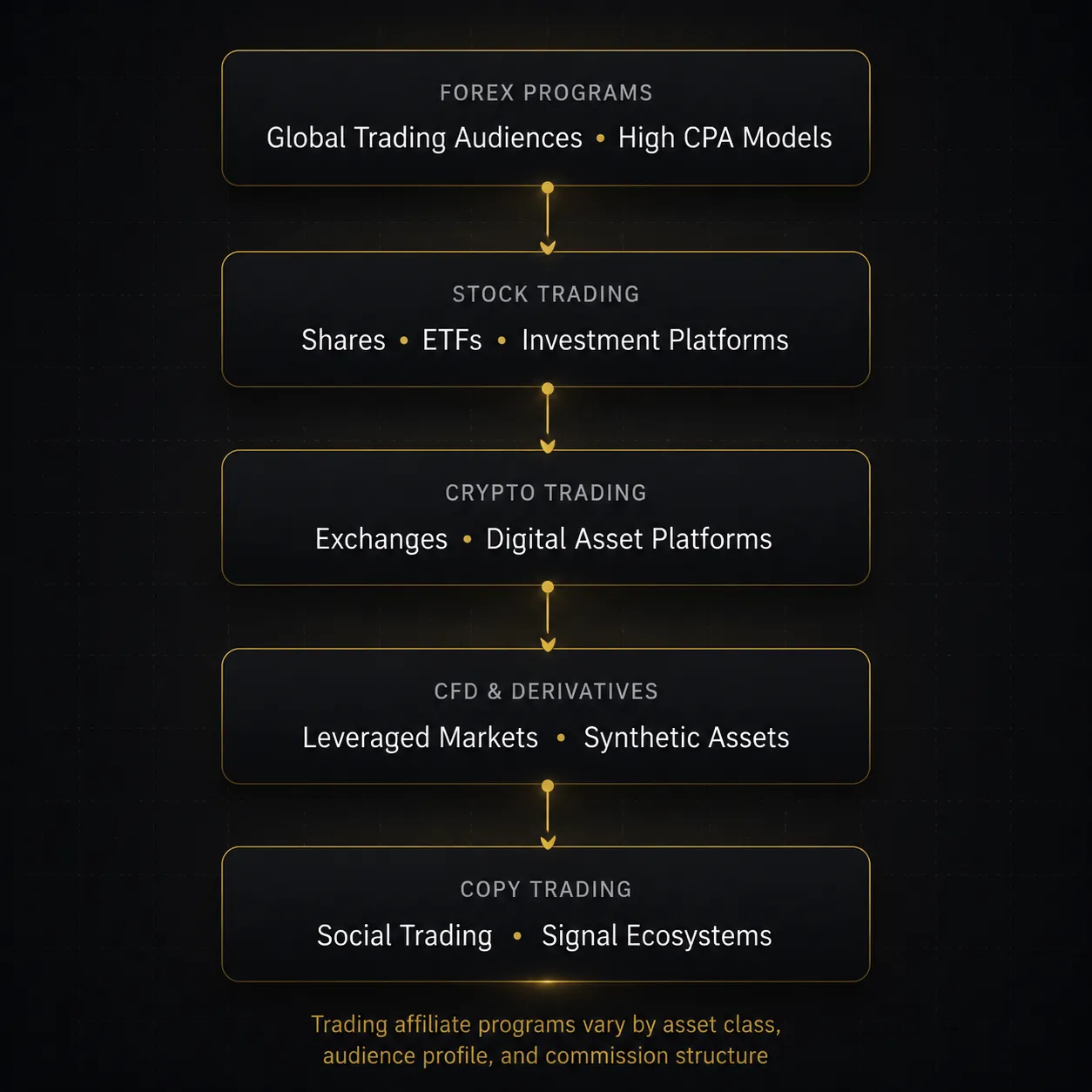
Programs vary significantly based on audience profile, asset class specialization, commission structure, and regulatory framework. The diversity of modern financial markets has resulted in multiple categories ranging from forex trading and equities to digital assets and copy trading ecosystems. Choosing the right affiliate program often depends on audience demographics, content focus, and geographic reach.
Forex Affiliate Programs
Forex-focused programs remain among the most established categories within performance marketing for financial services. These structures typically promote online forex brokers, MetaTrader platforms, trading tools, and educational resources. According to the Bank for International Settlements, the global forex market exceeds USD 7.5 trillion in daily turnover, supporting substantial acquisition budgets and competitive payouts. Many publishers describe top forex affiliate programs as among the highest-paying categories within financial marketing.
Key characteristics often include:
- Multilingual promotional materials for global audience targeting
- Region-based payout structures tied to client quality
- Dedicated support managers for high-volume publishers
- Promotion of webinars, forex tester solutions, and analytical trading software
Stock Trading Programs
Equity-focused programs are associated with platforms providing access to shares, ETFs, and long-term trading and investment products. These environments often target audiences interested in portfolio diversification and trading and investing education rather than highly speculative strategies. Regulatory obligations for equity brokers may differ from those governing leveraged CFD products.
Crypto Trading Programs
Cryptocurrency-related structures represent one of the fastest-evolving segments within online trading. Crypto exchanges and CFD platforms frequently compete aggressively for user acquisition, leading to elevated payout models and high commissions. Regulatory treatment of digital assets varies substantially across jurisdictions, causing frequent updates to program conditions and geographic restrictions.
CFD and Derivatives Programs
CFD-focused structures promote leveraged products linked to commodities, indices, and synthetic assets. ESMA data notes that a significant percentage of retail accounts lose money when trading CFDs, requiring regulated promotions to include standardized risk disclosures. Because leveraged products may generate higher revenue per active user, these arrangements can sometimes support more rewarding affiliate compensation structures than standard equity-focused offerings.
Copy Trading and Social Trading Partnerships
Copy trading ecosystems target users interested in automated participation or signal-based systems rather than fully self-directed execution. These environments frequently combine educational communities with community-driven analytics and leaderboards. Growth in social trading has created niche opportunities for publishers focused on trading style discussions, trading community engagement, and high-quality trading education.
Benefits of Online Trading Affiliate Programs
Performance-driven compensation, global audience reach, and scalability are frequently cited advantages associated with these partnership models. Within the broader affiliate marketing world, trading-related verticals are often viewed as premium categories due to comparatively high payouts and specialized audiences.
Performance-Based Revenue Models
Under performance-driven structures, brokers typically incur acquisition costs only after measurable outcomes occur. For publishers, compensation may scale according to the quality and volume of referred users. Industry research consistently places financial services among the highest-paying verticals for comprehensive affiliate and CPA models.
Global Audience Reach
Financial brands often rely on international partner program networks to expand into emerging regions where localized marketing may be more effective. Forex community websites and multilingual publishers can support engagement strategies adapted to regional preferences. Global reach is especially important for leading forex and multi-asset brands operating across dozens of countries.
Scalability of Digital Marketing Channels
Many publishers operate simultaneously across SEO websites, YouTube channels, newsletters, Telegram groups, and social communities. This multi-channel approach may allow referral traffic to scale over time without proportional increases in media expenditure. Organic rankings in competitive search categories such as “10 best forex” or “best forex affiliate program” can continue generating traffic for extended periods.
Access to Marketing Materials and Analytics
Most comprehensive affiliate program environments provide banners, landing pages, educational widgets, and reporting dashboards. Some trading brokers also assign dedicated account managers who assist with analytics interpretation, localized campaigns, and promotional planning.
Risks and Limitations of Trading Programs
The financial marketing sector is influenced by regulatory pressure, evolving market conditions, and intense competition within SEO and paid acquisition channels. Long-term results may vary considerably depending on geography, broker reputation, and audience quality.
Regulatory Restrictions in Financial Advertising
Financial advertising standards differ significantly across jurisdictions. The FCA in the UK, ESMA in Europe, ASIC in Australia, and the CFTC in the United States each impose distinct requirements governing leveraged products and retail forex promotion. Promotional campaigns targeting multiple regions simultaneously may encounter additional compliance complexity.
| Jurisdiction | Regulator | Key Consideration |
|---|---|---|
| United Kingdom | FCA | Mandatory risk disclosures | European Union | ESMA | Retail loss disclosures required |
| Australia | ASIC | Restrictions on leverage promotion |
| United States | CFTC / NFA | Strict retail forex oversight |
Dependence on Broker Reputation
Partner revenue is closely connected to broker credibility and user perception. Negative publicity, regulatory actions, or licensing issues affecting a broker may reduce conversion rates and damage publisher trust. Experienced participants often evaluate platform history, customer support quality, and execution standards before promoting a trading business.
Revenue Volatility and Market Cycles
Revenue may fluctuate alongside retail trading activity, volatility conditions, and broader economic sentiment. Lower market volatility can reduce public interest in online trading platforms, while periods of strong price movement historically attract increased participation. Revenue share models are particularly sensitive to user retention and long-term activity levels.
Increasing Competition in Finance SEO
Forex and CFD categories remain among the most competitive SEO sectors globally. Acquisition costs for high-value financial keywords have increased significantly over time, while major comparison portals dominate many search results. New publishers entering forex affiliate marketing often require substantial content development and technical SEO investment to compete effectively.
What to Look for in Online Trading Affiliate Programs
Evaluating program quality typically involves examining operational transparency, regulatory standing, conversion efficiency, and marketing support rather than focusing exclusively on headline payout figures.

Commission Transparency
Transparent structures usually provide clear definitions of qualifying events, payout schedules, and clawback conditions. Reliable dashboards allowing independent verification of conversion metrics are commonly viewed as indicators of operational quality.
Broker Regulation and Licensing
Regulation is widely considered a significant factor when evaluating a broker’s affiliate program. Brokers supervised by organizations such as the FCA, ASIC, CySEC, or MAS are generally required to meet capital adequacy and conduct obligations that may reduce operational risks.
Conversion Rates and Traffic Quality
Conversion metrics are strongly influenced by audience demographics, geography, financial literacy, and device usage patterns. Optimized registration flows and multilingual landing pages may improve user engagement across different traffic sources.
Marketing Support and Educational Resources
Many best forex affiliate environments provide updated promotional libraries, platform demonstrations, trading tools, webinars, and educational materials aligned with major market events. Dedicated support managers familiar with sophisticated trading environments are often viewed positively by experienced publishers.
Platform Reputation and User Experience
Execution quality, mobile usability, pricing structures, and customer support all influence user retention. Third-party reviews and historical regulatory records are commonly reviewed before entering a long-term partner relationship with an online trading platform.
Key Points About Affiliate Programs
- Online trading affiliate programs remain an important client acquisition channel across forex trading, equities, CFDs, and cryptocurrency markets.
- Common compensation models include CPA, revenue share, forex CPA, and hybrid arrangements, each influenced by traffic quality, user behavior, and market conditions.
- Participants in forex affiliate marketing operate through SEO websites, educational portals, social media communities, YouTube channels, and other digital platforms.
- Regulatory obligations, broker licensing standards, and disclosure requirements continue to shape how promotional activity is conducted across different jurisdictions.
- Evaluation criteria commonly include transparency, platform reputation, support infrastructure, conversion efficiency, and long-term operational stability rather than headline high commissions alone.
- Partnership-driven acquisition models are expected to remain significant within both established and innovative trading markets as retail participation in the world of trading continues to evolve.
Frequently Asked Questions
What Is an Online Trading Affiliate Program?
An online investment affiliate program is a performance-based setup where brokers or platforms pay partners for referring new clients who complete actions like registration or depositing funds. It covers financial markets such as forex, equities, CFDs, and crypto. Payment is tied to measurable user actions instead of impressions or clicks. This model is widely used in digital client acquisition strategies.
How Do Trading Affiliate Programs Pay Affiliates?
These programs usually pay through CPA (fixed fee per qualified client), revenue share (a percentage of client-generated income), or hybrid models combining both. CPA pays after a deposit or similar action, while revenue share continues as long as the client remains active. Hybrid systems balance upfront and long-term earnings. Payments are typically made via bank transfer, e-wallets, or crypto on scheduled cycles.
What Markets Are Covered by Trading Affiliate Programs?
They cover forex, CFDs on indices and commodities, equities, ETFs, and crypto exchanges, plus copy-trading ecosystems. Each category has different regulations, audiences, and payout structures. Forex remains one of the largest segments due to global retail demand. Crypto-related programs have expanded quickly alongside digital asset adoption.
Are Trading Affiliate Programs Regulated?
Regulation depends on the broker’s license and the jurisdiction where promotions are shown. In regions like the UK, EU, and Australia, marketing must follow strict financial promotion rules and include risk disclosures. Some affiliates need pre-approval for content from licensed entities. Regulatory oversight continues to increase across financial marketing channels.
What Is the Difference Between an Affiliate and an Introducing Broker?
Affiliates mainly drive traffic and client referrals without managing ongoing relationships. Introducing brokers (IBs) usually interact directly with clients and may provide support or localized services. IB compensation is often based on trading volume, while affiliates are paid per acquisition or revenue share. The IB model involves deeper operational and compliance responsibilities.
Why Do Brokers Use Affiliate Marketing?
Brokers use this channel because it delivers measurable acquisition costs tied to real client activity. It also helps reach audiences in regions where direct advertising of leveraged products is restricted. Partner networks allow access to niche financial content audiences worldwide. Overall, it remains one of the most efficient growth channels in online investment services.
What Marketing Channels Are Common in the Trading Affiliate Industry?
Common channels include SEO-driven content sites, YouTube education videos, paid search (where allowed), email newsletters, and communities on Telegram or Discord. Influencer partnerships are also widely used in financial content ecosystems. Many partners combine multiple channels to stabilize traffic sources. Multi-channel strategies are generally more resilient than relying on a single source.