Effective email marketing remains one of the most structurally significant communication channels within the forex affiliate marketing ecosystem. While social media platforms and paid advertising networks have expanded rapidly, direct subscriber communication continues to function as a high-retention channel for audience engagement, broker promotion, and monetisation in the trading industry. For forex affiliate marketers, introducing brokers (IBs), and financial publishers, campaigns delivered to a managed subscriber base represent a long-term relationship infrastructure rather than a one-off broadcast mechanism.
The relationship between forex brokers, affiliate partners, and trading audiences is layered and operationally complex. Brokers depend on affiliate marketers and introducing brokers to bring qualified traffic, and direct communication channels offer a measurable path that can be segmented and refined at scale. In a market characterised by intense competition and regulatory scrutiny, the discipline of building an email list and managing it strategically may distinguish sustainable affiliate businesses from transient ones. A well-executed marketing plan that incorporates automation, segmentation, and compliance-aware content may meaningfully boost affiliate earnings over time.
Role of Email Marketing in the Forex Affiliate Industry
Using email marketing within forex affiliate operations means maintaining a direct communication layer between affiliate marketers and both prospective and existing trading audiences. Unlike paid acquisition channels, this approach allows affiliates to communicate with their subscriber base without algorithmic interference, making it a structurally distinct component within broader digital marketing strategies. Email marketing can boost brand recognition, subscriber trust, and recurring revenue when implemented consistently and with attention to content quality.
Email Communication Across Forex Affiliate Funnels
Forex affiliate funnels typically integrate direct subscriber communication at multiple stages, from initial lead capture through to long-term retention. Lead capture sequences may introduce a new subscriber to a broker partnership or educational resource. Onboarding sequences often follow with structured content designed to familiarise the subscriber with the affiliate’s educational positioning.
Nurturing campaigns are commonly distributed over weeks or months, delivering market commentary, trading education, or broker-related content. Re-engagement sequences may be deployed when subscribers become inactive, attempting to restore open and click-through rates through updated content themes or refreshed subject lines.
Relationship Between Forex Brokers and Affiliate Campaigns
Forex brokers frequently provide affiliate partners with dedicated marketing materials, co-branded landing pages, and CRM integrations to streamline campaign management. Many brokers offer pre-approved promotional copy, banner assets, and tracking links that affiliates may incorporate into their communications. This infrastructure is designed to ensure consistency in brand representation and regulatory compliance across partner communications.
Some broker affiliate programs also extend to newsletter sponsorship or co-managed campaigns, where the broker’s product is featured directly within a publisher’s content. Forex CPA (cost-per-acquisition) and revenue share structures typically determine compensation for referred trader activity, making conversion attribution a central concern for fx affiliate operators.
Direct Communication Compared With Paid Forex Traffic Sources
| Channel | Audience Ownership | Recurring Engagement | Cost Structure | Scalability |
|---|---|---|---|---|
| Subscriber Campaigns | Marketer-owned list | High, via ongoing sequences | Variable, platform-dependent | High with automation |
| PPC Advertising | Platform-dependent | Low, single visit | Cost-per-click, ongoing spend | High but cost-intensive |
| SEO Traffic | Domain authority-dependent | Medium, returning visitors | Time-intensive, lower marginal cost | Moderate |
| Social Media | Platform-controlled | Medium, algorithm-dependent | Paid or organic effort | High, algorithmic limits apply |
| Influencer Traffic | Influencer-controlled | Low, one-time exposure | Fee or revenue share | Limited per campaign |
A well-managed subscriber list allows affiliates to send communications directly to an owned audience, which represents a durable marketing opportunity compared with channels where reach depends on third-party platforms. Building an email list with high engagement quality is commonly viewed as a foundational component of affiliate marketing success.
Importance of Audience Retention in Forex Affiliate Marketing
Subscriber retention within forex affiliate operations is often viewed as a proxy for monetisation longevity. A list that maintains strong open and click-through rates and low unsubscribe trends may generate recurring affiliate sales through repeated broker promotions, webinar registrations, and product referrals. Subscriber engagement quality, rather than raw list size, is frequently cited as a more meaningful indicator of affiliate business health in the trading niche.
Forex Affiliate Email List Building Methods
Building a qualified subscriber base involves a combination of lead generation strategies, organic audience development, and content-driven acquisition. The composition and quality of an affiliate email list may significantly influence campaign performance, given the highly engaged nature of financially motivated subscribers in the trading sector. A structured marketing plan that identifies the right lead magnets, landing pages, and traffic sources is generally considered a prerequisite for sustainable list growth.
Forex Newsletters and Market Commentary Signups
Many affiliates use market analysis, economic calendars, and currency commentary as the primary incentive for newsletter subscriptions. This approach positions the marketer as an educational or analytical resource rather than a purely promotional entity, which may improve subscriber trust and long-term retention. Weekly currency outlooks, macroeconomic event previews, and central bank decision summaries are among the content types commonly associated with newsletter subscriber growth in financial publishing.
Webinar Registration and Trading Education Funnels
Webinars and online trading seminars represent a widely used subscriber acquisition channel within forex affiliate marketing. Registration forms for live or on-demand events capture contact details as part of the sign-up process, with follow-up sequences distributed to attendees. Topics such as platform tutorials, risk management concepts, and trading psychology may attract both beginner and intermediate trading audiences, expanding the marketer’s subscriber base across experience levels.
Landing Pages for Lead Collection
Landing pages function as the primary interface between organic or paid traffic and list growth. In forex affiliate marketing, lead magnets commonly associated with landing page conversions include:
- A free trading ebook covering forex terminology or technical analysis fundamentals
- Access to a free demo account offered through a broker partnership
- Downloadable economic calendars or market reference sheets
- Gated video content explaining trading concepts or platform walkthroughs
The design and messaging of a landing page may influence conversion rates for sign-ups. Clear value propositions, minimal distractions, and explicit descriptions of what subscribers will receive are design elements frequently cited in financial lead generation contexts.
Social Media Traffic for Subscriber Growth
Social media communities focused on trading, investment education, and financial literacy can serve as a traffic source for subscriber growth. Affiliates may share content previews, market commentary snippets, or lead magnet promotions to drive traffic toward sign-up pages. The relationship between social media reach and list growth is indirect but may contribute to sustainable acquisition over time, particularly when combined with a consistent content publishing schedule.
Compliance Considerations for Subscriber Collection
Subscriber collection within forex affiliate marketing is subject to a range of privacy and data protection regulations. In European markets, GDPR requires explicit consent for commercial communication, transparent data storage practices, and clear opt-out mechanisms. Affiliates operating across multiple jurisdictions may also encounter CASL (Canada), CAN-SPAM (United States), and other regional requirements. Double opt-in mechanisms and clearly stated communication purposes are generally considered foundational compliance practices in financial marketing environments.
Types of Campaigns Used by Forex Affiliate Marketers
Forex affiliate campaigns typically span several content categories, each serving a distinct communication objective within the conversion funnel. The variety of campaign types reflects the diverse informational and engagement needs of trading audiences:
- Welcome sequences introduce new subscribers to the marketer’s content, partnerships, and newsletter expectations
- Market update newsletters deliver economic event commentary and currency market analysis
- Broker promotion campaigns highlight platform features, account types, and onboarding incentives
- Educational drip sequences provide structured learning content on trading concepts over time
- Re-engagement campaigns attempt to reconnect inactive subscribers through updated content or relevance signals
Welcome Campaigns for New Forex Subscribers
Welcome sequences are commonly the first direct communication between a forex affiliate and a new subscriber. These campaigns may introduce available educational resources, clarify the type of content subscribers will receive, and present broker partnerships in an informational context. Successful email sequences that establish clear expectations for future communication are generally associated with lower early-stage unsubscribe rates in digital marketing literature.
Forex Market Update Newsletters
Market update newsletters represent one of the most commonly distributed content types within the forex affiliate ecosystem. These campaigns typically cover upcoming central bank decisions, economic data releases, and currency volatility observations. By providing informational context around market events, market update newsletters can maintain recurring engagement from subscribers who value ongoing awareness of forex trading developments.
Broker Promotion Campaigns
Broker promotion communications are used to highlight specific services, account types, educational programmes, or incentive structures. These communications typically include tracking links that attribute new account registrations to the originating affiliate campaign. The tone of such content in a compliant marketing environment is generally informational and comparative rather than directive, avoiding prescriptive language around trading decisions.
Educational Sequences for Trading Audiences
Educational drip sequences are automated series structured to deliver trading knowledge progressively. Topics may include forex market mechanics, currency pair characteristics, platform navigation, order types, and risk management principles explained at a conceptual level. Educational sequences are commonly associated with longer subscriber engagement cycles because they provide sustained value beyond individual promotions, contributing to affiliate marketing success over extended timeframes.
Re-Engagement Campaigns for Inactive Subscribers
Re-engagement campaigns target subscribers who have not opened or clicked communications over a defined period. These campaigns may feature updated content themes, subject line testing, or references to new educational resources. The goal is generally to restore engagement metrics rather than convert immediately, with unresponsive subscribers sometimes removed from active lists to maintain list hygiene and deliverability quality.
Forex Affiliate Content Strategies
Content strategy within forex affiliate marketing reflects the dual objective of educating subscribers and maintaining affiliate revenue streams. Effective email marketing in this context is built on the premise that engaging with your audience consistently, with content tailored to their needs and interests, is more likely to support conversion outcomes than purely promotional messaging.
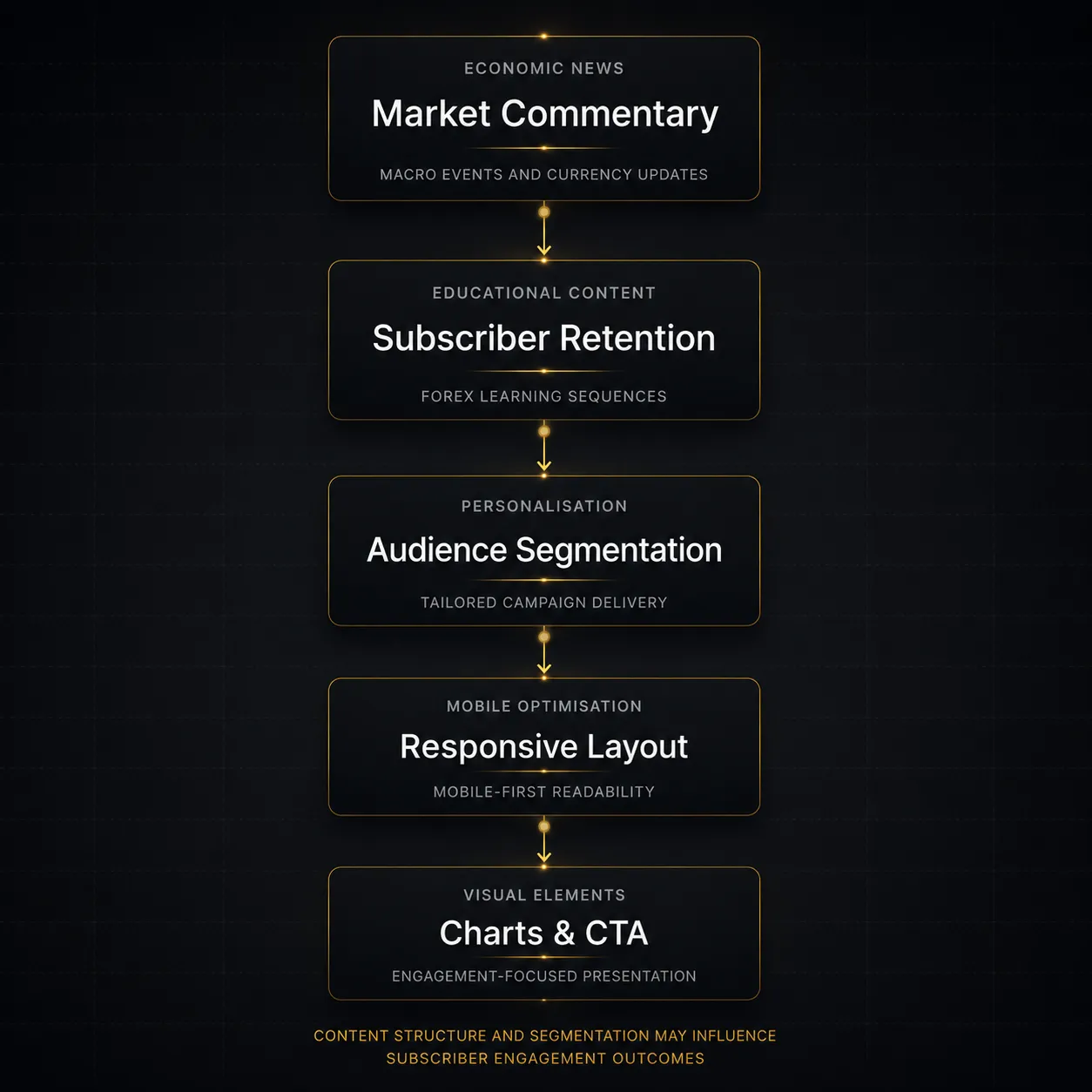
Economic News and Currency Market Commentary
Macroeconomic event coverage is a high-engagement content category within forex marketing campaigns. Central bank interest rate decisions, non-farm payroll data releases, and geopolitical developments affecting currency markets are among the topics that may generate elevated open rates among financially motivated subscribers. Using an economic calendar as a structural guide for newsletter planning is a widely documented practice in financial publishing.
Educational Forex Content for Subscriber Retention
Beginner and intermediate trading education is frequently integrated into forex affiliate sequences to extend engagement cycles. Content areas such as understanding leverage, interpreting candlestick patterns, or comparing account types may appeal to newer trading audiences. Educational content may also reduce subscriber churn by establishing the marketer as a trusted knowledge source. The best results in terms of retention are often achieved when educational topics are sequenced logically rather than distributed randomly.
Personalisation and Segmentation
Segmentation and personalisation involve tailoring content delivery to align with subscribers’ needs and interests. The ability to segment your list based on subscriber characteristics is one of the key advantages of direct communication channels over paid advertising. Common segmentation variables include:
- Geographic region and associated regulatory environment
- Declared trading experience level (beginner, intermediate, advanced)
- Platform or broker interest expressed during sign-up
- Engagement behaviour, such as click-through history on prior campaigns
To tailor your content to meet the expectations of different audience segments, many affiliates maintain separate lists or tagged sub-segments within their marketing software. This approach may improve open and click-through rates meaningfully compared with unsegmented broadcast campaigns.
Mobile-Friendly Content in Financial Niches
A significant proportion of opens in financial niches occur on mobile devices, making responsive design a practical consideration for forex affiliate campaigns. Subject lines that display fully on mobile screens, concise preview text, and single-column layouts are design elements commonly associated with improved mobile engagement. Mobile readability may also influence conversion pathways, as subscribers clicking tracking links from mobile devices may encounter different landing page experiences depending on broker platform optimisation.
Visual Elements in Forex Marketing Campaigns
Visual components may include currency pair performance charts, infographic summaries of economic data, and call-to-action (CTA) buttons linking to broker registration pages or educational resources. Chart imagery and market snapshots can contextualise written commentary, potentially improving subscriber engagement for visually oriented audiences. CTA placement is often tested through A/B methodologies, with above-the-fold positioning and contrasting button colours frequently cited as engagement-influencing design variables.
Automation in Forex Affiliate Campaigns
Automation infrastructure is a defining feature of scalable forex affiliate operations. Automated workflows allow marketers to manage large subscriber bases across multiple geographic regions and broker partnerships without proportional increases in manual effort. Choosing the right email marketing software and configuring it effectively is generally considered one of the highest-leverage decisions an affiliate team can make when scaling operations.
Automated Onboarding Sequences
Automated onboarding sequences introduce new subscribers to the marketer’s content ecosystem through pre-built series triggered by sign-up activity. These sequences may distribute educational materials across several days or weeks, presenting broker partnerships progressively rather than immediately upon subscription. Effective marketing automation is designed to build familiarity and trust before conversion-oriented communications are introduced.
Behaviour-Based Segmentation
Behaviour-based segmentation classifies subscribers according to their engagement patterns and website interactions. A subscriber who consistently opens content about a specific currency pair may be moved into a targeted segment for related broker promotions. Click behaviour on educational content may signal readiness for more advanced platform comparisons. These segmentation signals are typically processed by email marketing software with audience analytics capabilities, enabling affiliates to improve their campaigns continuously.
CRM Integration in Forex Affiliate Operations
Customer relationship management (CRM) systems connected to sending platforms allow forex affiliates to track subscriber journeys across multiple touchpoints. Integration between sending infrastructure, broker affiliate tracking dashboards, and CRM databases may enable attribution of campaign-initiated conversions to specific sequences. This data infrastructure supports performance analysis and helps the affiliate team identify which content types and segments generate the strongest conversion rates.
Triggered Campaigns in Trading Funnels
Triggered communications are automated messages sent in response to specific subscriber actions. Examples relevant to forex affiliate marketing include:
- Webinar reminder sequences sent after registration
- Follow-up campaigns triggered by clicks on broker comparison pages
- Inactivity notifications sent after prolonged periods without engagement
- Confirmation sequences following demo account sign-up referrals
Triggered communications are generally characterised by higher open rates than broadcast campaigns because they are contextually relevant to the subscriber’s most recent action, making them a particularly effective marketing channel within automated funnels.
Scalability of Automated Campaigns
Automation enables forex affiliate businesses to manage growing subscriber databases without linear increases in operational overhead. Campaigns targeting multiple regional audiences, broker partnerships, and content verticals may run simultaneously within a single email marketing software environment. Scalability considerations include list management infrastructure, deliverability monitoring across ISPs, and compliance verification for international subscriber bases.
Compliance and Regulations in Forex Marketing
Regulatory compliance is a foundational operational requirement for forex affiliate marketing rather than an optional consideration. The intersection of financial advertising standards, data privacy legislation, and anti-spam regulations creates a complex compliance environment for affiliates operating across multiple jurisdictions.
GDPR and Data Privacy
GDPR applies to any forex affiliate processing personal data of European Union residents, regardless of the marketer’s geographic location. Key requirements include obtaining explicit consent for commercial communication, providing clear information about data storage and usage, enabling subscribers to withdraw consent at any time, and maintaining records of consent for regulatory audit purposes. Non-compliance with GDPR can result in administrative fines of up to 4% of annual global turnover, as established by the European Data Protection Board.
Financial Advertising Restrictions
Financial regulators, including the Financial Conduct Authority (FCA) and the European Securities and Markets Authority (ESMA) impose restrictions on how financial products are promoted in marketing communications. Claims about trading returns, performance guarantees, and investment outcomes are subject to specific wording requirements. According to ESMA guidelines, approximately 70–89% of retail investor accounts lose money when trading CFDs — a statistic frequently required in communications involving leveraged product promotions.
Risk Disclosure Requirements
Marketing campaigns promoting broker services or trading products are typically required to include risk disclosure statements. These disclosures communicate the speculative nature of leveraged trading, the potential for losses exceeding initial capital, and the unsuitability of certain products for all investor types. The specific language and positioning of risk disclosures may vary by regulatory jurisdiction.
Anti-Spam Regulations
International anti-spam regulations establish baseline requirements for commercial communication. The CAN-SPAM Act requires accurate sender identification, clear opt-out mechanisms, and physical sender address disclosure. CASL in Canada requires express consent prior to sending commercial messages and prohibits misleading subject lines or sender information. Avoiding spam-triggering words like “sale,” “guaranteed returns,” or “risk-free” in subject lines is a commonly cited deliverability practice within financial marketing environments.
Broker Compliance Policies for Affiliate Partners
Regulated forex brokers typically maintain compliance review processes for partner marketing materials. Affiliates may be required to submit content templates for pre-approval before distribution, adhere to brand guidelines, and avoid performance claims not explicitly authorised by the broker’s compliance department. Broker compliance monitoring may also extend to post-distribution audits of partner communications to identify regulatory exposure.
Performance Metrics in Forex Affiliate Campaigns
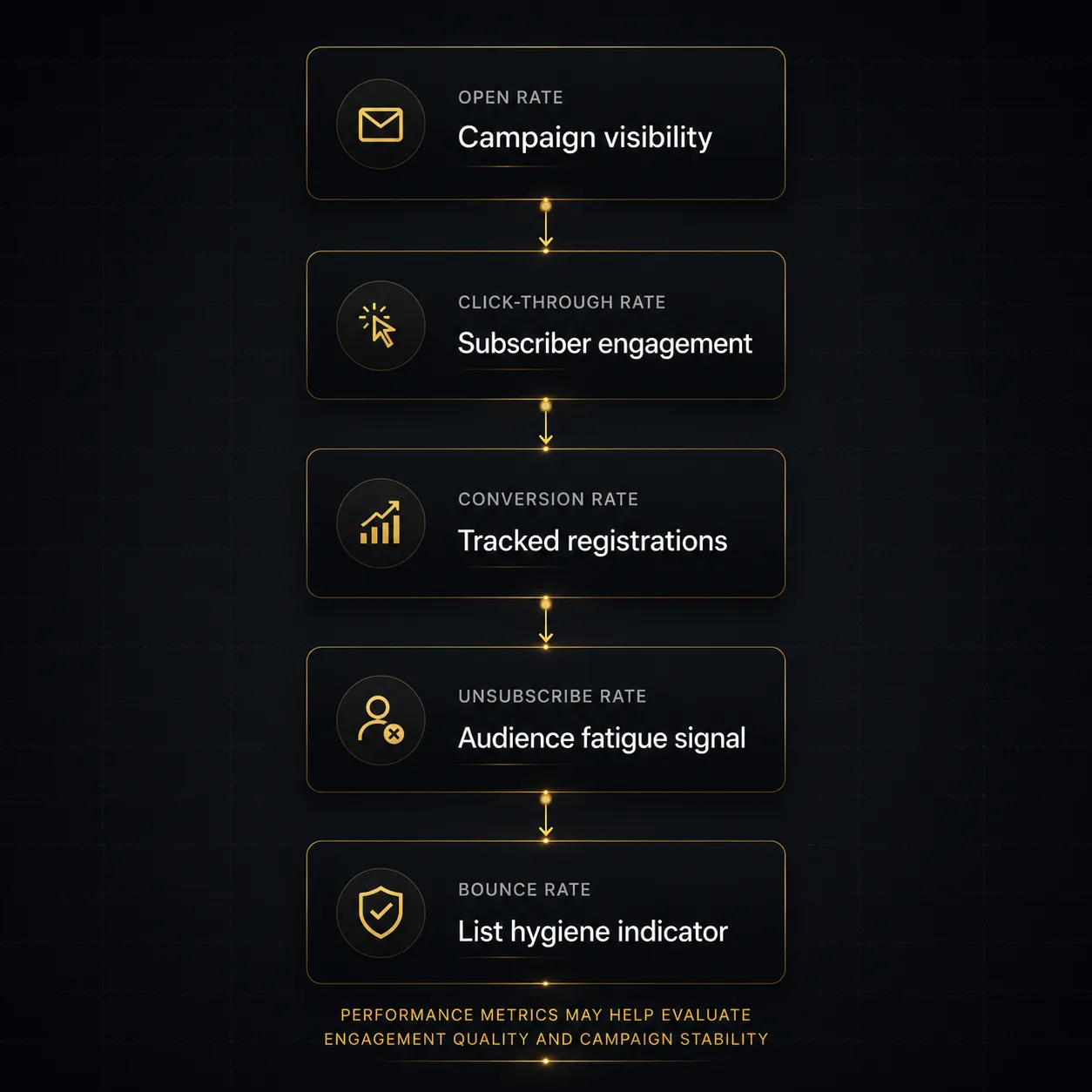
Performance measurement relies on a combination of engagement metrics, conversion attribution data, and list health indicators. Understanding the relationship between open and click-through rates, conversion rates, and list stability may inform campaign refinement decisions and help affiliates boost their earnings from trading-related promotions.
| Metric | Definition | Relevance in Forex Affiliate Context |
|---|---|---|
| Open Rate | Percentage of delivered campaigns opened | Indicates the subject line and sender reputation effectiveness |
| Click-Through Rate (CTR) | Percentage of openers who click a link | Measures content and offer engagement quality |
| Conversion Rate | Percentage of clicks resulting in a tracked action | Reflects landing page and broker offer alignment |
| Unsubscribe Rate | Percentage of subscribers opting out per campaign | Signals content relevance and audience fatigue |
| Bounce Rate | Percentage of undeliverable sends | Indicates list hygiene and data quality |
Open Rates in Financial Campaigns
Open rates in forex-related campaigns are influenced by subject line relevance, sender name recognition, and the timing of delivery relative to market events. The best days and times to send emails to trading audiences typically align with active market sessions, though optimal timing varies by geographic segment and content type. Average open rates in the financial services sector are frequently cited between 20–30%, with highly segmented lists sometimes achieving meaningfully higher results.
Click-Through Rates for Broker Promotions
Click-through rates on broker promotion campaigns reflect the degree to which content motivates subscribers to engage with tracking links. CTR performance may be influenced by the clarity of the value proposition, the relevance of the broker offer to the subscriber segment, and the placement and visual prominence of the CTA. Personalised content tailored to subscribers’ needs and interests is generally associated with higher CTR outcomes and improved chances of conversion compared with generic broadcast communications.
Conversion Tracking in Affiliate Funnels
Conversion tracking involves attributing specific actions — such as demo account registrations, live account openings, or first deposits — to originating campaigns. This attribution typically occurs through broker-provided tracking links that record click source data. The relationship between open and click-through rates and downstream conversion events helps affiliates assess campaign ROI and identify content or audience segments with the highest monetisation potential. For forex CPA models, accurate conversion tracking is essential for compensation reconciliation with broker partners.
Subscriber Retention and Unsubscribe Trends
Subscriber retention is a function of consistent content relevance, campaign frequency management, and audience expectation alignment. High unsubscribe rates following promotional campaigns may indicate a mismatch between subscribers’ needs and interests and delivered content. Segmentation strategies that differentiate educational subscribers from conversion-ready audiences may reduce friction between content types and lower unsubscribe pressure over time. Improving your relationship with your audience through consistent value delivery is generally considered the most sustainable approach to list stability.
A/B Testing in Forex Campaigns
A/B testing involves systematically varying individual elements to identify configurations associated with improved performance outcomes. Subject line testing is among the most commonly practiced forms of optimisation in direct subscriber communication, with variations in length, personalisation tokens, curiosity framing, and urgency signals evaluated for open rate impact. Layout, CTA placement, send timing, and content structure are additional test variables that may yield meaningful differences across segments. Successful email campaigns are typically the product of iterative testing rather than single-execution planning.
Email Marketing Platforms Used in Forex Affiliate Operations
The selection of an email provider may influence the operational capabilities available to a forex affiliate business, including automation depth, segmentation granularity, CRM integration, and deliverability management. Many platforms offer free email marketing tiers that allow smaller affiliate operations to start forex-related subscriber campaigns without upfront platform costs.
Mailchimp for Forex Affiliate Campaigns
Mailchimp is a widely referenced email marketing software platform that provides list management, campaign automation, audience segmentation, and performance analytics. Its accessible interface makes it a commonly used entry point for marketers establishing subscriber operations. Mailchimp’s automation workflows support drip sequence construction, behaviour-triggered campaigns, and audience tagging, which are relevant capabilities for trading-focused conversion funnels. A free email marketing tier is available for lists under a defined subscriber threshold, making it accessible for affiliates building an email list in the early stages of their marketing business.
GetResponse and Webinar Integration
GetResponse is an email marketing software platform that includes native webinar hosting functionality, making it particularly relevant for affiliates who use trading education events as subscriber acquisition channels. The integration between webinar registration and automation workflows within a single email provider environment may reduce operational complexity for affiliates running education-led lead generation campaigns.
ActiveCampaign for Subscriber Automation
ActiveCampaign is commonly associated with advanced automation capabilities, including conditional branching, multi-stage workflows, and granular subscriber behaviour tracking. These features may support sophisticated segmentation strategies within forex affiliate operations, allowing marketers to deliver tailored content pathways based on individual engagement histories and improve their campaigns based on behavioural data.
HubSpot and CRM-Based Operations
HubSpot combines sending infrastructure with CRM functionality, enabling affiliates to track subscriber journeys, manage lead pipelines, and attribute campaign-originated conversions within a unified platform. The CRM integration may be particularly relevant for introducing brokers managing direct client relationships alongside broader audience communication strategies. HubSpot’s marketing plan tools and reporting dashboards are frequently cited as advantages for affiliate teams managing multiple broker partnerships simultaneously.
Self-Hosted Infrastructure in Forex Niches
Some high-volume forex affiliates operate self-hosted sending infrastructure to maintain direct control over deliverability, data privacy, and sending costs. Self-hosted systems using platforms such as Postal, Mautic, or Sendy allow affiliates to avoid per-subscriber pricing constraints associated with third-party email providers. However, self-hosted infrastructure requires technical expertise in authentication configuration (SPF, DKIM, DMARC), IP reputation management, and ISP relationship maintenance. This approach is generally considered appropriate for established affiliate teams with technical resources rather than those in the early stages of building subscriber operations.
Challenges in Forex Affiliate Marketing via Direct Subscriber Channels
The operational and strategic challenges facing forex affiliate marketers reflect the intersection of a competitive niche, a regulated promotional environment, and an audience that may be exposed to multiple competing communications simultaneously.
Deliverability in Financial Niches
Deliverability in forex-related marketing campaigns is frequently affected by the presence of financial terminology, promotional language, and tracking link patterns that may trigger spam filters across major ISPs. Avoiding spam-triggering words like “sale,” “guaranteed,” or “risk-free” in subject lines is a foundational deliverability practice. Maintaining clean sender reputation scores, using authenticated sending domains, and monitoring inbox placement rates across major clients are commonly associated practices within financial publishing.
Competition Among Forex Affiliate Campaigns
The forex affiliate space is characterised by a high volume of competing campaigns targeting similar audiences. Subscribers interested in trading education or broker services may receive communications from multiple marketers simultaneously, contributing to inbox saturation and reduced engagement rates. Differentiation through content quality, subject line originality, and niche audience targeting may influence subscriber engagement in competitive list environments. Building an email list with genuine educational value at its core is often cited as a distinguishing factor for affiliates achieving long-term marketing success.
Build Trust With Trading Audiences
Trust is a defining factor in the long-term effectiveness of forex affiliate subscriber communication. To build trust with a trading audience, affiliates generally need to maintain consistency between educational positioning and promotional content, ensure that broker-related claims align with regulatory compliance standards, and avoid overstating potential trading outcomes. Subscribers who perceive promotional content as misleading or inconsistent with prior educational communications may disengage or report campaigns as spam, damaging both deliverability and long-term affiliate sales potential.
Regional Restrictions in Forex Campaigns
Geographic differences in broker regulatory status, permitted financial products, and advertising standards create complexity for affiliates managing internationally distributed subscriber lists. Certain broker promotions may not be permissible in specific jurisdictions, and segmenting lists by region may be necessary to ensure that promotional content reaches only eligible audiences. Regulatory environments in the European Union, the United Kingdom, Australia, and North America each present distinct compliance requirements for forex-related subscriber marketing.
Balancing Educational and Promotional Content
The structural tension between educational value and promotional intent is a persistent operational challenge for forex affiliate marketers. Subscriber acquisition campaigns often position the marketer as an educational resource, while revenue generation depends on broker promotion and referral conversion. Maintaining this balance across sequences, particularly as subscriber lists grow and audience expectations diversify, may require ongoing content strategy review and segmentation refinement. A marketing plan that explicitly allocates content proportions between educational and promotional material may help affiliates manage this tension systematically.
Email Marketing as a Long-Term Asset in the Forex Affiliate Ecosystem
Using email marketing as a long-term strategic asset within the forex affiliate ecosystem requires consistent investment in content quality, list hygiene, compliance infrastructure, and platform capability. For forex affiliate marketers and introducing brokers, subscriber list development represents a durable business infrastructure investment. An email list allows affiliates to communicate directly with their audience at any point, independent of algorithm changes, platform policy shifts, or paid acquisition cost fluctuations.
Effective email marketing in forex contexts is built on the convergence of educational content, broker partnerships, automation technology, and compliance-aware communication. Affiliate marketing success in this channel is generally associated with marketers who treat their subscriber relationships as long-term assets rather than short-term conversion targets.
As the forex industry continues to evolve, with expanding digital asset markets, shifting regulatory landscapes, and emerging personalisation capabilities within email marketing software, direct subscriber communication is likely to remain a significant component of the affiliate communication toolkit. The foundational principles of subscriber value delivery, transparent promotional practice, and data-driven campaign refinement are expected to retain their relevance regardless of technological changes in the broader marketing environment.
FAQ
What is email marketing in forex affiliate marketing?
Email marketing in forex affiliate marketing refers to the practice of communicating directly with a subscriber base through structured campaigns to educate, engage, and inform audiences about broker services, trading concepts, and market developments. Forex affiliate marketers use direct subscriber communication as a primary channel for distributing newsletters, broker promotions, educational content, and webinar invitations. Unlike social media or paid advertising, this communication occurs within a marketer-controlled environment, making it a structurally distinct component of a comprehensive affiliate marketing plan.
Why do forex affiliates use subscriber campaigns?
Forex affiliates use subscriber campaigns primarily because the channel supports ongoing engagement beyond single-session interactions. Direct communication allows affiliates to maintain recurring contact with trading-interested audiences, build familiarity with broker partnerships over time, and distribute educational content that may establish the marketer as a credible resource. The measurability of open and click-through rates and conversion attribution data also provides affiliates with performance insights that can inform continuous campaign improvement.
Which platforms are commonly used by forex affiliates?
Commonly referenced email marketing software platforms within the forex affiliate space include Mailchimp, GetResponse, ActiveCampaign, HubSpot, and Klaviyo. Platform selection is generally influenced by automation capability, CRM integration depth, deliverability infrastructure, and pricing structures relative to list size. Some platforms offer free email marketing tiers that allow smaller affiliate operations to start forex-related subscriber campaigns without upfront platform investment, making them accessible for marketers at earlier stages of building subscriber operations.
Are forex affiliate campaigns regulated?
Forex affiliate subscriber campaigns are subject to multiple layers of regulation, including data privacy legislation such as GDPR and CASL, anti-spam regulations such as CAN-SPAM, and financial advertising standards enforced by regulators including the FCA and ESMA. These regulations may impose requirements on subscriber consent collection, opt-out mechanisms, risk disclosure language, and the accuracy of promotional claims. Broker compliance policies may add further requirements for affiliates distributing broker-related marketing content.
What types of content appear in forex marketing campaigns?
Forex marketing campaigns typically include a range of content types reflecting the educational and promotional objectives of affiliate operations. Market update newsletters covering economic events and currency developments represent a high-engagement content category. Educational sequences address trading terminology, platform functionality, and market mechanics for newer trading audiences. Broker promotion campaigns highlight account types, trading platforms, and onboarding resources, while webinar invitations are used to drive event registrations. Re-engagement campaigns may feature updated content or relevance-based subject lines targeted at inactive subscribers.