Forex affiliate marketing represents one of the most established performance-based distribution models in the online trading industry. Brokers, trading educators, media publishers, financial comparison platforms, and content creators commonly participate in these ecosystems by directing audiences toward regulated trading services in exchange for compensation tied to measurable outcomes. The structure of these partnerships varies considerably depending on the audience type, geographic market, and the regulatory frameworks that govern financial advertising in each jurisdiction.
Promotional methods observed across the industry range from long-form educational content and search engine optimization to social media channels, email newsletters, and paid advertising campaigns. Each channel carries distinct characteristics in terms of traffic quality, compliance requirements, and audience intent. Understanding how these channels function conceptually may provide useful context for those studying the mechanics of digital distribution in financial services markets.
Forex Affiliate Marketing Landscape
The forex affiliate marketing landscape encompasses a wide range of partnership models, traffic acquisition channels, and compensation structures. Brokers typically operate formal affiliate programs that allow registered partners to direct prospective clients to trading platforms in exchange for commissions tied to client activity. The structure of these programs, and the methods used to promote them, can vary considerably based on geography, regulatory environment, and the experience level of the target audience.
Forex Referral Programs vs Forex Affiliate Programs
Referral programs and affiliate programs are structurally related but functionally distinct within forex marketing ecosystems. A referral program typically involves an existing client recommending a broker to a personal contact, with compensation often tied to the referred party completing a registration or making a deposit. Traditional forex affiliate programs, by contrast, are formal commercial arrangements where third-party publishers, introducing brokers (IBs), or content creators receive compensation for directing traffic at scale.
Compensation structures commonly associated with forex affiliate programs include:
- Cost Per Acquisition (CPA): A fixed payment is made when a referred user completes a defined action, such as registering and funding an account.
- Revenue share: The affiliate receives a percentage of the spread or commission generated by the referred client over time.
- Hybrid models: A combination of an upfront CPA payment and an ongoing revenue share arrangement.
- Sub-IB structures: Introducing brokers may recruit additional partners beneath them, earning a portion of the commissions generated by their sub-partners’ referred clients.
Partner tracking systems typically assign each affiliate a unique identifier used to attribute incoming traffic to the correct source for commission calculation purposes.
Role of Affiliate Links in Client Acquisition
Affiliate links function as the technical bridge between a publisher’s audience and a broker’s registration or landing page. Each forex affiliate link is a unique tracking URL that encodes the partner’s identifier, enabling brokers to attribute incoming registrations, deposits, or trading activity to the correct affiliate account. Cookies, session tokens, and server-side tracking methods are commonly used to maintain attribution across user sessions.
Landing pages associated with affiliate links may be provided by the broker or created independently by the affiliate, depending on the terms of the partnership. Attribution windows — the period during which a click on an affiliate link can be credited to a conversion — vary by program, with some brokers offering windows of 30, 60, or 90 days. The choice of attribution model can significantly affect the measured performance of affiliate campaigns.
Types of Forex Affiliate Traffic Sources
Forex affiliate traffic is generated through a broad spectrum of digital channels, each with distinct characteristics in terms of audience intent and conversion potential.
| Traffic Source | Primary Format | Audience Intent Profile |
|---|---|---|
| SEO content websites | Long-form articles, broker reviews | Informational to commercial |
| YouTube channels | Video reviews, market commentary | Mixed; educational and comparative |
| Telegram communities | Pinned posts, channel descriptions | High engagement; variable intent |
| Email newsletters | Market summaries, educational content | Subscriber-based; relationship-driven |
| Paid search (Google Ads) | Sponsored search results | High commercial intent |
| Social media (Meta, TikTok, X) | Short-form content, posts | Primarily awareness and education |
| Trading forums and Reddit | Community discussions, broker threads | Peer-driven; research-oriented |
| Comparison platforms | Feature tables, account reviews | Commercial intent; late-stage research |
Traffic quality is commonly assessed by conversion rate, the ratio of clicks to completed registrations, and the lifetime trading volume generated by referred clients. Informational traffic, such as visitors reading general educational content, may demonstrate lower immediate conversion rates compared to traffic from audiences actively researching specific brokers or account types.
Regulatory Considerations in Forex Promotion
Financial advertising in the forex sector is subject to regulatory oversight in most jurisdictions where retail trading is permitted. Regulators such as the Financial Conduct Authority (FCA) in the United Kingdom, the European Securities and Markets Authority (ESMA) across the European Union, and the Australian Securities and Investments Commission (ASIC) publish guidelines governing how financial products may be advertised to retail audiences.
Key compliance considerations commonly associated with forex affiliate promotion include:
- Mandatory risk disclosures, including standardized warnings such as those required under ESMA guidelines, which indicate that approximately 70–89% of retail investor accounts lose money when trading CFDs.
- Restrictions on performance claims, testimonials, and implied return projections.
- Requirements to clearly identify promotional content as such, distinguishing it from independent editorial material.
- Jurisdiction-specific rules governing which financial products may be advertised to retail audiences in specific regions, including restrictions on leverage levels and product availability.
Affiliates operating in regulated environments may be required to obtain authorization from financial regulators in certain jurisdictions before distributing financial promotions, depending on the nature and reach of their content.
SEO Strategies for Forex Affiliate Links
Search engine optimization plays a central role in the long-term traffic acquisition strategies of many forex affiliate publishers. Organic search visibility allows content to generate consistent traffic over time without the ongoing cost associated with paid advertising. Understanding the structural and content-based factors that influence search rankings is commonly considered foundational knowledge in this space.
Forex SEO Content Structure
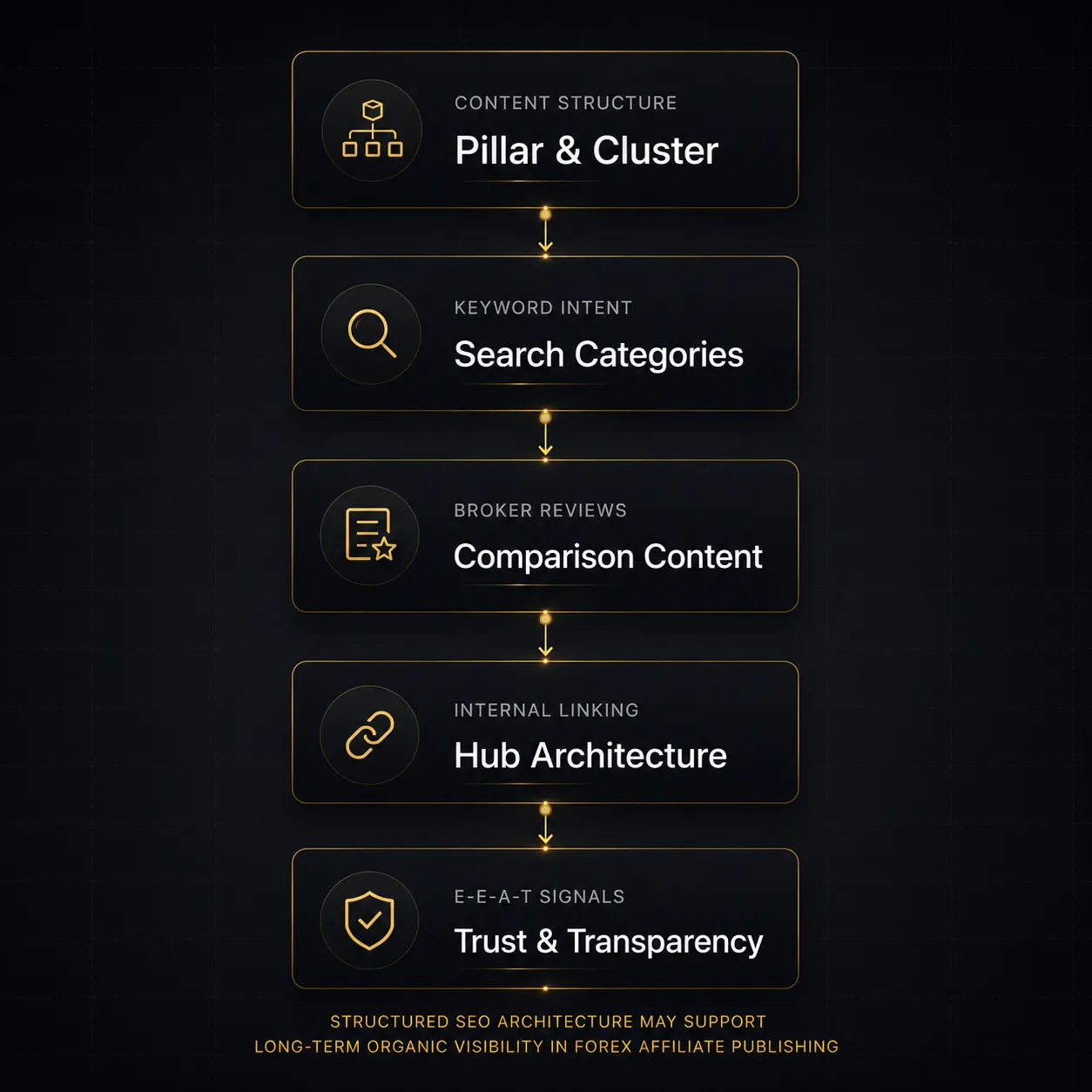
Forex affiliate websites commonly organize content around topic clusters designed to capture search traffic at multiple stages of the research process. Pillar pages covering broad themes — such as “forex trading explained” or “best forex trading strategies” — are often supported by more specific cluster articles addressing narrower questions. This structural approach may improve both search engine crawlability and user navigation through a publisher’s content ecosystem.
Keyword Clusters for Forex Affiliate Content
Keyword research in the forex affiliate space generally involves three categories of search intent:
- Informational intent: Queries such as “what is a pip” or “how does leverage work in forex” reflect audiences seeking educational content. These queries typically demonstrate lower immediate commercial value but may contribute to audience development.
- Commercial intent: Queries such as “best forex broker for beginners” or “IC Markets vs Pepperstone comparison” indicate an audience actively evaluating options, often associated with higher conversion potential.
- Navigational intent: Queries targeting specific brands, such as a broker’s name combined with “review” or “login,” reflect users already familiar with the service.
Long-tail keyword variations — phrases with lower search volume but more specific intent — are often targeted by affiliate publishers because competition from large financial publishers may be comparatively lower.
Broker Review Pages and Comparison Content
Broker review pages represent one of the most common content formats in forex affiliate publishing. A well-structured review typically examines:
- Regulatory status and licensing jurisdictions
- Account types and minimum deposit requirements
- Trading platform availability (MetaTrader 4, MetaTrader 5, cTrader, proprietary platforms)
- Spread and commission structures across major currency pairs
- Leverage limits applicable in relevant regions
- Deposit and withdrawal methods and processing times
- Customer support availability and quality
Comparison tables allowing readers to evaluate multiple brokers across standardized criteria are commonly associated with high commercial intent and may be favored by search engines for queries with clear comparative intent.
Internal Linking in Forex Affiliate Websites
Internal linking structures contribute to both user navigation and search engine understanding of a site’s topical authority. Affiliate publishers commonly implement hub-and-spoke or pillar-cluster architectures in which a central overview page links to a series of supporting articles covering related sub-topics. This approach may help distribute authority signals across the site and improve the discoverability of lower-traffic pages that serve specific audience segments.
E-E-A-T Signals in Financial Affiliate Content
Google’s Search Quality Evaluator Guidelines place particular emphasis on Experience, Expertise, Authoritativeness, and Trustworthiness (E-E-A-T) for content in the “Your Money or Your Life” (YMYL) category, which encompasses financial content. Forex affiliate publishers may seek to demonstrate E-E-A-T through:
- Named author profiles with verifiable credentials or trading experience
- Transparent disclosure of affiliate relationships and compensation arrangements
- Citations of regulatory sources and statistical data
- Clearly identified company information, editorial policies, and contact details
- Prominent risk disclosures consistent with applicable regulatory requirements
Content Marketing for Forex Affiliate Promotion
Content marketing represents the primary organic distribution method for most forex affiliate publishers. The range of content formats used spans educational articles, market commentary, visual media, and localized multilingual publishing, each serving different audience segments and discovery pathways.
Educational Trading Articles
Educational articles covering fundamental forex concepts — currency pair structures, pip calculation, margin requirements, order types, and trading session mechanics — are commonly produced by affiliate publishers to attract audiences at the early stages of their research process. These articles may serve as entry points that introduce readers to the publisher’s broader content ecosystem before directing traffic toward broker comparison or review content.
Forex News and Market Analysis Content
News-driven content, including economic calendar summaries, central bank policy commentary, and technical analysis of major currency pairs, is commonly used to attract recurring visitors. Regular market commentary may support audience retention and increase the frequency of site visits, expanding the opportunity for affiliate link exposure across multiple sessions. Economic events such as Federal Reserve interest rate decisions, non-farm payroll releases, and European Central Bank announcements are frequently referenced in this content category.
Evergreen Forex Topics
Evergreen content covers themes that remain consistently relevant over time regardless of current market conditions. Common examples include:
- Explanations of leverage, margin, and how CFD trading works
- Overviews of different order types (market orders, limit orders, stop orders)
- Introductions to major, minor, and exotic currency pairs
- Descriptions of the difference between ECN, STP, and market-maker execution models
- Guides to trading platform features and functionalities
Evergreen content is generally associated with consistent long-term search traffic and may form the backbone of a forex affiliate site’s organic visibility strategy.
Visual Content for Forex Audiences
Visual content formats used within forex affiliate ecosystems include infographics illustrating market structure concepts, platform screenshots demonstrating interface features, annotated charts showing technical analysis principles, and video content covering broker walkthroughs or educational themes. Webinars hosted by affiliate publishers or in partnership with brokers may serve dual purposes of audience education and affiliate link promotion within a compliant framework.
Multilingual Forex Affiliate Content
The global nature of the forex market means that significant trading audiences exist across Asia, the Middle East, Latin America, and Africa. Publishers targeting these markets may produce localized content in languages including Arabic, Mandarin, Spanish, Portuguese, Malay, and Swahili, adapting not only the language but also regulatory context, payment methods, and broker availability relevant to each region.
Social Media Channels for Forex Affiliate Links
Social media platforms have become increasingly significant distribution channels within forex affiliate marketing, offering direct access to large audiences of retail traders, finance enthusiasts, and investment researchers. The format requirements, compliance constraints, and audience behaviors vary considerably across platforms.
YouTube Forex Content
YouTube represents one of the most established social media channels for forex affiliate promotion. Publishers commonly produce broker review videos, platform comparison walkthroughs, educational series covering trading concepts, and market commentary videos. Affiliate links are typically placed in the video description section, sometimes alongside partner disclosures. YouTube’s search functionality also enables longer-form content to generate ongoing organic discovery beyond the initial publication period.
TikTok and Short-Form Trading Content
Short-form video content on platforms such as TikTok has created a new category of forex-adjacent audience consisting primarily of younger retail-oriented viewers. Content in this format typically covers trading psychology themes, brief introductions to financial concepts, lifestyle content associated with trading, and platform demonstrations. The compliance environment for financial promotions on short-form video platforms remains subject to active regulatory scrutiny in several jurisdictions.
Telegram Communities and Forex Signals Groups
Telegram communities occupy a unique position in the forex affiliate ecosystem, functioning as high-engagement, direct-communication channels between publishers and their audiences. Affiliate links are commonly integrated into channel descriptions, pinned messages, and resource posts. Some Telegram channels focus on market signals, economic news, or educational content, with affiliate partnerships forming part of the channel’s monetization structure. Regulatory authorities in several jurisdictions have issued guidance concerning financial promotions distributed via messaging platforms.
X and LinkedIn for Forex Promotion
X (formerly Twitter) is commonly used for real-time market commentary, macroeconomic discussion, and industry networking among traders, analysts, and brokers. LinkedIn serves as a platform for B2B-oriented forex content, including institutional commentary, compliance updates, and partnership announcements relevant to introducing brokers and professional market participants. Affiliate link promotion on both platforms is subject to platform-specific advertising policies and applicable financial promotion regulations.
Reddit and Trading Forums
Community-driven forums such as Reddit’s r/Forex and r/algotrading host substantial discussions of broker experiences, platform performance, and market mechanics. Organic participation in these communities by affiliate marketers is subject to platform rules governing promotional content. User-generated broker reputation threads and experience reports may significantly influence the research process of prospective traders and can affect the visibility of affiliate publishers who are cited or referenced within these discussions.
Paid Traffic Methods in Forex Affiliate Marketing
Paid advertising offers affiliate marketers the ability to direct targeted traffic to broker landing pages or affiliate content without relying exclusively on organic search growth. However, the forex sector presents significant compliance and platform-policy challenges for paid traffic campaigns.
Google Ads for Forex Affiliate Campaigns
Google Ads restricts financial services advertising under its policies, requiring advertisers in many jurisdictions to obtain Google certification as a financial products and services advertiser. Forex-related keywords are among the most competitively priced in paid search, reflecting the high commercial value of converting a prospective trader. Landing page quality, relevance, and compliance with Google’s financial services policies are significant factors in campaign viability.
Native Advertising Platforms
Native advertising platforms, which distribute advertorial content across third-party publisher networks, are used by some forex affiliates to reach finance-oriented audiences in a format that blends with editorial content. Platforms such as Taboola and Outbrain have been used for this purpose, though finance-related campaigns on these networks are also subject to content and compliance review processes.
Social Media Advertising for Forex Offers
Meta Ads (Facebook and Instagram), TikTok Ads, and X Ads each operate distinct policies governing financial services advertising. Meta requires financial advertisers to hold applicable regulatory authorizations in target jurisdictions and prohibits certain promotional claims. These platform-level restrictions mean that paid forex affiliate campaigns on social media require careful compliance review before launch.
Key challenges commonly associated with paid forex traffic include:
- High cost-per-click in competitive keyword environments
- Ad account suspensions due to policy violations or flagged content
- Variable lead quality depending on targeting parameters and landing page alignment
- Jurisdiction-specific restrictions that may limit campaign reach in regulated markets
- Attribution complexity when multiple touchpoints precede a conversion
Retargeting Campaigns in Forex Marketing
Retargeting involves serving advertisements to users who have previously visited a website or engaged with a publisher’s content. In the forex affiliate context, retargeting may be used to re-engage visitors who viewed a broker comparison page without completing a registration. Audience segmentation based on pages visited, time spent on site, or content category consumed allows for more targeted follow-up messaging.
Risks Associated With Paid Forex Traffic
Paid forex affiliate campaigns carry compliance risks beyond standard advertising policy violations. Financial regulators may scrutinize promotional claims made in paid advertisements, including implied return projections and performance representations. Rising acquisition costs in competitive markets and the potential for ad accounts to be restricted or permanently suspended represent operational risks for affiliates relying heavily on paid traffic channels.
Email Marketing for Forex Affiliate Links
Email marketing remains a widely used channel in forex affiliate ecosystems, offering direct communication with an audience that has demonstrated prior interest through an opt-in action. The channel’s effectiveness is often attributed to the relatively high engagement rates of subscriber lists compared to social media audiences.
Forex Email Newsletters
Forex email newsletters typically combine educational content, market commentary, economic calendar summaries, and broker announcements within a structured periodic format. Weekly or daily publications are common, with affiliate links often integrated into broker feature spotlights, platform reviews, or promotional offers communicated on behalf of partner brokers. The informational content surrounding affiliate links may support higher engagement rates by providing genuine value to subscribers beyond the promotional element.
Lead Magnets in Forex Affiliate Campaigns
Lead magnets — resources offered in exchange for an email address — are commonly used to build subscriber lists in the forex affiliate space. Typical formats include:
- Downloadable trading glossaries or terminology guides
- Educational ebooks covering specific trading concepts or strategies
- Access to recorded webinars or educational video series
- Economic calendar tools or market analysis summaries
- Platform comparison checklists or broker selection frameworks
The quality and specificity of a lead magnet may influence both the volume of opt-ins generated and the relevance of the resulting subscriber list to forex-related affiliate offers.
Email Segmentation in Trading Niches
Subscriber list segmentation allows publishers to tailor email content to distinct audience groups based on factors such as geographic location, stated experience level, preferred trading instruments, or engagement history. A subscriber who has opened multiple emails about forex trading mechanics may respond differently to broker offers than one who engaged primarily with cryptocurrency-related content. Segmentation may improve the relevance of affiliate offer presentations and reduce unsubscribe rates resulting from content mismatch.
Compliance and Disclosure in Financial Emails
Financial email marketing is subject to data protection regulations, including the General Data Protection Regulation (GDPR) in the European Union and the CAN-SPAM Act in the United States. Mandatory requirements typically include clear unsubscribe mechanisms, sender identification, and honest subject lines. Emails containing affiliate links or financial promotions are generally expected to include clear disclosure of the commercial nature of the content and applicable risk warnings.
Automation Systems in Forex Affiliate Funnels
Automated email sequences are commonly used to deliver structured onboarding experiences to new subscribers. A typical forex affiliate automation sequence may begin with a welcome email and an educational resource, followed by content introducing the publisher’s broker recommendations over a series of follow-up messages. Engagement tracking — measuring open rates, click-through rates, and link-specific interactions — informs ongoing optimization of sequence timing and content.
Influencer and Community-Based Forex Promotion
Influencer partnerships and community-based distribution have become significant elements of the forex affiliate landscape, particularly for reaching younger retail audiences and building trust within established trading communities.
Forex Influencers and Trading Personalities
Forex influencers — individuals with established followings on platforms such as Instagram, YouTube, TikTok, and X — may participate in affiliate arrangements with brokers by creating content featuring platform walkthroughs, account opening demonstrations, or trading commentary. The perceived authenticity and subject expertise of an influencer may affect how affiliate recommendations are received by their audience. Regulatory guidance in several jurisdictions addresses the disclosure obligations of social media influencers promoting financial products.
Affiliate Partnerships With Trading Educators
Trading educators, who offer courses, mentorship communities, webinars, or market analysis subscriptions, represent a distinct affiliate partner category. Their audiences typically demonstrate higher engagement and subject interest than general finance audiences, which may be associated with higher conversion rates for broker referrals. Educators commonly integrate broker recommendations into their instructional content or position partner platforms as part of their recommended trading infrastructure.
Discord Communities and Trading Networks
Discord has emerged as a significant platform for organized trading communities, offering voice channels, structured discussion categories, and direct messaging capabilities. Some Discord communities have formalized affiliate arrangements with brokers, incorporating partner links into channel resources sections and promotional announcements. The community structure may also facilitate organic peer-to-peer discussion of brokers and platforms, indirectly supporting affiliate visibility.
Brand Trust in Forex Affiliate Promotion
Trust is frequently cited as a foundational element of sustainable affiliate performance in the forex sector. Publishers who clearly disclose affiliate relationships, present balanced assessments of broker strengths and weaknesses, and avoid exaggerated promotional claims may be associated with higher audience retention and repeat engagement. Regulatory bodies in several jurisdictions have increased scrutiny of financial content creators who present affiliate promotional content without adequate disclosure.
Reputation Risks in Trading Communities
Misleading promotional content, unsubstantiated performance claims, and the promotion of unregulated or low-quality brokers may generate negative reputational consequences within trading communities, where peer discussion and review sharing are common. Forum threads, social media responses, and third-party review platforms can amplify negative sentiment rapidly, affecting not only the affiliate’s credibility but also their organic search rankings through reduced engagement and increased bounce rates.
Common Challenges in Forex Affiliate Marketing
The forex affiliate sector presents a range of structural and operational challenges that affect the long-term viability of affiliate strategies. Understanding these challenges conceptually may help those studying the market form a more realistic picture of the competitive landscape.
High Competition in Forex Search Results
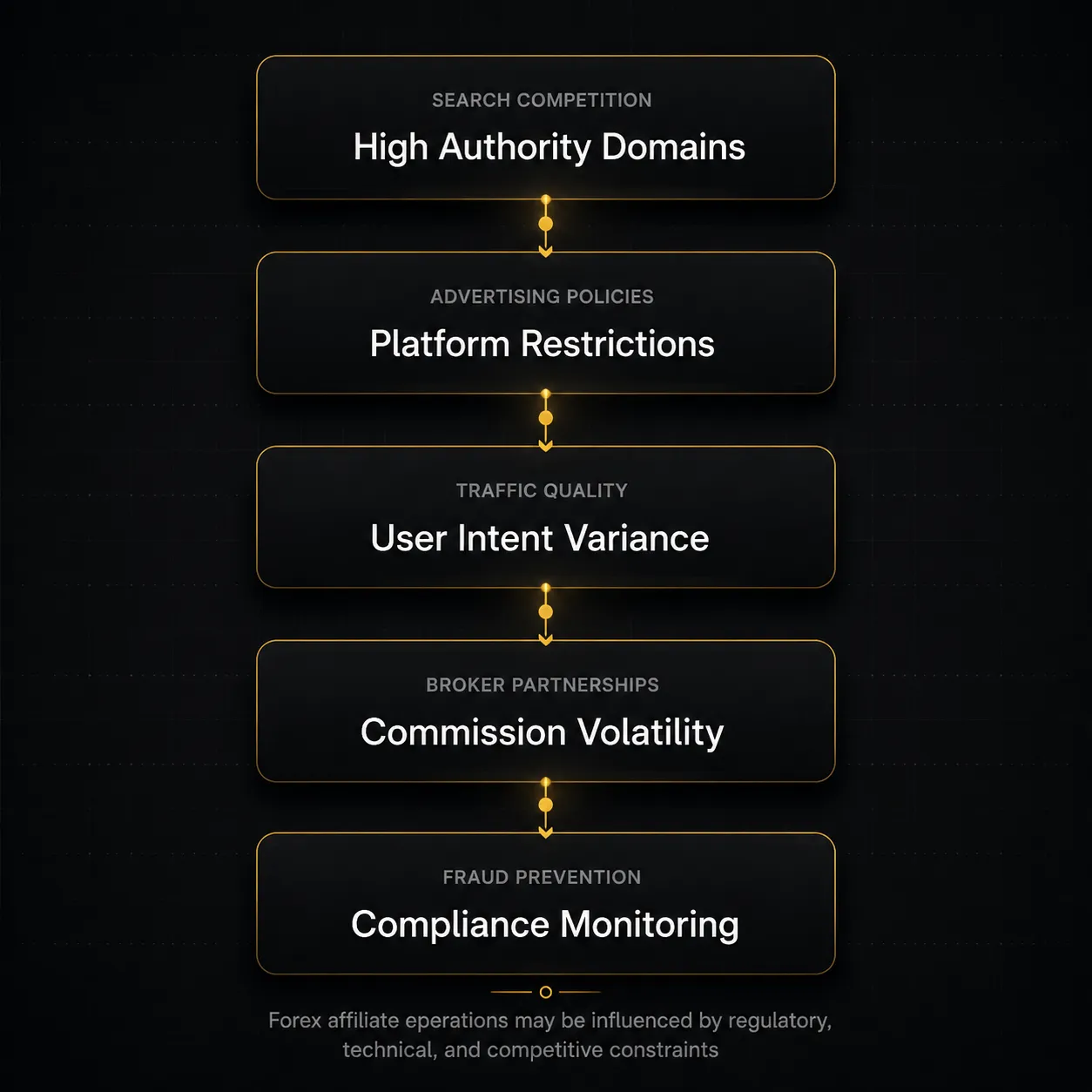
Organic search results for high-commercial-intent forex queries are often dominated by established financial publishers with significant domain authority, large content libraries, and substantial link profiles. Newer publishers may encounter difficulty achieving visibility for competitive terms and may pursue niche or long-tail keyword strategies as an alternative approach. The cost of producing the research, editorial, and technical content required to compete in this environment is considerable.
Changing Financial Advertising Policies
Platform advertising policies governing financial services promotions are updated periodically and may significantly affect the viability of paid traffic strategies with little advance notice. Broker affiliate programs may also change their terms, commission rates, or regional availability, creating uncertainty for affiliates who have built significant revenue dependence on specific partnerships.
Traffic Quality and User Intent
Not all traffic directed toward broker affiliate links reflects equivalent commercial intent. Informational visitors exploring general market concepts may demonstrate substantially lower conversion rates than visitors who arrive via specific broker-comparison or account-opening-related queries. Understanding the intent profile of different traffic sources may be relevant to managing affiliate campaign performance expectations.
Volatility of Broker Partnership Terms
Affiliate commission structures in the forex sector are not permanently fixed and may be adjusted by brokers in response to market conditions, regulatory requirements, or internal business decisions. Geographic restrictions may also be introduced or expanded, affecting the eligible territories from which referred clients can be credited. These structural uncertainties represent an inherent characteristic of performance-based affiliate arrangements in regulated financial markets.
Fraud Prevention and Compliance Monitoring
Forex affiliate programs typically employ fraud detection systems designed to identify click fraud, fake lead submissions, and incentivized traffic that does not reflect genuine trading intent. Sophisticated attribution systems may flag traffic patterns that deviate from expected behavioral norms. Affiliates operating in breach of program terms — whether intentionally or inadvertently — risk account suspension, commission forfeiture, and exclusion from future program participation.
The Evolving Role of Forex Affiliate Promotion
The forex affiliate marketing sector continues to evolve in response to changes in search engine algorithms, platform advertising policies, regulatory frameworks, and audience behavior. Key themes observed across the industry include the growing importance of E-E-A-T signals in financial content ranking, the increasing regulatory scrutiny of influencer-based financial promotion, the fragmentation of audience attention across multiple social platforms, and the continued relevance of organic search as a long-term distribution channel.
Key Takeaways About Forex Affiliate Promotion
- Forex affiliate marketing encompasses a broad range of distribution models, from SEO content publishing and paid advertising to community-based promotion and influencer partnerships.
- Compensation structures commonly include CPA, revenue share, and hybrid arrangements, with tracking managed through unique affiliate links and attribution systems.
- Regulatory compliance — including risk disclosures, clear identification of promotional content, and adherence to platform advertising policies — is a defining operational constraint in this space.
- Traffic quality, audience intent alignment, and partnership term stability are commonly cited as factors affecting the long-term performance of forex affiliate strategies.
- According to ESMA guidance, standardized risk disclosures indicating that 70–89% of retail CFD accounts lose money are a mandatory element of financial promotions in regulated jurisdictions.
Long-Term Role of Educational Financial Content
Educational content has consistently demonstrated long-term relevance within forex affiliate ecosystems by addressing the ongoing research needs of new market participants entering the trading space. Evergreen explanations of core trading concepts, regulatory environments, and platform mechanics may continue to generate organic search traffic independent of short-term market events. Publishers who combine genuine educational depth with transparent disclosure practices may be better positioned to sustain audience trust and search visibility over time compared to those relying primarily on promotional or trend-driven content.
FAQ
What Are Forex Referral Links?
A forex referral link is a unique tracking URL used to attribute new users to a broker or affiliate partner. When a qualified client registers or completes another verified action, the referral may generate commissions or other earnings for the partner. These links are widely used to promote forex services across websites, social media, and email campaigns. Tracking systems commonly rely on cookies or server-side attribution to measure marketing efforts accurately.
How Do Forex Affiliate Programs Work?
Forex affiliate programs are partnerships between brokers and publishers who promote forex platforms in exchange for performance-based compensation. Common structures include CPA affiliate models, revenue share agreements, and hybrid arrangements that combine both. Affiliates usually receive access to reporting dashboards, marketing materials, and campaign analytics. Earnings and earning potential often depend on traffic quality, audience engagement, and regional compliance standards.
Which Platforms Are Commonly Used for Forex Affiliate Promotion?
Promoting forex affiliate links commonly involves SEO websites, broker review portals, YouTube channels, social media platforms, and trading communities. Telegram, Discord, TikTok, Instagram, and X are frequently used to engage with your audience and distribute valuable content. Search engines remain a major source of long-term organic traffic for successful affiliate publishers. Paid advertising and email marketing may also support broader marketing efforts in competitive forex niches.
Are Forex Affiliate Programs Regulated?
Forex affiliate activity is regulated differently depending on the country and the type of financial promotion involved. In many jurisdictions, affiliates who promote forex brokers may need to comply with advertising standards or operate under authorized financial entities. Regulators such as the FCA, ESMA, and ASIC have issued guidance related to influencer marketing and digital financial promotions. Compliance requirements may vary significantly across international markets.
Why Is SEO Important in Forex Affiliate Marketing?
SEO may help forex affiliates generate consistent organic traffic without relying entirely on paid advertising. Many forex-related searches reflect strong research intent, especially for broker reviews, account comparisons, and platform analysis. Publishers that create valuable content and provide valuable insights may improve visibility and long-term audience trust. User experience, site structure, and topical authority are also commonly associated with stronger search performance.
Can Social Media Influence Forex Affiliate Traffic?
Social media platforms may play a significant role in promoting forex affiliate offers and expanding audience reach. YouTube and TikTok are widely used for educational videos, broker discussions, and market commentary, while Telegram and Discord support community engagement. Different platforms tend to attract different audience types and traffic behaviors. Regulatory policies and content moderation rules are also important considerations for affiliates operating on social channels.