Multi-Account Manager (MAM) systems represent a specialized layer of trading infrastructure used primarily by professional money managers, institutional participants, and introducing brokers operating within the forex and broader financial markets.
Unlike standard retail trading accounts, MAM architecture is designed to consolidate execution control while distributing trade outcomes across multiple client accounts simultaneously. Understanding the structural mechanics of MAM systems is relevant for anyone operating within managed account environments or evaluating brokerage technology for professional deployment.
What Is a MAM Account
The MAM account is a type of trading infrastructure that enables a single money manager to execute and allocate trades across multiple client accounts from one centralized master interface. MAM systems are commonly offered by forex brokers that serve professional and institutional clients, and they are typically built on established trading platforms such as MetaTrader 4 or MetaTrader 5.
Core Definition of MAM Account Structure
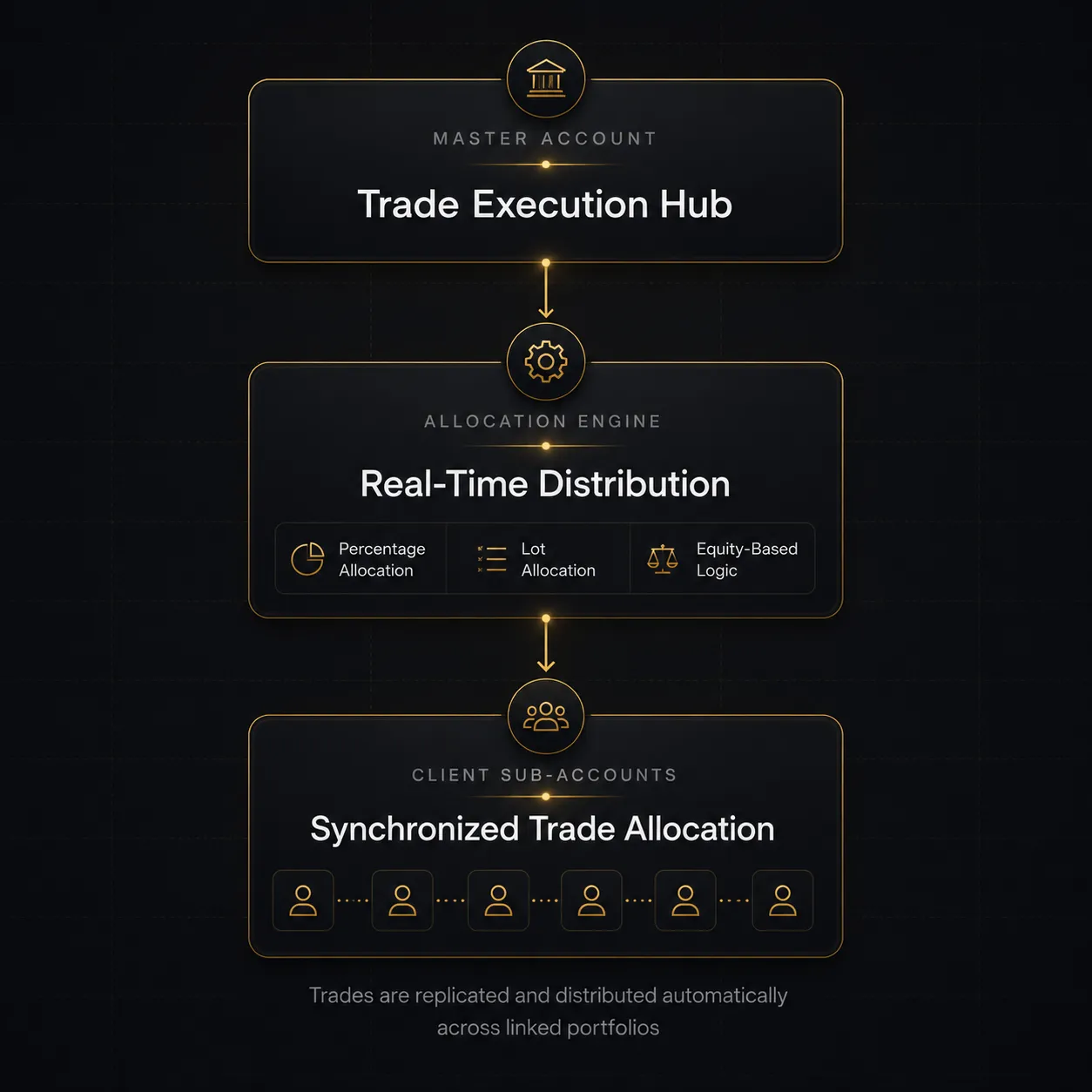
A MAM account is a type of managed trading structure where a fund manager operates a master account connected to multiple investor sub-accounts. The allocation module automatically distributes trade volume, profits, and losses across linked accounts according to predefined criteria such as balance, equity, or lot size. Unlike a standard individual trading setup, a MAM structure provides centralized trade execution instead of requiring separate management of each sub-account.
Key Purpose in Asset Management Environment
MAM systems are designed to reduce the operational complexity of managing multiple client portfolios simultaneously. Their main purpose is execution efficiency: a single order placed on the master account is automatically replicated and allocated across connected client accounts. This model is widely used in asset management, where handling trades through separate logins would create delays, inconsistencies, and higher operational risk.
How MAM Account Systems Operate
The operational mechanics of a MAM system involve a defined hierarchy of accounts connected through broker-level infrastructure. The system coordinates order generation, distribution logic, and real-time synchronization between the master account and all linked sub-accounts. Understanding how this flow functions is central to evaluating the system’s suitability for different management contexts.
- Trade execution originates exclusively from the master account interface.
- The allocation management module distributes volumes to sub-accounts in near real-time.
- Each sub-account may carry different allocation parameters based on configuration.
- Profits and losses are distributed proportionally or by fixed rules.
Master Account Role in Trade Execution
In a MAM system, the master account serves as the central execution hub from which all trading activity is initiated. When the manager places a trade, the system automatically replicates and allocates it across connected client portfolios according to the selected allocation model. The master structure does not directly hold client funds; instead, it functions as the operational interface used to manage trading strategies across the entire setup.
Sub-Account Allocation Mechanisms
Sub-accounts in a MAM system are individual client portfolios connected to the master structure through the broker’s infrastructure. Each one can be configured with different allocation settings, enabling the manager to apply specific lot sizes, percentage weights, or equity-based parameters based on the investor’s profile or agreement. The allocation module processes these settings automatically during execution, ensuring that every client receives the appropriate share of each trade without manual intervention.
Order Synchronization Across Accounts
Order synchronization in a MAM system refers to the near-simultaneous replication of trades from the master structure to all connected client portfolios. The system is designed to minimize execution latency across linked profiles, although timing may vary depending on broker infrastructure, server load, and overall trading volume. In practice, synchronization is largely automated, with the allocation module managing distribution logic in the background.
Key Features of MAM Account Models
MAM accounts are differentiated from standard managed account types by a combination of technical and structural features. These characteristics determine the flexibility available to money managers and the level of customization accessible to individual client accounts.
| Feature | Description |
|---|---|
| Flexible Allocation Methods | Supports lot-based, percentage-based, and equity-weighted distribution |
| Multi-Strategy Support | A single master account may manage different strategies across sub-accounts |
| Centralized Execution Interface | All trades originate from one master account dashboard |
| Individual Account Visibility | Sub-account holders may retain access to view their own account activity |
| Customizable Parameters | Allocation settings may be adjusted per sub-account |
Flexible Allocation Methods
MAM systems typically support multiple allocation frameworks that determine how trade volumes are distributed among client portfolios. Percentage-based models allocate trades according to each client’s balance or equity share within the total pool. Lot-based methods assign fixed or variable lot sizes regardless of capital differences. Equity-driven models automatically adjust allocations as balances fluctuate over time. The availability of these methods depends on the forex broker and the specific MAM platform being used.
Multi-Strategy Support Capability
In certain MAM configurations, a single master account may be structured to apply different trading strategies to different sub-accounts, depending on how the broker’s system supports segmentation. This flexibility is generally described as an advantage for fund managers operating diversified portfolios or serving clients with different risk profiles. The practical implementation of multi-strategy support is, however, dependent on the technical capabilities of the MAM system provided by the broker.
Execution Speed and Aggregation Logic
MAM systems are typically designed to aggregate orders from the master structure and distribute them across multiple client portfolios within a compressed timeframe. This aggregation process can reduce the number of individual orders handled by the broker’s infrastructure, helping maintain more consistent pricing across connected portfolios. The efficiency of this execution model is often considered a key technical advantage of MAM architecture over manual multi-portfolio management.
MAM Account vs PAMM Account Structures
Both MAM and PAMM (Percentage Allocation Management Module) account types represent managed frameworks used in forex trading environments, but they differ in their structural approach to allocation, investor control, and operational flexibility.
| Characteristic | MAM | PAMM |
|---|---|---|
| Allocation Method | Flexible (lot, percentage, equity) | Percentage-based pool allocation |
| Investor Account Control | Sub-accounts remain individually managed | Funds pooled into a single account |
| Allocation Transparency | Visible at individual account level | Reflected through pool performance |
| Manager Interface | Single master account with sub-account links | Single master account for entire pool |
| Typical Use Case | Managers with diverse client requirements | Managers with uniform strategy distribution |
Allocation Transparency Differences
The PAMM system pools investor capital into a shared account and distributes profits and losses based on each participant’s proportional share of the total pool. In a MAM account structure, individual client accounts remain separate and receive allocations independently, which may provide more granular visibility into how each account is affected by individual trades. This structural distinction is often considered relevant when evaluating the appropriateness of each model for different investor types and regulatory environments.
Investor Control Variations
In a PAMM structure, investor capital is commingled within a single pooled account, limiting individual investors’ ability to observe or adjust their specific allocation in real time. MAM systems, by contrast, may allow clients to retain access to their own portfolios, potentially providing greater transparency regarding trade activity and balance changes. The degree of investor access and control in either setup is ultimately determined by the broker’s platform configuration and the manager’s operational structure.
Operational Use Cases in Market Practice
PAMM accounts are commonly associated with scenarios where a money manager applies a uniform trading strategy to a broad group of investors. MAM accounts are generally described as more suitable for environments where individual customization is required — for example, when different clients have different leverage settings, allocation sizes, or strategy exposures. The selection between MAM and PAMM structures is often influenced by the manager’s operational requirements, the broker’s available infrastructure, and applicable regulatory considerations.
Allocation Models in MAM Systems
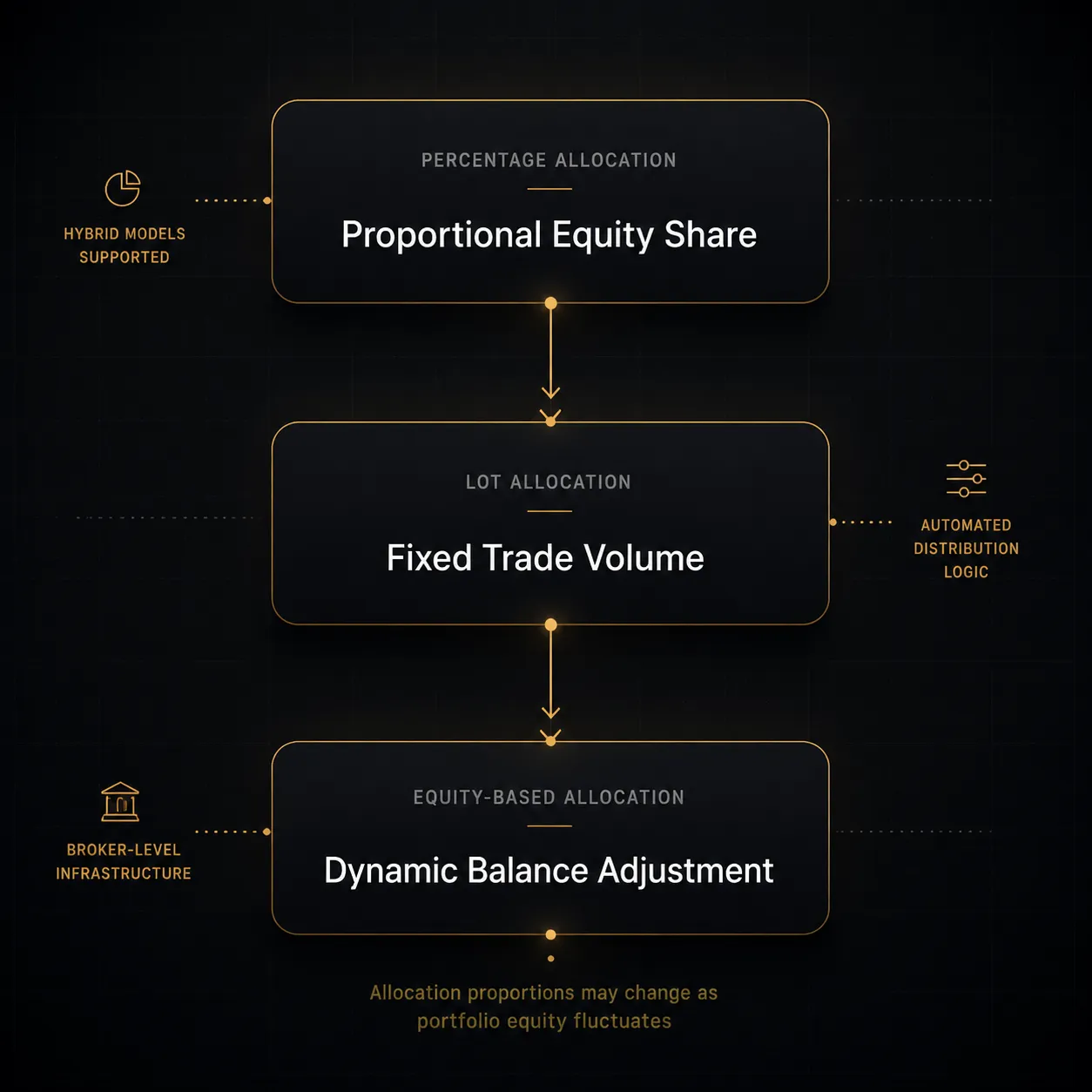
The allocation model embedded within a MAM system determines how trade volumes from the master account are distributed to individual sub-accounts at execution. Different models reflect different approaches to proportionality and are associated with distinct practical implications.
- Percentage allocation distributes trade volume proportionally to account equity or balance.
- Lot allocation assigns predetermined fixed or variable lot sizes to each sub-account.
- Equity-based allocation dynamically adjusts distribution as account balances change.
- Some MAM systems support hybrid models combining elements of multiple allocation approaches.
Percentage Allocation Model
The percentage allocation model distributes trade exposure from the master structure to client portfolios according to each investor’s share of the total managed capital. For example, if a client represents 10 percent of the combined equity pool, that portfolio would receive approximately 10 percent of every trade executed through the master structure. This method is commonly used when the manager wants to maintain proportional exposure across investors with different capital sizes.
Lot Allocation Model
The lot allocation model assigns a fixed number of lots to each sub-account independently of account balance. This method may be applied when uniform trade sizes are preferable across clients, or when specific contractual arrangements require consistent lot exposure regardless of equity fluctuations. The lot allocation model may be more straightforward to administer in terms of predictability, though it does not inherently adjust to changes in individual sub-account balances over time.
Equity-Based Allocation Model
Equity-based allocation dynamically recalculates trade distribution based on the real-time equity of each sub-portfolio. As balances change due to open profits, losses, or deposits, allocation proportions are updated accordingly. This model is generally considered more responsive to live portfolio conditions, though it may introduce variability in individual exposures during periods of high market volatility.
Participants in MAM Account Ecosystem
The MAM account ecosystem involves several distinct participant categories, each interacting with the system in a defined functional role. Understanding these roles is relevant for introducing brokers and institutional participants evaluating managed account infrastructure.
Money Managers’ Role in System
The money manager — often referred to as the account manager or fund manager — operates the master account and is responsible for placing trades and configuring the allocation parameters that govern how those trades are distributed to sub-accounts. In regulated environments, money managers operating MAM systems may be required to hold appropriate licensing or registration with relevant financial authorities, depending on the jurisdiction and the nature of their client relationships.
Investor Account Participation
Investors in a MAM system hold individual sub-portfolios linked to the manager’s master structure through the broker’s infrastructure. Each investor receives trade allocations based on parameters agreed with the money manager. Depending on the platform and setup, investors may retain the ability to monitor their own activity, request withdrawals, or modify certain settings independently of the manager.
Broker Infrastructure Support
The forex broker plays a central infrastructure role in enabling MAM functionality. Brokers offering MAM accounts typically integrate this system into their trading platform environment, providing the technical architecture for master account connectivity, sub-account linking, allocation management, and reporting. The robustness of the broker’s MAM infrastructure — including order routing capabilities, server reliability, and platform integration — directly influences the operational efficiency of the overall system.
Costs and Fee Structures in MAM Accounts
Fee arrangements associated with MAM accounts vary depending on the broker, the manager’s operational model, and the terms negotiated with individual clients. Understanding the general structure of these costs is relevant for both managers and investors evaluating managed account participation.
Performance Fee Arrangements
Performance-based fee models in MAM systems typically involve the money manager receiving a percentage of the profits generated within each sub-account over a defined period. These arrangements may be structured using a high-water mark principle, under which performance fees are only applicable when an account reaches a new equity high, thereby preventing fees from being charged on the recovery of previous losses. The specific terms of performance fee arrangements are generally established through bilateral agreements between the manager and the investor.
Management Fee Models
Some MAM account managers charge a periodic management fee calculated as a percentage of assets under management, regardless of performance outcomes. This fee model provides more predictable revenue for the manager but may not align fee compensation directly with trading results. Management fees are typically disclosed in client agreements and may be subject to regulatory requirements regarding fee transparency in certain jurisdictions.
Brokerage and Execution Costs
Execution costs within MAM environments include broker-charged spreads and commissions applied at the sub-account level. In some MAM structures, aggregated order execution may result in uniform spread conditions across all sub-accounts, while in others, costs may vary depending on account size, leverage settings, or broker tier arrangements. These transaction-level costs represent an ongoing component of total cost that may influence the net outcome for individual investors.
Risk Considerations in MAM Structures
MAM systems carry distinct risk characteristics that are relevant for both managers and investors. These risks arise from structural, operational, and market-level factors inherent in multi-account management environments. As with any leveraged trading environment, losses may exceed initial expectations, and past performance does not guarantee future results.
Allocation Risk Variability
Differences in allocation model configuration may produce varying outcomes across client portfolios even when the same master trades are executed. For example, setups using lot-based allocation may experience disproportionate exposure relative to their balance compared to those using percentage-based models. These allocation differences can result in materially different risk profiles across portfolios managed within the same MAM system.
Execution Latency Impact
Although MAM systems are designed for near-simultaneous order distribution, execution timing differences across sub-accounts can occur due to server processing speed, account volume, and broker infrastructure capacity. In fast-moving market conditions, even minor latency differences between sub-account fills may result in slightly different execution prices. This execution variability is generally a structural consideration rather than an outcome that can be entirely eliminated at the system level.
Market Volatility Exposure
All sub-accounts linked to a MAM master account share simultaneous exposure to the positions placed by the money manager. During periods of elevated market volatility, the risk to all connected accounts increases in parallel. Investors in MAM structures have limited ability to modify individual position exposure in real time, as trade execution is controlled by the manager through the master account interface.
Broker Role in MAM Infrastructure
The broker’s role in a MAM system extends beyond providing access to financial markets. Brokers offering MAM functionality provide the technical platform, connectivity, and operational tools necessary to support multi-account execution and reporting.
Platform Technology Integration
MAM functionality is commonly embedded within MetaTrader 4 (MT4) or MetaTrader 5 (MT5) environments through dedicated plugins or modules developed by the broker or third-party technology providers. The platform integration determines the range of allocation models available, the granularity of reporting accessible to managers and investors, and the overall system performance under high account-volume conditions.
Order Routing Systems
Brokers supporting MAM systems are responsible for routing aggregated orders from the master account to individual sub-accounts through their internal execution infrastructure. The quality and speed of this routing process can influence the consistency of fill prices across all linked accounts. Brokers operating under ECN or STP execution models may provide different routing characteristics compared to those using market-maker execution frameworks.
Account Monitoring Tools
Most MAM-enabled brokers provide managers and investors with reporting dashboards that display account performance, allocation history, open positions, and fee calculations. These tools are considered an important component of transparency within the MAM ecosystem, supporting both managerial oversight and investor visibility into account activity.
Regulation and Oversight of MAM Accounts
MAM accounts, as a form of discretionary money management, operate within regulatory frameworks that vary significantly by jurisdiction. Understanding the general regulatory context is relevant for both money managers considering MAM operations and investors evaluating managed account participation.
Regional Regulatory Framework Variations
Regulatory requirements governing MAM accounts differ across major financial jurisdictions. In the European Union, the management of client funds through discretionary systems is generally subject to the Markets in Financial Instruments Directive (MiFID II) framework, which establishes requirements for authorization, reporting, and client classification. In the United Kingdom, the Financial Conduct Authority (FCA) maintains oversight of investment management activities. In offshore financial centers commonly associated with forex broker registration, regulatory requirements may be less stringent, which introduces variation in investor protection standards across different operating environments.
Compliance Requirements for Managers
In regulated jurisdictions, money managers operating MAM systems are typically required to hold specific licenses or registrations that authorize discretionary management of client funds. The applicable requirements may include capital adequacy thresholds, professional qualification standards, record-keeping obligations, and client disclosure requirements. Managers operating without appropriate authorization in jurisdictions where such requirements apply may expose themselves and their clients to regulatory and legal risk.
Investor Protection Mechanisms
Regulated environments may provide certain structural investor protections for participants in managed account systems, including requirements for segregation of client funds, periodic performance reporting, and access to dispute resolution mechanisms. The degree of investor protection available within a specific MAM arrangement is largely a function of the regulatory status of both the broker and the money manager, as well as the jurisdiction under which services are provided.
Conclusion on MAM Account Structure
The MAM account represents a technically sophisticated managed account framework that addresses the operational requirements of money managers overseeing multiple client accounts simultaneously. Its core value lies in centralized execution control combined with flexible allocation logic, enabling a fund manager to apply trading strategies across a diverse client base from a single master interface. For professional participants evaluating managed infrastructure, the MAM system’s structural characteristics — including allocation model options, broker integration, regulatory context, and fee frameworks — are all relevant factors in assessing its appropriateness for specific operational and compliance requirements.
Frequently Asked Questions
How Does a MAM Account Differ from a Standard Trading Account?
A standard trading setup provides individual access to financial markets for a single trader or investor. A MAM structure, by contrast, connects a master trading interface operated by a money manager to multiple client portfolios simultaneously. The key structural difference is that the MAM setup enables centralized trade execution and automated allocation across many portfolios at once, while a standard setup is designed for single-user trading activity. MAM systems are specifically intended for fund managers who handle multiple client relationships through a single execution interface.
Who Typically Uses MAM Accounts?
MAM accounts are most commonly used by professional money managers, fund managers, proprietary trading operations, and introducing brokers who manage capital on behalf of multiple clients. Investors who prefer to allocate trading responsibility to an experienced manager may participate as sub-account holders within a MAM structure. The system is generally designed for participants with an understanding of managed trading structures, as individual investors in MAM setups cede day-to-day execution control to the manager in exchange for participation in their trading strategies.
What Makes MAM Systems Distinct from Other Managed Account Types?
The principal distinction of MAM systems relative to other managed structures, such as PAMM, lies in the flexibility of the allocation management module and the structural separation of individual client portfolios. Unlike PAMM systems, where funds are pooled into a single structure, MAM setups maintain separate sub-portfolios for each investor, allowing for more granular allocation customization and individual portfolio visibility. This approach is often described as providing greater flexibility for managers working with clients who have diverse equity sizes, risk preferences, or contractual requirements.
Can Investors Withdraw Funds from a MAM Sub-Account?
In most MAM account configurations, investors retain ownership of their individual sub-accounts and may request withdrawals directly from their broker, subject to the terms of their managed account agreement with the money manager and any applicable broker policies. The precise mechanics of withdrawal — including notice periods, processing timelines, and any conditions related to open positions — are generally governed by the agreement between the investor and the manager, as well as the forex broker’s operational procedures. Investors considering participation in a MAM structure are generally advised to review these terms carefully before committing capital.
How Are Profits and Losses Distributed in a MAM Account?
Profits and losses in a MAM system are distributed among client portfolios according to the active allocation model. In a percentage-based model, each portfolio’s result is proportional to its share of the total managed capital at the time of each trade. In a lot-based model, outcomes are determined by fixed lot sizes assigned regardless of balance differences. The exact distribution mechanics depend on the allocation model in use, the broker’s infrastructure, and the manager’s configuration settings for each portfolio.
What Should Introducing Brokers Consider When Offering MAM Accounts?
Introducing brokers evaluating MAM account products for their client base should consider several structural and compliance-related factors. These include the quality and technical capabilities of the forex broker’s MAM infrastructure, the range of allocation models supported, the reporting tools available for both managers and investors, and the regulatory framework applicable to discretionary managed account services in their jurisdiction. Additionally, introducing brokers operating in regulated environments may face their own disclosure and suitability obligations when facilitating client access to managed account systems. The reputational and operational risks associated with the money managers operating within the MAM structure are also commonly considered as part of a comprehensive due diligence process.