MAM (Multi-Account Manager) and PAMM (Percentage Allocation Management Module) are two distinct allocation technologies widely used within Forex money management environments. Both systems allow multiple investor accounts to connect to centralized trading activity managed by a single professional trader or portfolio manager.
Their growing adoption among institutional participants, introducing brokers (IBs), and passive investors reflects a broader demand for structured managed account solutions in global Forex markets. Although MAM and PAMM systems share a common purpose, they differ materially in execution logic, allocation methodology, operational flexibility, and investor customization potential. Understanding these distinctions is considered foundational knowledge for professional traders and brokers operating within managed account frameworks.
What MAM Accounts Mean in Forex
MAM accounts represent a category of managed trading infrastructure that enables a single money manager to execute trades across multiple linked investor sub-accounts simultaneously. The technology is deeply embedded within broker infrastructure and is commonly used by professional traders managing capital on behalf of multiple clients. MAM systems provide a centralized execution environment while distributing trade outcomes across connected accounts according to predefined allocation parameters.
Core Structure of MAM Technology
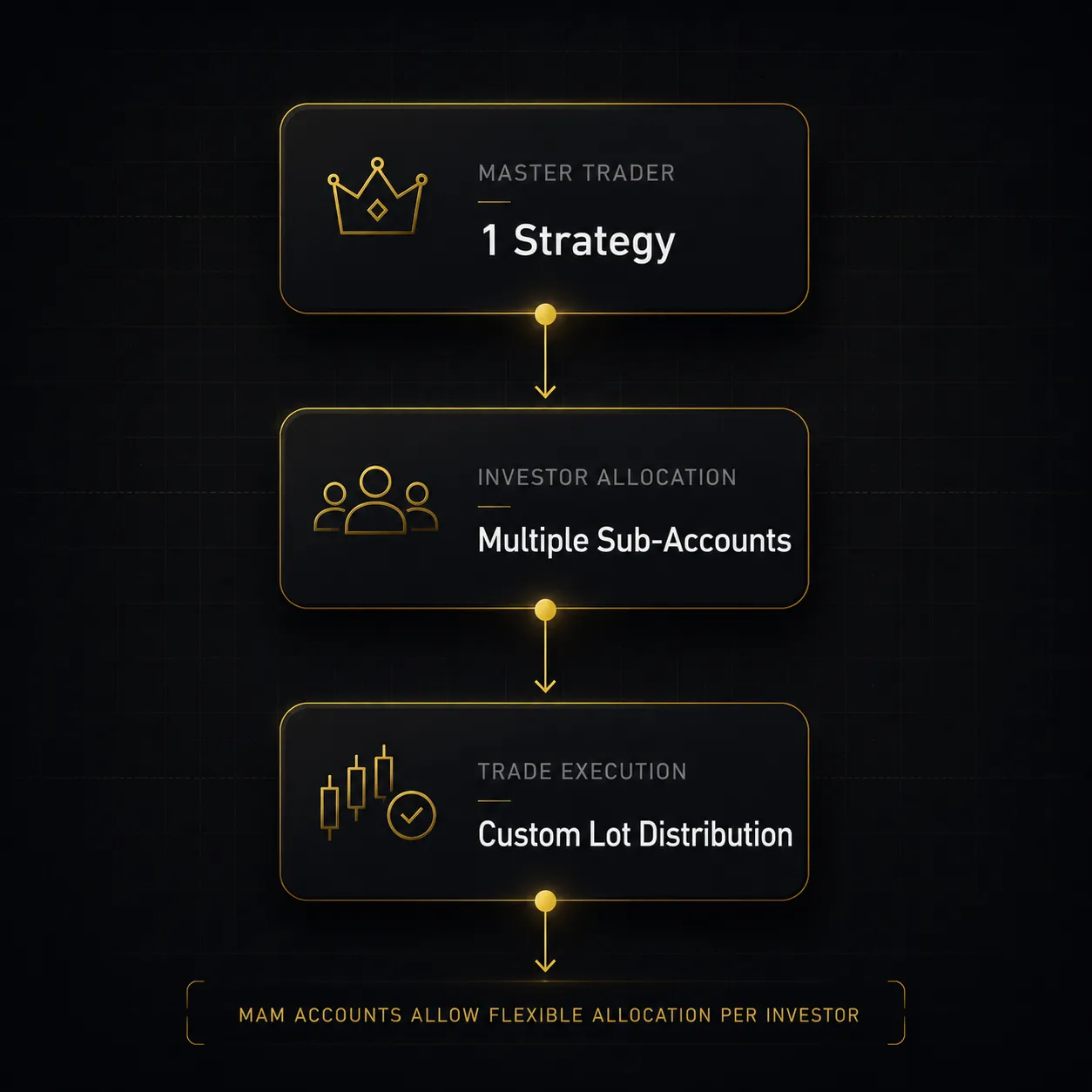
A MAM system operates through a master account from which all trading activity originates. Individual investor accounts are linked to this master account as sub-accounts. When the money manager executes a trade from the master account, the MAM system mirrors that activity across all connected sub-accounts based on the allocation method configured at the broker level. The master account does not pool funds; instead, each investor retains a separate, individually segregated account while benefiting from centralized trade management.
Trade Allocation Methods in MAM Systems
MAM platforms are commonly associated with multiple allocation methodologies, which is one of the features that distinguishes the system from PAMM structures. Allocation approaches typically found in MAM environments include:
- Lot-based allocation: A fixed number of lots is assigned to each sub-account regardless of account equity size.
- Percentage-based allocation: Trade volume is distributed as a percentage of the total trade placed by the manager.
- Equity-proportional allocation: Trade size is scaled relative to each investor’s account equity, maintaining proportional exposure.
- Balance-based allocation: Trade distribution is calculated using account balance rather than real-time equity figures.
This flexibility in allocation design is generally considered one of the defining structural advantages of MAM technology in managed Forex environments.
Role of Money Managers in MAM Accounts
In a MAM framework, the money manager — sometimes referred to as an account manager or trading manager — is granted limited power of attorney to execute trades within connected investor accounts. The manager does not take custody of client funds. Investor deposits remain in segregated accounts at the broker level. According to common industry practice, MAM managers may charge performance fees, management fees, or a combination of both, typically governed by formal agreements between the manager and each investor.
Common Platforms Supporting MAM Accounts
MAM functionality is most frequently associated with the MetaTrader ecosystem, particularly MetaTrader 4 (MT4) and MetaTrader 5 (MT5). Brokers often implement MAM as a plugin or server-side module that integrates with the MetaTrader infrastructure. Some institutional-grade brokers also support proprietary multi-account management platforms beyond the MetaTrader environment, offering additional functionality for professional managers operating at scale.
What PAMM Accounts Mean in Forex
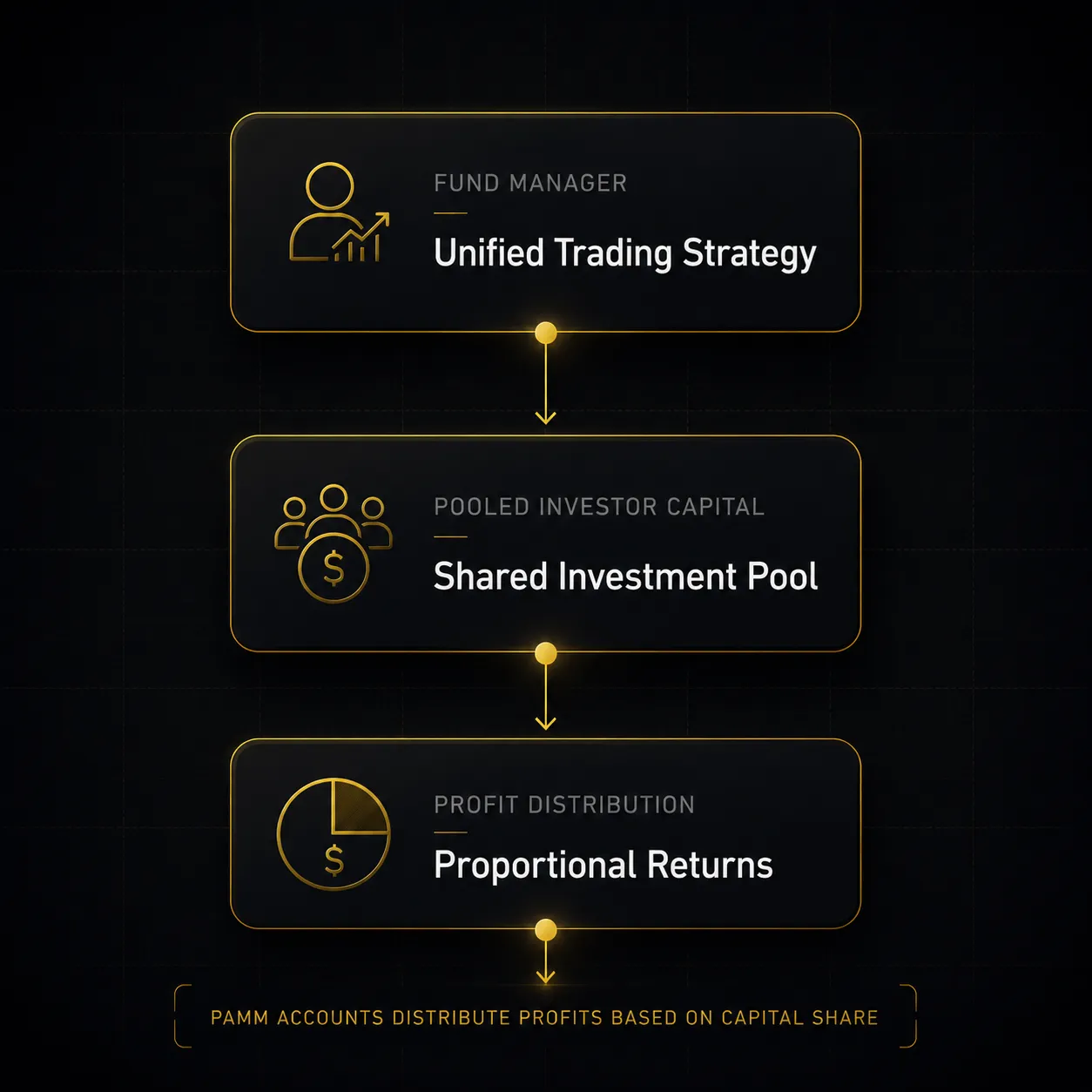
PAMM, which stands for Percentage Allocation Management Module, is a managed account structure in which investor funds are pooled together and traded collectively by a single manager. Unlike MAM systems, PAMM accounts operate on a pooled capital model where each investor’s participation is defined by their proportional share of the total pool. Gains and losses generated by the manager’s trading activity are distributed among all participants according to each investor’s contribution percentage.
Core Structure of PAMM Technology
The PAMM structure consolidates capital from multiple investors into a single trading pool managed by one trader. Each investor’s share of the pool is determined by the ratio of their deposit to the total pooled capital. When the manager executes trades, all trading activity occurs within this unified pool rather than across individual segregated accounts. This pooled structure simplifies the operational framework compared to MAM systems but reduces individual account-level customization.
| Feature | MAM Structure | PAMM Structure |
|---|---|---|
| Capital model | Segregated sub-accounts | Pooled investor funds |
| Allocation method | Flexible (lot, equity, percentage) | Percentage of pool share |
| Individual customization | High | Limited |
| Execution environment | Per sub-account | Unified pool |
| Transparency | Per-account performance visible | Pool-level performance reported |
Profit and Loss Distribution in PAMM Accounts
Profits and losses in a PAMM account are distributed proportionally based on each investor’s share of the total pool at the time the trading period closes. For example, an investor contributing 10% of the total pool capital would receive 10% of the profits generated during that period, or absorb 10% of any losses incurred. This percentage-based distribution model is automated by the broker’s PAMM infrastructure and operates without requiring manual intervention per investor account.
Manager Participation in PAMM Systems
A notable characteristic of many PAMM arrangements is that the trading manager often invests their own capital alongside investor funds within the same pool. This co-investment is generally viewed as an incentive alignment mechanism, as the manager’s personal capital is exposed to the same trading outcomes as the investor pool. The proportion of the manager’s own capital within the pool can vary significantly depending on the individual arrangement and broker requirements.
Broker Infrastructure Behind PAMM Accounts
PAMM systems are typically maintained as server-side technology by Forex brokers. The broker’s platform automates the calculation of investor shares, the distribution of profits and losses at the close of each trading period, and the management of deposits and withdrawals. Performance reporting dashboards and investor portals are commonly offered by brokers to provide visibility into pool-level trading activity and historical performance data.
Differences Between MAM and PAMM Accounts
Although MAM and PAMM systems are both designed to facilitate managed Forex trading, they differ significantly across several structural and operational dimensions. Professional traders and introducing brokers frequently evaluate these distinctions when selecting infrastructure appropriate for specific client requirements and operational models.
Allocation Flexibility Comparison
MAM systems provide considerably more flexibility in allocation methodology than PAMM structures. MAM platforms typically support lot-based, equity-proportional, percentage-based, and balance-based distribution models, allowing managers to tailor allocation to individual investor preferences. PAMM systems, by contrast, operate exclusively on a percentage-of-pool model, which may not accommodate customized exposure requirements at the individual investor level.
Trade Execution Mechanics
In a MAM environment, trades are executed and mirrored across individual sub-accounts, with each account potentially receiving a different lot size depending on the chosen allocation method. In a PAMM environment, the manager executes trades within the unified pool, and all participants are automatically affected in proportion to their share. This distinction has practical implications for execution quality, particularly when sub-account sizes vary significantly in MAM structures.
Investor Control and Customization
MAM accounts are generally considered to offer greater investor-level control. Individual sub-account holders may, depending on broker configuration, be able to adjust risk parameters, set account-level stop-loss thresholds, or request specific allocation settings. PAMM investors typically have less granular control, as their participation is governed by their pool share percentage rather than individually configured account settings.
Operational Transparency Differences
MAM systems provide per-account performance visibility, allowing each investor to view the trading history and results specific to their own sub-account. PAMM systems report performance at the pool level, meaning individual investors observe the aggregate trading results of the entire pool rather than isolated account-level data. This distinction may be relevant to investors with compliance or reporting requirements that mandate individual account transparency.
Scalability for Money Managers
Both systems are designed to support multiple investors simultaneously, but their scalability characteristics differ. MAM systems may require more sophisticated broker infrastructure and administrative oversight as the number of sub-accounts grows, particularly when varied allocation settings are applied. PAMM systems may offer simpler scalability due to the pooled model, as adding investors involves increasing pool capital rather than adding individual account configurations.
Similarities Between MAM and PAMM Systems
Despite their structural differences, MAM and PAMM systems share a range of fundamental characteristics that define their shared purpose within managed Forex trading environments.
- Both systems allow a single professional trader to manage capital across multiple investors simultaneously.
- Both structures originate trading activity from a centralized manager account or pool.
- Both rely on automated allocation technology provided or supported by the broker infrastructure.
- Both systems are commonly integrated with MetaTrader platforms or compatible broker environments.
- Both structures typically involve fee arrangements between the manager and investors, commonly including performance-based compensation.
Centralized Trading Structure
In both MAM and PAMM environments, all trade decisions originate from a single manager. This centralized model allows professional traders to implement consistent strategies across all connected capital without managing individual accounts separately. Centralization is considered a core operational efficiency feature shared by both systems.
Multi-Investor Participation
A defining characteristic shared by both structures is the capacity for multiple investors to participate simultaneously. MAM systems accommodate this through linked sub-accounts, while PAMM systems accommodate multiple participants through proportional pool shares. The multi-investor architecture in both cases allows managers to scale their operations without proportionally increasing administrative complexity.
Automated Allocation Processes
Both MAM and PAMM systems rely on automated allocation engines to distribute trades, calculate profits and losses, and manage investor accounts in real time. This automation reduces the potential for manual errors in distribution calculations and ensures consistency in applying the agreed allocation methodology across all participating investors.
Broker-Provided Infrastructure
Forex brokers play a central operational role in both MAM and PAMM systems. Brokers provide the server-side technology, investor portals, performance reporting tools, and compliance frameworks that underpin both account types. The quality and features of MAM and PAMM infrastructure can vary considerably between brokers, which is often cited as a key consideration in broker selection for professional managers and IBs.
Advantages Commonly Associated With MAM Accounts
MAM systems are frequently discussed in the context of their operational flexibility and individual account transparency, characteristics that may be relevant to certain professional trading environments.
Flexible Allocation Options
The range of allocation methods available in MAM systems — including lot-based, equity-proportional, and balance-based models — is often considered one of the structural strengths of the technology. This flexibility may allow managers to accommodate investors with varying account sizes, risk preferences, or capital requirements within a single managed framework.
Individual Account Visibility
Because each investor in a MAM structure maintains a separate segregated account, performance data can be reported at the individual account level. This feature may be particularly relevant for professional managers working with institutional investors or high-net-worth clients who require detailed, auditable performance records.
Compatibility With Different Trading Styles
MAM systems are often associated with active trading environments that involve frequent position adjustments, varying trade sizes, or complex multi-strategy execution. The sub-account architecture may accommodate dynamic position management more efficiently than pooled structures in certain high-frequency or diversified trading contexts.
Multi-Strategy Management Potential
Some MAM configurations allow managers to apply different allocation settings or risk parameters to distinct groups of investor sub-accounts. This capability is sometimes associated with the management of multiple trading strategies or risk profiles within a single managed account framework.
Advantages Commonly Associated With PAMM Accounts
PAMM systems are often discussed in terms of their operational simplicity and accessibility for passive investors seeking indirect Forex market participation.
- Simplified entry process for investors, typically requiring only a deposit to participate in the pool.
- Automated percentage-based distribution of profits and losses without manual calculation requirements.
- Reduced administrative overhead for brokers managing pooled structures relative to multiple individual sub-accounts.
- Transparent performance history at the pool level, commonly displayed in broker-provided investor portals.
Simplified Participation Structure
The pooled capital model in PAMM systems creates a relatively straightforward participation framework. Investors contribute funds to the pool, and their share is automatically calculated based on their contribution relative to total pool capital. This simplicity is frequently cited as a characteristic that makes PAMM systems accessible to a broader range of investors compared to more structurally complex alternatives.
Automated Percentage Distribution
The percentage-based allocation mechanism in PAMM accounts automates the distribution of both gains and losses across all participants at the close of each trading period. This automation is handled at the broker infrastructure level, reducing the potential for distribution discrepancies and minimizing manual processing requirements.
Operational Efficiency for Brokers
Brokers supporting PAMM systems may benefit from reduced operational complexity relative to MAM environments, as the pooled model consolidates multiple investors into a single trading entity. This consolidation can simplify compliance monitoring, performance reporting, and settlement processes at the broker level.
Accessibility for Passive Investors
PAMM accounts are commonly associated with passive investment participation, as investors contribute capital to a pool managed by a professional trader without requiring direct involvement in trade execution or strategy development. This characteristic has contributed to the adoption of PAMM systems among retail investors and passive market participants.
Limitations Often Discussed in MAM Accounts
Professional evaluations of MAM systems also consider a range of structural and operational limitations.
| Limitation Category | Description |
|---|---|
| Infrastructure complexity | Managing numerous sub-accounts with varied allocation settings may require significant broker and manager-level administrative resources |
| Execution variability | Differences in sub-account size, broker conditions, or latency may create inconsistencies in trade replication across accounts |
| Manager dependency | Centralized decision-making means all sub-accounts are exposed to the performance and judgment of a single manager |
| Broker-specific differences | MAM functionality, allocation options, and reporting features may vary significantly between brokers and platform versions |
Higher Infrastructure Complexity
Operating a MAM system with a large number of sub-accounts and varied allocation configurations may require sophisticated broker infrastructure and dedicated administrative oversight. The complexity can increase as the number of investors grows, particularly when individual customization requirements differ materially across the investor base.
Execution Variability Across Accounts
In MAM environments, execution outcomes may not be identical across all sub-accounts. Differences in account size, margin levels, or broker-imposed conditions may result in minor variations in fill prices or lot sizes across connected accounts. This execution variability is generally considered a structural characteristic of sub-account architectures rather than a system failure.
Limitations Often Discussed in PAMM Accounts
PAMM systems also carry structural considerations that are commonly discussed in professional evaluations of managed account frameworks.
Reduced Allocation Flexibility
The percentage-only allocation model in PAMM systems limits the degree to which individual investor exposure can be customized. Investors with specific lot-size preferences, risk limits, or account-level requirements may find the pooled percentage model insufficient for their needs. This limitation is often contrasted with the greater flexibility available in MAM structures.
Limited Investor-Level Adjustments
Because investor participation in a PAMM pool is defined solely by their percentage share, individual investors typically cannot adjust trade sizes, set account-specific risk parameters, or request changes to their exposure without altering their pool contribution. This constraint may be relevant to institutional investors with regulatory or internal risk management requirements.
Exposure to Collective Performance Outcomes
All participants in a PAMM pool are proportionally exposed to the aggregate trading outcomes of the manager, regardless of the timing of their entry into the pool. An investor who joins the pool at an unfavorable point in the trading cycle may absorb losses generated before their participation. This collective exposure characteristic is inherent to the pooled structure.
Transparency Variations Across Brokers
The quality and depth of PAMM performance reporting can vary considerably between brokers. Some platforms provide detailed trade-level analytics, while others offer only summary performance data. Investors relying on granular reporting for due diligence or compliance purposes may encounter limitations depending on the broker’s infrastructure and reporting capabilities.
MAM vs PAMM Risk Management Structure
Risk management frameworks in MAM and PAMM environments differ in meaningful ways that are relevant to professional traders, IBs, and institutional investors evaluating managed account infrastructure.
Risk Allocation Models
MAM systems allow risk to be distributed at the individual sub-account level, with the possibility of applying different allocation settings or risk parameters to each connected account. PAMM systems distribute risk proportionally across all pool participants based on their contribution percentage, creating a uniform exposure model across the investor base. These structural differences may have practical implications for portfolio-level risk monitoring.
Drawdown Distribution Characteristics
In a MAM structure, drawdowns experienced during a trading period affect each sub-account in proportion to the allocation method applied, which may differ between investors. In a PAMM structure, drawdowns are distributed proportionally across all pool participants according to their share percentage. The collective nature of PAMM drawdown distribution means that a significant loss event affects all participants simultaneously and proportionally.
Margin Management Approaches
Margin utilization in MAM systems is calculated at the individual sub-account level, meaning each investor’s margin exposure is theoretically isolated from other sub-accounts. In PAMM systems, margin is managed at the pool level, and the margin requirements of the entire pool are influenced by the combined capital of all participants. Both structures are subject to margin call risk if trading losses reduce available margin below broker-required thresholds.
Investor Protection Mechanisms
Brokers supporting MAM and PAMM systems may implement additional safeguards such as drawdown limits, high-water mark provisions for performance fee calculations, and mandatory reporting periods. Account segregation practices — which apply at different levels in MAM versus PAMM structures — are also commonly cited as investor protection considerations. Regulatory frameworks applicable to managed account services vary by jurisdiction and may influence the specific protections available to investors in each structure.
Broker Support for MAM and PAMM Accounts
Forex brokers play a central role in the delivery, maintenance, and operational integrity of both MAM and PAMM systems. The quality of broker support is frequently cited as a significant factor in the practical viability of managed account infrastructure for professional managers and IBs.
MetaTrader Integration
Both MAM and PAMM technologies are widely supported within the MetaTrader ecosystem. MT4 and MT5 serve as the primary platforms through which most retail and professional-grade MAM and PAMM implementations are delivered. Brokers typically implement MAM functionality as a server-side plugin integrated with the MetaTrader back-office infrastructure. PAMM systems may operate through dedicated modules that interface with the MetaTrader trading environment or through proprietary broker platforms.
Reporting and Analytics Features
Professional-grade brokers offering MAM and PAMM services commonly provide investor portals with performance dashboards, equity curve visualization, drawdown analysis, and trade history reporting. The depth and quality of these tools vary between brokers and may represent a differentiating factor for professional managers evaluating infrastructure options. Introducing brokers may also have access to IB-level reporting tools that consolidate performance data across multiple managed accounts.
Fee Structures in Managed Accounts
Fee arrangements in MAM and PAMM environments typically fall into the following categories:
- Performance fees: A percentage of profits generated during each trading period, commonly calculated on a high-water mark basis.
- Management fees: A fixed periodic charge based on assets under management, independent of trading performance.
- Broker commissions: Spreads or per-trade charges applied by the broker on each transaction executed within the managed account structure.
- Rollover or swap fees: Interest charges or credits applied to positions held overnight, which affect net returns in both MAM and PAMM environments.
Regulatory and Compliance Considerations
The regulatory framework governing MAM and PAMM services varies significantly across jurisdictions. In regions subject to oversight by bodies such as the Financial Conduct Authority (FCA), the Cyprus Securities and Exchange Commission (CySEC), or the Australian Securities and Investments Commission (ASIC), brokers offering managed account services may be required to comply with specific licensing, disclosure, and operational standards.
Professional traders and IBs operating MAM or PAMM structures are generally advised to verify the regulatory status of their broker and understand the compliance obligations applicable to managed account activity in their jurisdiction. Past performance of any managed account structure does not guarantee future results, and losses may exceed initial investor expectations.
MAM and PAMM Accounts: Structural Summary
MAM and PAMM Forex accounts represent two distinct approaches to managed trading that share a common purpose — enabling professional traders to manage capital on behalf of multiple investors — while differing substantially in allocation methodology, operational structure, transparency, and investor customization potential.
MAM systems are characterized by segregated sub-account architecture, flexible allocation methods, and individual account-level visibility. PAMM systems are characterized by pooled capital models, automated percentage-based distribution, and simplified investor participation frameworks. Neither structure inherently represents a superior solution; the operational suitability of each depends on the specific requirements of the manager, the investor base, the broker infrastructure, and the regulatory environment in which the managed account service operates.
FAQ: MAM and PAMM Forex Accounts
What does MAM stand for in Forex?
MAM stands for Multi-Account Manager. In Forex trading infrastructure, a MAM system refers to a technology that allows a single professional trader or portfolio manager to execute trades simultaneously across multiple linked investor sub-accounts. Each sub-account remains individually segregated at the broker level, and trades are distributed according to a predefined allocation method such as lot-based, equity-proportional, or percentage-based distribution. MAM systems are primarily associated with MetaTrader-compatible broker environments and are commonly used by professional money managers operating managed account services.
What does PAMM stand for in Forex?
PAMM stands for Percentage Allocation Management Module. A PAMM account is a managed Forex trading structure in which multiple investor funds are pooled into a single capital pool managed by one trader. Each investor’s participation is defined by the percentage their contribution represents relative to total pool capital, and profits and losses are distributed proportionally at the close of each trading period. PAMM systems are characterized by automated allocation processes and are typically administered through server-side broker infrastructure.
What is the main difference between MAM and PAMM accounts?
The primary structural distinction between MAM and PAMM accounts lies in capital architecture and allocation flexibility. MAM systems operate through individually segregated sub-accounts with customizable allocation methods, while PAMM systems consolidate investor capital into a single pool with percentage-only distribution. MAM structures generally offer greater investor-level customization and transparency, while PAMM structures are associated with operational simplicity and streamlined multi-investor participation. These differences have practical implications for manager flexibility, investor control, and broker infrastructure requirements.
Are MAM and PAMM accounts available on MT4 and MT5?
Both MAM and PAMM account types are widely supported within the MetaTrader 4 and MetaTrader 5 ecosystems. Brokers typically implement MAM functionality as a server-side plugin integrated with the MetaTrader back-office environment. PAMM systems may operate through dedicated broker modules that interface with MetaTrader or through proprietary platform solutions. The specific features, allocation options, and reporting capabilities available within MetaTrader-based MAM and PAMM implementations can vary between brokers depending on their technology infrastructure and licensing arrangements.
Do brokers charge fees for managed Forex accounts?
Brokers and managers typically apply multiple fee categories within MAM and PAMM structures. Performance fees — calculated as a percentage of profits generated during each trading period — are common and are often structured on a high-water mark basis to prevent charging fees on recovered losses. Management fees may also be charged as a periodic percentage of assets under management. In addition, broker-level commissions, spreads, and overnight swap charges apply to all trading activity within managed account environments. The specific fee structure varies by broker, manager agreement, and account type.
Can multiple investors participate in one managed account structure?
Both MAM and PAMM systems are designed to accommodate multiple investors simultaneously within a single managed framework. In MAM structures, multiple investors participate through individually linked sub-accounts, each receiving trade allocations according to the configured distribution method. In PAMM structures, multiple investors participate through proportional pool shares, with each investor’s exposure determined by their contribution percentage relative to total pool capital. The multi-investor architecture is a fundamental characteristic shared by both account types and is central to their utility as managed account solutions.
Are MAM and PAMM accounts commonly used in copy trading environments?
MAM and PAMM systems share conceptual overlap with copy trading technologies in that both allow a single trader’s activity to be replicated across multiple investor accounts. However, they differ structurally from most retail copy trading platforms. Copy trading typically operates at the retail level through social trading networks where investors choose to replicate specific traders based on publicly visible performance metrics. MAM and PAMM systems are generally considered institutional or semi-institutional infrastructure, operating through broker-level technology with formal fee agreements and managed account frameworks rather than open social trading environments. Some brokers position PAMM accounts as an accessible entry point to managed trading that bridges the gap between retail copy trading and fully structured managed account services.