The MT4 MAM account represents one of the more structurally sophisticated instruments available within the MetaTrader 4 ecosystem. Designed to serve professional account managers, fund managers, and introducing brokers, the MT4 multi-account manager framework enables centralized trade execution that distributes positions across multiple investor accounts simultaneously. This article explores the architecture, allocation logic, institutional applications, and broader market context of MetaTrader 4 MAM systems from an informational and analytical perspective.
Concept and Core Definition of the MT4 Multi-Account Manager
Understanding the MT4 MAM account requires familiarity with the infrastructure layers that connect a professional trader or fund manager to multiple investor accounts through a single master account. The framework is embedded within broker-side systems and relies on predefined allocation logic to distribute trades proportionally. This section outlines the foundational architecture and the conceptual role of each structural component within the MetaTrader 4 MAM environment.
MT4 MAM Architecture Overview
An MT4 MAM is a multi-account management framework built within the MetaTrader 4 infrastructure. The system enables a single master profile to serve as the origin point for trade activity, with all positions distributed to linked investor profiles through broker-side allocation mechanisms. This architecture is commonly used in managed environments where a professional trader or fund manager oversees capital on behalf of multiple clients.
Within the broker infrastructure, the MT4 multi-account framework occupies a distinct operational layer. It differs from standard retail trading structures in that it is designed for scale, enabling managers to execute block trades that are then automatically apportioned across a pool of investor profiles according to system-level parameters.
Multi Account Manager Function Role
The Multi Account Manager component in an MT4 MAM system functions as the distribution engine that governs how trading activity from the master profile is replicated across multiple linked investor profiles. Its role is not merely technical but structural, since it defines the relationship between the manager’s position and each investor by applying an allocation formula that may be based on equity, lot size, or percentage contribution.
In professional trading environments, this component is commonly used by fund managers who operate under managed fund agreements. The system allows the manager to execute a single trade decision and have it reflected across dozens or potentially hundreds of linked profiles simultaneously, subject to broker infrastructure capacity.
Core System Structure Components
The MT4 MAM system is composed of several interdependent structural elements. The master profile is the originating source from which all trading activity is generated. Investor profiles, sometimes referred to as sub-accounts, receive allocated trade portions based on predefined logic. The allocation engine interprets the manager’s trade and calculates the appropriate distribution. The execution routing layer communicates with the MetaTrader 4 server to process and confirm fills across all participating profiles.
These components interact in a sequential manner. When a trade is placed from the master account, the allocation engine processes the order, applies the distribution formula, and routes individual fills to each investor account through the broker’s server infrastructure. The process is generally designed to occur near-simultaneously, though execution timing may vary based on server load and market conditions.
The table below provides a structural breakdown of the primary MT4 MAM components and their functions:
| Component | Role | Interaction Point |
|---|---|---|
| Master Account | Origin of all trading activity | Initiates trade and allocation process |
| Investor Account | Receives proportional allocation of trades | Linked to master through broker system |
| Allocation Engine | Applies distribution formula to each trade | Processes master order pre-execution |
| Execution Routing Layer | Sends individual fills to each account | Communicates with MT4 server infrastructure |
Comparing MAM Software Solutions: MT4 MAM vs PAMM vs Copy Trading
Several managed account models exist within the financial services industry, and the MT4 MAM account is often compared to PAMM (Percentage Allocation Management Module) systems and copy trading platforms. While these models may appear similar on the surface, their structural differences have meaningful implications for how trades are executed, how exposure is distributed, and how investor positions interact with the broader market. Understanding these distinctions is relevant for brokers, managers, and institutional participants evaluating infrastructure options..
Structural Differences Between MAM and PAMM
The MAM model and the PAMM model are often discussed together, yet they differ in fundamental structural ways. In a PAMM account, investor funds are pooled into a single trading account, and profits or losses are distributed proportionally after the fact based on each investor’s equity share. The PAMM model treats the pool as a unified entity during active trading.
An MT4 MAM setup, by contrast, maintains individual investor profiles as separate entities throughout the trading process. Each profile holds its own balance and receives a proportional portion of each trade at the point of execution. This distinction can have implications for transparency, individual reporting, and the application of different risk parameters per participant.
Execution Logic Differences with Copy Trading
Copy trading systems operate on a follower-based replication model, where a subscriber account automatically mirrors the positions of a signal provider, typically through a third-party platform or API bridge. The replication occurs on a per-account basis and may be subject to latency depending on the technology infrastructure.
MT4 MAM systems, by contrast, process allocations through broker-side infrastructure rather than through external replication layers. This generally results in a more tightly integrated execution pathway, as the allocation occurs closer to the point of order execution. However, the two models serve different client profiles, with copy trading often targeting retail participants and MAM systems more commonly associated with professional and institutional environments.
Allocation Mechanism Comparison
The allocation mechanisms available across MAM, PAMM, and copy trading models reflect the different priorities of each system. The following characteristics are commonly associated with each approach:
- MAM systems may support multiple allocation methods, including lot-based, percentage-based, and equity-weighted distribution.
- PAMM models generally use a single pooled percentage approach, distributing results proportionally after trade closure.
- Copy trading platforms typically replicate full positions or scaled versions based on the follower account size relative to the signal provider.
- Hybrid MAM configurations may combine allocation methods depending on the broker’s software solution and account manager preferences.
Allocation Methods in MT4 MAM Trading Systems
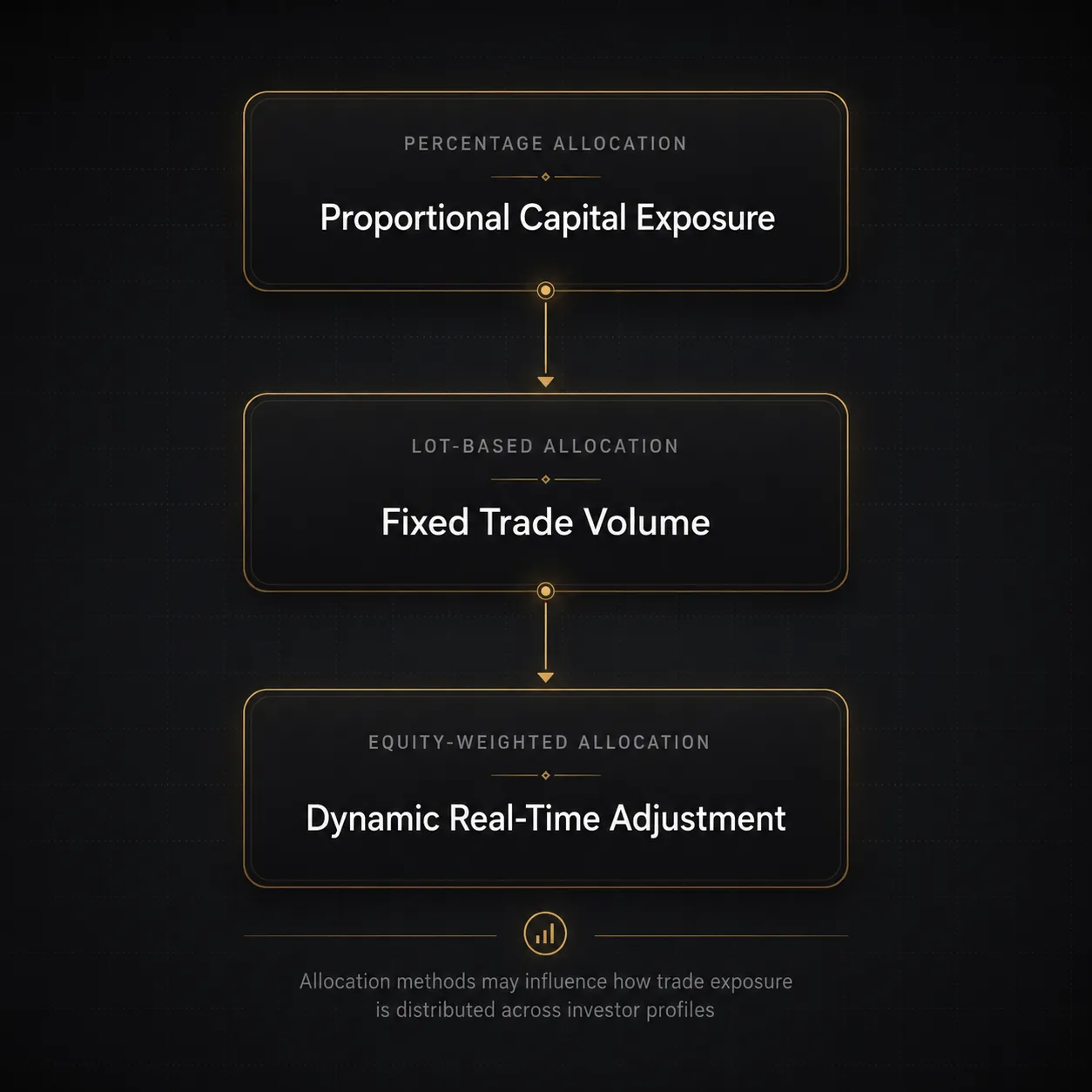
The allocation methodology applied within an MT4 multi-account manager system determines how trade exposure is distributed across investor profiles. The choice of allocation method can influence how each profile’s risk exposure aligns with the manager’s overall trading strategy. Different allocation structures may be appropriate in different operational contexts, and brokers offering MAM solutions typically provide several options to accommodate varying manager requirements.
Percentage-Based Allocation Models
In a percentage-based allocation model, each investor profile receives a portion of the master trade proportional to its balance or equity relative to the total pool. If one profile holds 10 percent of total equity across all linked profiles, it would typically receive approximately 10 percent of each trade’s volume. This model is often described as intuitive for investors who want exposure that scales directly with their capital size.
The percentage-based approach is commonly used in environments where linked profiles vary significantly in size, as it provides a natural form of proportional distribution without requiring manual adjustment per trade.
Lot-Based Allocation Logic
Lot-based allocation distributes fixed trade volumes across investor profiles, with each profile receiving a predetermined number of lots regardless of equity level. This method is sometimes used in structured environments or where managers have established fixed exposure parameters per client. Lot-based distribution may be preferred when participants need uniform exposure in absolute terms rather than proportional terms.
The limitation of this approach is that it may not account for differences in capital size, potentially resulting in disproportionate risk for smaller profiles if not configured carefully within the MAM solution.
Equity-Weighted Allocation Approach
Equity-weighted allocation takes into account the current equity of each investor account at the time of trade execution and distributes exposure proportionally based on those real-time values. Unlike balance-based percentage allocation, this approach adjusts dynamically to account for open positions and unrealized profits or losses across the investor pool.
This method is often associated with environments where account equity fluctuates frequently and where the account manager prioritizes consistent proportional risk across the investor base. Equity-weighted systems require real-time data access at the allocation engine level.
Hybrid Allocation Structures
Some MT4 MAM software solutions support hybrid allocation configurations that combine elements of multiple allocation methods depending on account type, size tier, or investor agreement. For example, a broker may configure certain investor accounts to receive lot-based allocations while others operate under equity-weighted parameters within the same master account structure.
Hybrid structures are generally associated with more complex institutional deployments where a single fund manager oversees diverse investor profiles with varying risk tolerances and contractual terms.
How Professional Traders and Investors Use MT4 MAM Accounts
The MT4 MAM structure is predominantly associated with professional and institutional trading environments, where managing multiple client portfolios under a unified execution framework offers operational and efficiency advantages. From asset management firms to broker-side managed offerings, the MAM model serves a range of organizational contexts. The following sections describe the primary institutional use cases commonly associated with MT4 multi-account manager deployments.
Asset Management Environments
In multi-client asset management contexts, fund managers may use MT4 MAM setups to centralize decision-making while maintaining individual portfolio separation for each investor. This setup allows the manager to apply a single trading strategy across all client portfolios without manually replicating each decision. The individual structure preserves transparency and enables granular performance reporting per client.
Asset managers operating in regulated environments may find this model preferable to pooled structures, as it can support compliance with requirements around segregated client funds and individualized reporting.
Broker Infrastructure Integration
Brokers offering managed account services may integrate MAM technology directly into their platform infrastructure to support professional account managers and introducing brokers. From a broker’s perspective, the MT4 MAM system enables them to offer a structured product to fund managers without requiring external software bridges.
The integration of MAM software within MT4 server infrastructure also allows brokers to maintain oversight of execution quality, monitor allocation accuracy, and apply risk management parameters at the broker level. This positions the MAM system as both a client-facing tool and an internal infrastructure component.
Multi-Account Portfolio Coordination
Operational scenarios involving dozens or hundreds of investor profiles require coordination mechanisms that manual trading cannot provide. An MT4 multi-account manager framework addresses this by enabling simultaneous execution across all linked portfolios from a single trade decision. This coordination capability is particularly relevant in environments where speed and consistency of execution are operational priorities.
The following represent typical operational characteristics in institutional multi-account deployments:
- Centralized execution from a single master account with near-simultaneous distribution.
- Individual account reporting and performance attribution without manual reconciliation.
- Flexible allocation parameter adjustment at the account manager or broker level.
- Integration with broker-side risk management and compliance systems.
Technical Infrastructure Behind MT4 Multi-Account Manager Software
The technical foundation of an MT4 MAM system determines the reliability, speed, and accuracy of trade allocation across investor accounts. The infrastructure spans multiple layers, from the MetaTrader 4 server integration to the order routing mechanisms and latency management protocols. An understanding of these technical elements is relevant for brokers evaluating MAM software solutions and for account managers assessing the execution environment of their chosen platform.
MetaTrader 4 Server Integration Layer
MT4 MAM systems typically integrate directly with the MetaTrader 4 server through dedicated software plugins or API connections provided by the broker or third-party MAM solution vendors. This integration allows the MAM allocation engine to interact with the core order management system of the MT4 platform in real time.
The depth of server integration influences how tightly the allocation process is coupled with trade execution. Deeper integration generally supports faster and more consistent distribution of trades, while loosely coupled systems may introduce additional processing steps that can affect timing.
Order Execution Distribution Mechanism
When a trade order is submitted from the master account, the order execution distribution mechanism processes the allocation formula and generates individual sub-orders for each investor account. These sub-orders are then routed through the broker’s execution infrastructure to be filled according to prevailing market conditions.
The distribution mechanism operates within the constraints of the broker’s execution model, which may be STP (Straight Through Processing), ECN (Electronic Communications Network), or a hybrid arrangement. The execution model influences how sub-orders interact with available liquidity and how slippage may manifest across different investor accounts.
Latency and Execution Handling Dynamics
Latency within an MT4 MAM system refers to the time elapsed between the submission of a master trade and the completion of all sub-order fills across investor accounts. In volatile market conditions or during periods of high server load, latency can increase, potentially resulting in execution variability across accounts.
Infrastructure design elements that may influence latency include server co-location, network connectivity quality, and the computational efficiency of the allocation engine. Professional MAM deployments often prioritize low-latency infrastructure to minimize execution discrepancies across the investor account pool.
The following table outlines key technical considerations within MT4 MAM infrastructure:
| Technical Layer | Function | Potential Risk Factor |
|---|---|---|
| MT4 Server Integration | Connects MAM engine to order management system | Integration depth affects timing accuracy |
| Allocation Engine | Processes distribution formula per trade | Formula complexity may increase processing time |
| Order Routing Layer | Sends sub-orders to broker execution system | Subject to broker execution model constraints |
| Latency Management | Controls timing of sub-order distribution | Network conditions and server load influence outcomes |
Benefits and Limitations of MAM Software Solutions for Account Managers
Like all institutional trading infrastructure, MT4 MAM accounts present a set of operational advantages and structural limitations that are relevant to both brokers and account managers. A balanced understanding of these factors can inform decisions about whether the MAM model aligns with the operational requirements of a given trading environment. The following sections describe commonly cited characteristics of the MAM framework.
Scalability in Multi-Account Management
One of the primary characteristics associated with MT4 MAM systems is their capacity to scale execution across a large number of investor portfolios without a proportional increase in operational complexity for the manager. A single master trade decision is distributed across all linked portfolios simultaneously, enabling the management of multiple trading relationships that would be operationally prohibitive to handle manually.
Scalability in this context is bounded by broker infrastructure capacity and the computational limits of the allocation engine. Some MAM solutions are designed to handle hundreds of linked portfolios, while others may be optimized for smaller deployments.
Transparency and Reporting Structures
The individual account structure of the MT4 MAM model supports a higher degree of transparency compared to pooled models such as PAMM. Each investor account maintains its own trade history, balance record, and performance data, which can be accessed and reported independently. This characteristic is often cited in contexts where investor-level reporting is a regulatory or contractual requirement.
Reporting capabilities may vary depending on the MAM software solution and the broker’s back-office infrastructure. Advanced reporting tools may provide real-time visibility into allocation accuracy, execution quality, and account-level performance attribution.
Operational Constraints and Dependencies
MT4 MAM systems operate within the constraints of the broker’s infrastructure, execution model, and software configuration. Account managers do not have direct access to the allocation engine parameters in all deployments and may be dependent on the broker’s technical team for system adjustments. Additionally, the MT4 platform itself has certain architectural limitations compared to newer trading platforms.
The dependency on broker-side infrastructure means that the quality and reliability of the MAM system can vary significantly between brokers. Due diligence on the broker’s MAM software solution, server infrastructure, and support capabilities is commonly viewed as an important step for professional account managers evaluating platform options.
Exposure Distribution Considerations
How risk exposure is distributed across investor accounts in an MT4 MAM system depends on the chosen allocation method and the parameters configured within the system. Percentage-based and equity-weighted models distribute exposure in proportion to account size, which may align with investor expectations. However, in certain market conditions, the proportional distribution of losses can have different impacts on smaller accounts compared to larger ones.
Account managers and brokers typically monitor exposure distribution as part of broader risk management practices. The allocation method selected can influence the extent to which individual investor accounts experience drawdown during periods of adverse market movement.
Risk and Market Considerations in MT4 MAM Systems
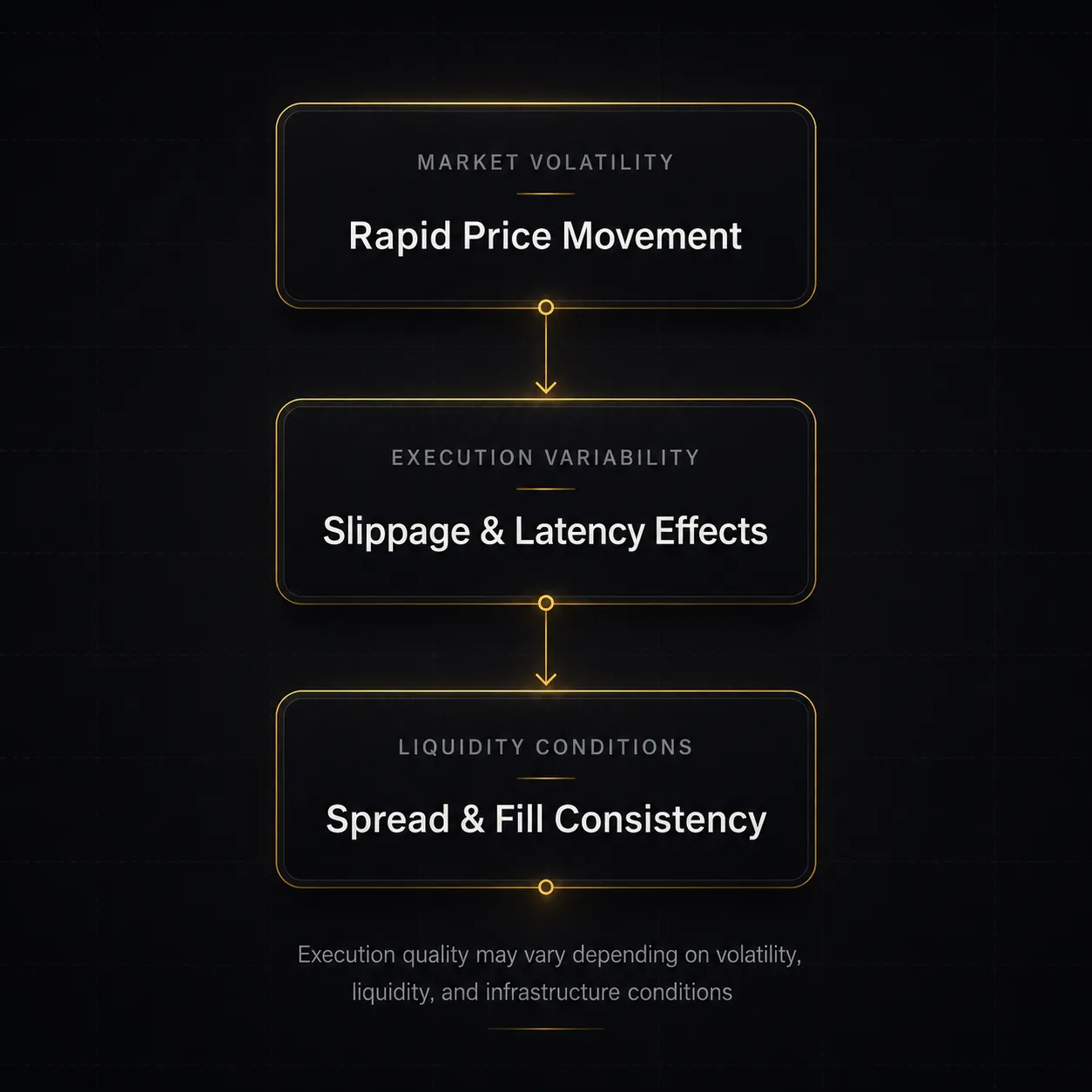
The operation of an MT4 multi-account manager framework takes place within a broader market environment that introduces variability in execution quality and allocation consistency. Market volatility, liquidity conditions, and infrastructure-level factors can all influence how trades are distributed and filled across investor accounts. Understanding these dynamics is relevant for account managers operating in professional trading environments and for brokers designing MAM-based service offerings.
Market Volatility Influence on Allocation
During periods of elevated market volatility, the execution environment can change rapidly. Price levels available at the moment of master trade submission may shift before all sub-orders have been processed and filled. This can result in execution variability across investor accounts, where some accounts may receive fills at slightly different prices than others depending on processing order and server timing.
Volatility-driven execution variability is not unique to MAM systems but may be amplified when a large number of sub-orders are generated from a single master trade. The practical impact of this variability depends on the size of price movements relative to the typical allocation amounts per investor account.
Execution Variability Factors
Execution variability in an MT4 MAM context may arise from several sources beyond market volatility. Slippage, which occurs when an order is filled at a price different from the intended price, can affect sub-orders differently depending on the timing of their submission to the execution layer. Latency within the broker’s infrastructure can compound this effect during high-activity periods.
Liquidity depth at the time of execution also influences how sub-orders interact with available market prices. In less liquid market conditions, individual sub-orders may encounter different price levels depending on the order in which they are processed by the broker’s execution system.
Liquidity Environment Effects
The liquidity environment in which an MT4 MAM account operates can have meaningful effects on order fulfillment quality across all investor accounts. When market depth is robust, sub-orders generated from a single master trade are generally filled quickly and at prices close to the intended level. When liquidity is thin, particularly during off-hours trading or around major economic data releases, the distribution of sub-orders may encounter wider spreads and reduced fill consistency.
The following conditions are commonly associated with liquidity-related execution variability in MAM systems:
- Thin order book depth during low-volume trading sessions.
- Sudden withdrawal of market maker quotes during high-impact news events.
- Fragmented liquidity in exotic currency pairs or less actively traded instruments.
- Elevated bid-ask spreads during periods of systemic market stress.
Role of MT4 MAM in the Forex Broker and Managed Account Ecosystem
The MT4 MAM account occupies a specific position within the broader landscape of forex trading infrastructure and managed account services. Its relationship with broker operations, its role in connecting retail and institutional capital, and its evolution alongside newer trading technologies are all relevant dimensions for understanding the system’s place in modern financial markets.
Relationship with Broker Operations
Brokers that offer MT4 MAM account services typically integrate the MAM software as a value-added component of their professional client offering. The MAM system enables brokers to attract and retain fund managers, introducing brokers, and professional traders who manage capital on behalf of multiple clients. From a broker’s perspective, the MAM infrastructure supports higher trading volumes and more complex client relationships than standard retail account offerings.
The broker’s execution model, liquidity arrangements, and server infrastructure all directly influence the quality of the MAM service offered to account managers. Brokers operating in well-regulated jurisdictions typically subject their MAM infrastructure to the same compliance and reporting standards as their broader trading services.
Position in Managed Account Industry
Within the managed account industry, the MT4 MAM system serves as a bridge between professional fund managers and a distributed base of investor accounts. The system enables smaller investors to access professional management without pooling their funds into a single collective vehicle, which may be a regulatory or preference consideration in certain jurisdictions.
The MT4 MAM model has historically been associated with the forex trading industry, where the MetaTrader 4 platform achieved broad adoption among retail and professional traders. However, the principles of multi-account management it embodies are applicable across other asset classes and trading environments where similar allocation mechanisms are available.
Evolution with Trading Platforms
The MetaTrader 4 platform, while widely used, represents an earlier generation of trading technology. Newer platforms, including MetaTrader 5, have introduced expanded multi-account management capabilities, additional asset class coverage, and enhanced back-office integration. The MT5 MAM architecture incorporates similar allocation principles as the MT4 model while offering updated technical infrastructure.
As the industry continues to evolve, some brokers and account managers are evaluating next-generation MAM software solutions that operate across multiple platforms or through proprietary technology stacks. The core principles of centralized execution and proportional allocation, however, remain central to the concept of multi-account management regardless of the underlying platform.
MT4 MAM Account Summary: Key Characteristics for Traders and Investors
The MT4 MAM account represents a well-established model for multi-account trade management within the MetaTrader 4 ecosystem. Its core characteristics include centralized execution from a single master account, broker-side allocation across multiple investor accounts, and support for various distribution methods including lot-based, percentage-based, and equity-weighted approaches.
The system’s primary use cases are associated with professional account managers, fund managers, and brokers who require scalable trade distribution infrastructure. Its technical foundation, embedded within the MT4 server environment, determines execution consistency and allocation accuracy across different market conditions.
Structural advantages of the MAM model include individual account transparency, scalable multi-account coordination, and flexible allocation configuration. Operational constraints include dependency on broker infrastructure quality, potential execution variability during volatile market conditions, and the architectural limitations of the MetaTrader 4 platform relative to newer trading systems. Understanding these characteristics may be relevant for market participants evaluating managed account infrastructure options.
Frequently Asked Questions
What does an MT4 MAM account represent in trading infrastructure?
An MT4 MAM account represents a multi-account management setup within MetaTrader 4 that allows a trader or money manager to execute trades from one master account and distribute them across many investor accounts. This is typically done using account manager software or an MT4 multi account manager integrated with broker infrastructure. The system enables professional fund management where a money manager’s trading is applied proportionally across all linked accounts. Each investor still keeps an individual MT4 account while the system operates through one master account.
How do allocation mechanisms operate conceptually within MT4 MAM systems?
Allocation in an MT4 MAM system works by applying predefined rules that split trades from the master account across multiple investor accounts. The multi account manager software may use equity weighting, fixed lot sizing, or hybrid formulas to distribute positions. A mam solution allows the manager trades to be replicated instantly across global markets via broker execution. This ensures consistent exposure for all accounts when using a MAM account.
Who typically uses MAM systems in professional financial environments?
MAM systems are commonly used by fund managers, forex professionals, and introducing brokers who need to manage multiple trading accounts. In online trading, a trader or money manager often relies on MT4 and MT5 platforms with an MT4 master account to handle client capital. These users often operate under a fund management business model and may charge a management fee. An account manager software on MetaTrader 4 helps streamline this process for managing investor funds.
How does the MT4 MAM model differ from other managed account structures?
The MT4 MAM model differs from PAMM and copy trading because it executes trades directly through broker-side infrastructure rather than pooling funds. Each MT4 account remains separate, while a powerful tool like an easy multi account manager distributes trades from one master account. This structure gives more flexibility in managing multiple accounts and customizing allocations. It is often considered a right multi account manager software solution for professional trading setups.
What role does broker infrastructure play in MT4 MAM performance?
Broker infrastructure plays a key role in execution speed, slippage, and allocation accuracy in MT4 MAM systems. The performance of the manager software on MetaTrader 4 depends heavily on server quality and liquidity conditions in global markets. Poor infrastructure can impact how well using a MAM account distributes trades across investor accounts. Strong systems ensure reliable trade execution for money manager’s account operations.
What are the primary operational risks associated with MT4 MAM account management?
Key risks include slippage, latency, and execution differences between multiple accounts when using a MAM setup. Since the system depends on broker infrastructure, outages or configuration errors can affect all managed accounts simultaneously. Mistakes in account number settings or allocation rules in account manager software can also lead to imbalances. Proper monitoring is essential when you manage multiple accounts in foreign exchange or CFD trading environments.
How does the MT4 MAM system handle multiple account types with different risk profiles?
MT4 MAM systems can adjust allocations per account, allowing different risk levels across investors. The software may apply different lot multipliers or equity ratios depending on the client profile, making it flexible for fund management. This allows the manager to trade and manage multiple accounts with tailored exposure while still executing from one master account. Such configurations are common in professional MAM systems used in online trading and investment management.