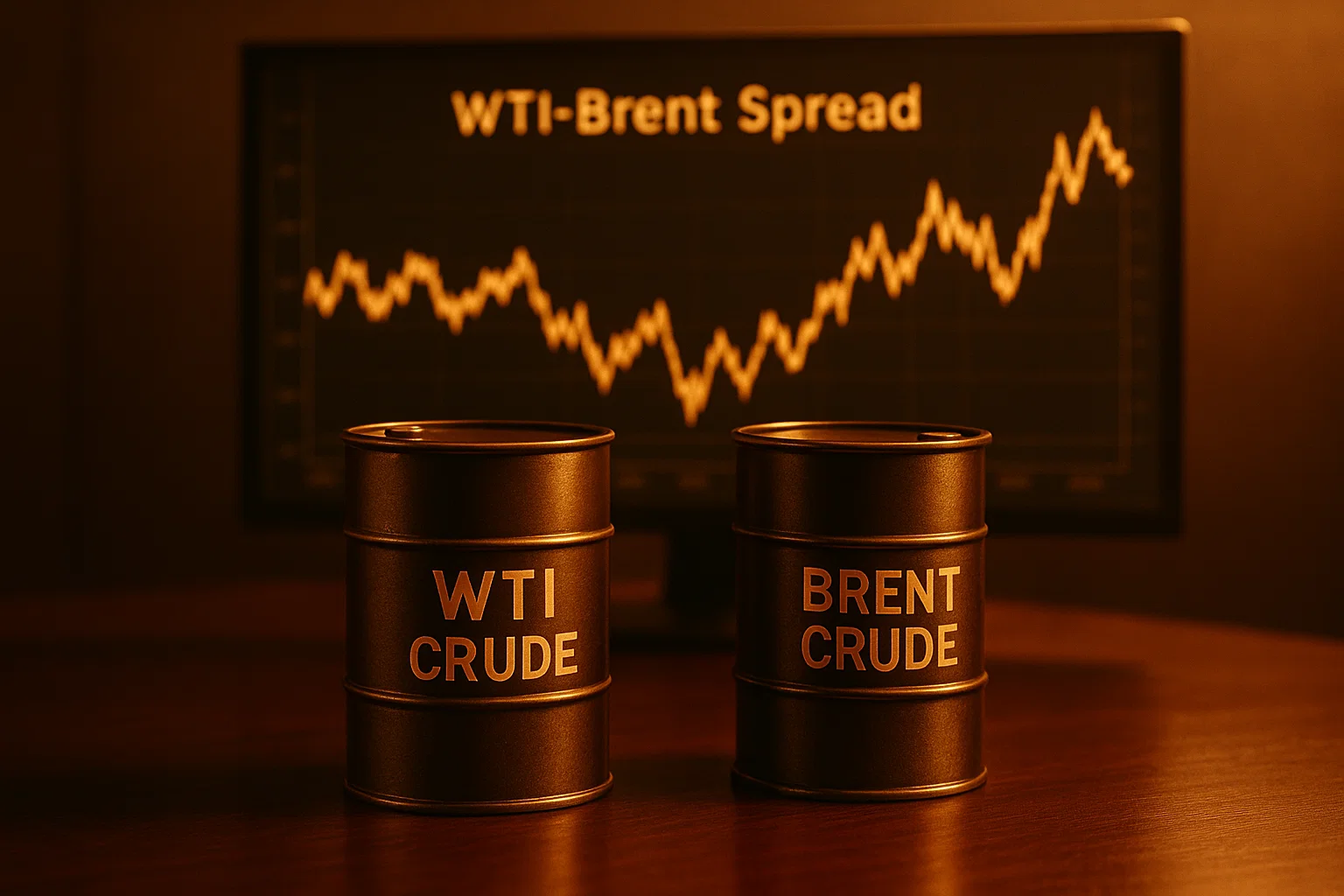
The global energy market relies heavily on crude oil, a commodity that powers industries and drives economies. However, not all crude oil is the same. When discussing oil prices, two names consistently dominate the conversation: West Texas Intermediate (WTI) and Brent Crude. These two are the world’s leading benchmarks, and while they both represent “black gold,” their geographic origin, chemical composition, pricing mechanisms, and market influence create significant differences.
For anyone involved in finance, trading, or economic analysis, understanding the key differences between WTI and Brent is fundamental. This authoritative guide, created by a financial services expert, delves into the specifics, offering the depth and clarity required to navigate this essential aspect of the commodity market.
Crude Oil Benchmarks and Importance

Defining Brent Crude and WTI Oil
WTI and Brent are specific grades of crude oil used as pricing standards, or benchmarks, for the wider global oil market. A benchmark is essentially a reference point against which the price of oil from various sources is measured.
- WTI (West Texas Intermediate): This is a high-quality, light, sweet crude oil produced primarily in the United States, particularly in Texas, Louisiana, and North Dakota. Its main storage and delivery point is Cushing, Oklahoma.
- Brent Crude: This is a light, sweet crude oil sourced from the North Sea—specifically, from oil fields in the Brent, Forties, Oseberg, and Ekofisk systems. It is the dominant pricing benchmark for oil produced in Europe, Africa, and the Middle East.
Why Oil Benchmarks Matter
Benchmarks simplify the complex world of oil pricing. Since crude oil varies widely in quality and location, having a standard reference price makes it possible for producers, refiners, and traders to establish a fair value for any specific barrel of oil, regardless of its origin.
A crude oil benchmark must possess several critical characteristics to be effective:
- High Liquidity: It must be actively traded to ensure its price reflects real-time supply and demand dynamics.
- Transparency: Its price discovery must be public and easily verifiable.
- Physical Integrity: Its quality and consistency must be predictable, allowing refiners to rely on it.
The price of Brent or WTI forms the base price, and other global crudes are often sold at a discount or premium (a differential) relative to one of these two benchmarks. For example, a barrel of Saudi Arabian Light might be priced as “Brent minus $2.00.”
Main Oil Benchmarks Overview
While WTI and Brent are the most dominant, there are other important regional benchmarks. These may include Dubai/Oman crude, which often serves as a primary benchmark for Middle Eastern oil destined for Asian markets, or Urals oil, used for Russian exports.
However, WTI and Brent together cover a significant majority of the world’s traded oil. Brent is typically considered the global benchmark, representing approximately two-thirds of the world’s crude oil trades, while WTI serves as the main North American benchmark. This differentiation in market coverage is crucial for understanding global pricing dynamics.
Comparing Crude Oil Versus Oil
It is important to clarify the terminology often used interchangeably.
- Crude Oil refers to the unrefined petroleum pumped directly from the ground. It is a raw, naturally occurring fossil fuel mixture composed of hydrocarbon deposits and other organic materials.
- Oil is a broader term that can refer to crude oil, refined petroleum products (like gasoline, diesel, and jet fuel), or even non-petroleum liquids (like vegetable oil).
In financial markets, when traders refer to “oil” as a tradable commodity, they are almost always referring to crude oil (specifically WTI or Brent futures). The price of crude oil directly influences the price of its refined products.
Brent Crude Oil Details
Geographic Source and Extraction Location
Brent Crude is named after the Brent field in the North Sea, which was one of the first fields to produce oil for the benchmark grade. Today, the benchmark is a blend of crude oil from four main systems in the region: Brent, Forties, Oseberg, and Ekofisk (the BFOE complex).
The extraction location off the coasts of the UK and Norway places Brent close to major European refining centers. This offshore location is key to its market mechanics, as the crude is typically transported by pipeline to storage terminals and then via oil tankers, facilitating global distribution. This accessibility to waterborne transport is a major factor in its global reach.
Brent Oil Quality and Composition
Brent is categorized as a light, sweet crude oil.
- Light: This refers to its low density, measured by its API Gravity. Brent typically has an API gravity of around 38 to 41 degrees, making it relatively easy and cost-effective to refine into high-demand products like gasoline and diesel.
- Sweet: This refers to its low sulfur content, generally less than 0.5 percent (by weight). Low sulfur content is desirable because it means refiners spend less on the complex processing required to remove sulfur (a key pollutant).
Factors Affecting Brent Crude Price
As the global benchmark, Brent’s price is influenced by a vast array of global factors:
- Geopolitics: Given its role as a global reference, political instability or supply disruptions in major oil-producing regions—especially the Middle East and Russia—have an immediate and significant impact on Brent prices. For instance, a disruption in the Strait of Hormuz, a key shipping choke point, would directly influence Brent pricing.
- OPEC+ Decisions: Decisions made by the Organization of the Petroleum Exporting Countries (OPEC) and its allies (known as OPEC+) regarding production cuts or increases directly affect the global supply balance, strongly influencing Brent prices.
- Global Economic Health: Since Brent reflects global demand, signs of strong economic growth in major consuming nations (like China, India, and the US) typically push the price higher, while recessionary fears tend to suppress it.
Global Market Influence and Reach
Brent Crude is the benchmark for the majority of the world’s oil. Its price is used to set the value for crude oil originating in over 60 percent of global production. Its ability to be easily shipped by sea means it can reach any global refining center. This logistical flexibility grants it superior global market influence compared to WTI.
The Brent contract is primarily traded on the Intercontinental Exchange (ICE) in London, which adds to its international status and global accessibility for traders.
West Texas Intermediate WTI Details
Geographic Source and Extraction Location
WTI is produced within the United States, predominantly from landlocked oil fields in the Southern and Midwest states. Unlike Brent, WTI is an inland crude with its main physical trading hub and storage facility located in Cushing, Oklahoma. Cushing is often called the “Pipeline Crossroads of the World” because it is the intersection of numerous pipelines and a massive storage complex.
The landlocked nature of WTI creates unique logistical challenges and market dynamics that are fundamentally different from Brent.
WTI Oil Quality and Composition
WTI is considered an even higher quality light, sweet crude than Brent.
- Light: WTI’s API gravity is generally higher than Brent, typically between 39 and 41 degrees.
- Sweet: Its sulfur content is extremely low, usually around 0.24 percent.
This superior quality makes WTI highly prized by refiners, particularly those in the US who specialize in processing light, sweet crude into high-octane gasoline.
Factors Affecting WTI Crude Price
WTI prices are strongly influenced by factors specific to the North American market:
- Cushing Inventory Levels: The most dominant factor is the inventory level at Cushing, Oklahoma. High storage levels at Cushing, often due to transportation bottlenecks or low domestic demand, can exert downward pressure on WTI prices, even if global prices (Brent) are rising. The infamous 2020 negative oil price event was primarily a WTI-specific logistical and storage issue at Cushing.
- US Production: The output from key US shale basins, such as the Permian Basin, directly affects the WTI supply. Surges in US domestic production can quickly overwhelm pipeline and storage capacity, driving down the WTI price relative to Brent.
- Pipeline Capacity: Since WTI is landlocked, the construction, expansion, or shutdown of major pipelines connecting Cushing to the Gulf Coast refining centers and export terminals significantly impacts its price.
Transportation and Storage Logistics
The biggest logistical challenge for WTI is its transportation. For decades, it was predominantly transported via pipelines to US refineries. However, with the boom in US shale production, bottlenecks often occur at Cushing. While the US has significantly increased its export capabilities since 2015, the inherent challenges of moving crude from the landlocked interior to coastal terminals mean WTI is less logistically flexible than Brent. The cost and speed of pipeline transport versus sea freight play a large role in the WTI price.
WTI Versus Brent Key Differences
| Feature | West Texas Intermediate (WTI) | Brent Crude |
|---|---|---|
| Geographic Source | Inland, primarily US Gulf Coast/Midwest. | Offshore, North Sea (UK, Norway). |
| Delivery Point | Cushing, Oklahoma (Landlocked). | Sullom Voe (UK) / Waterborne Cargo (Global). |
| API Gravity (Density) | Higher (lighter), approx. 39–41 degrees. | Lower (slightly heavier), approx. 38–40 degrees. |
| Global Reach | Primarily North American benchmark. | Global benchmark (2/3 of world oil trades). |
| Trading Exchange | NYMEX (New York Mercantile Exchange). | ICE Futures (Intercontinental Exchange) in London. |
Geographic Source and Market Influence
The fundamental difference lies in geography and, by extension, transport.
- Brent is an Atlantic Basin waterborne crude that is easily loaded onto tankers for delivery anywhere in the world. This makes it a better indicator of global supply and demand and ensures its price reflects broad geopolitical risks.
- WTI is a landlocked US domestic crude. Its price is often more reflective of North American supply, demand, and, crucially, US storage and pipeline capacity issues. As financial expert James Williams once noted, “Brent represents the price of oil delivered by water; WTI represents the price of oil delivered by pipeline.”
Density API Gravity and Sulfur Content
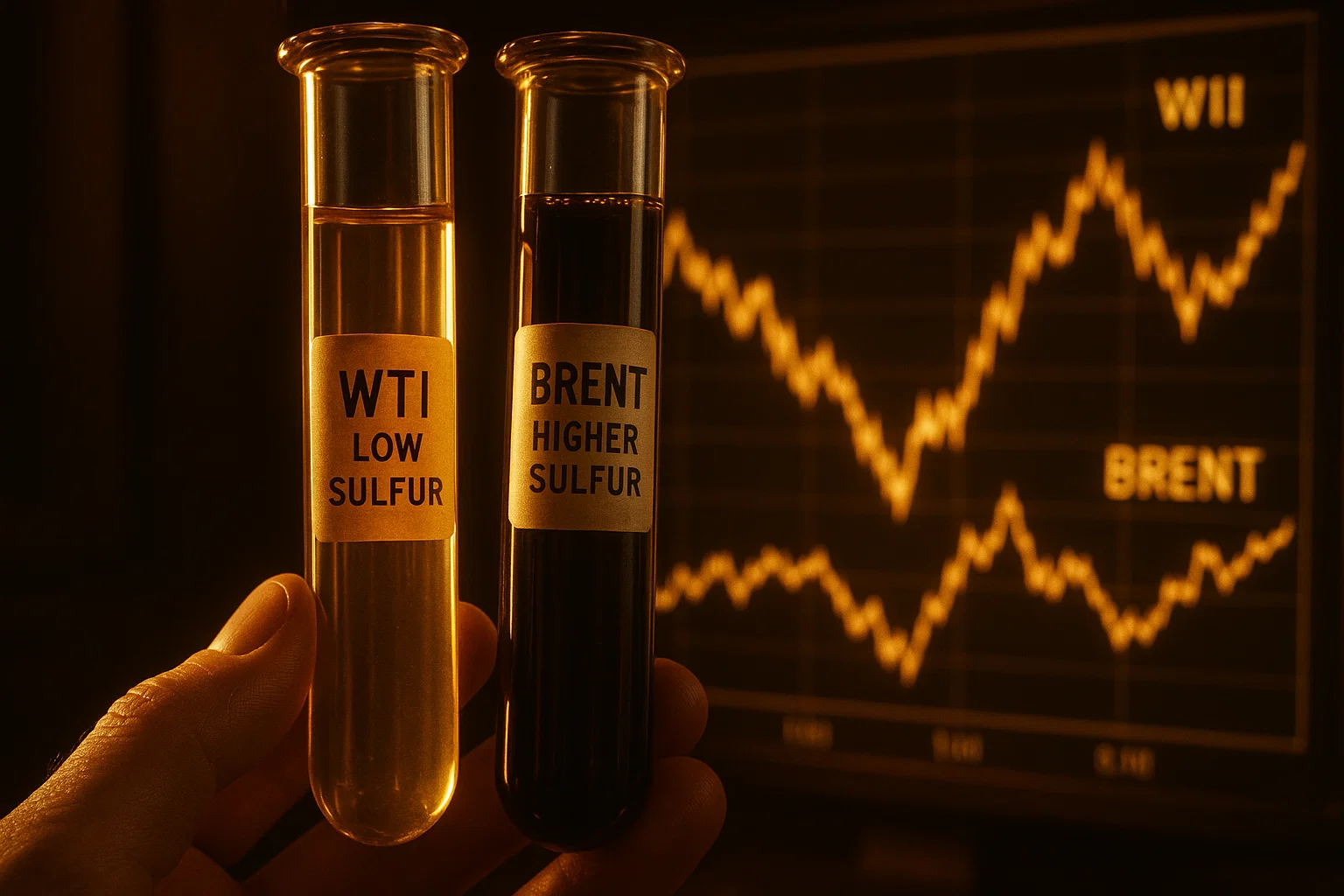
Both are light, sweet crudes, but WTI is technically of slightly higher quality.
- API Gravity: WTI’s slightly higher API gravity (meaning it’s lighter) generally makes it marginally easier to refine, which, in a vacuum, would suggest a premium.
- Sulfur Content: WTI’s lower sulfur content (meaning it is sweeter) is also preferable for environmental and refining purposes.
However, the quality difference is often overshadowed by logistics. The superior quality of WTI is frequently offset by the higher transport costs and supply bottlenecks associated with getting it out of Cushing, Oklahoma, to the end consumer.
Price Differences and WTI-Brent Spread
The price difference between the two—the WTI-Brent Spread—is a widely watched indicator in the financial world. Historically, WTI often traded at a small premium to Brent due to its slightly superior quality. However, after the US shale boom in the 2010s, WTI often traded at a significant discount to Brent.
This discount arose because the massive surge in US production overwhelmed pipeline capacity, leading to a glut of oil stockpiled at Cushing. With nowhere to go, the WTI price plummeted relative to the easily exportable Brent.
- Calculation: WTI-Brent Spread is typically calculated as Brent Price minus WTI Price. A positive spread (Brent is higher) suggests US logistical issues or strong global demand; a negative spread (WTI is higher) suggests tight US domestic supply or a global market surplus.
Transportation Logistics and Ease
The ease of transportation is the main driver of the long-term price relationship. Brent’s proximity to coastal terminals and immediate access to global sea routes gives it superior liquidity and stability as a global benchmark. WTI’s reliance on pipelines and storage at Cushing makes its price more vulnerable to regional US infrastructure constraints.
Trading Exchange and Pricing Mechanism
The contracts for WTI and Brent are traded on different, though connected, exchanges, which influences their pricing mechanisms.
- WTI futures are primarily traded on the New York Mercantile Exchange (NYMEX), a division of the CME Group. The WTI contract is priced in US Dollars and has a physical delivery mechanism at Cushing, Oklahoma.
- Brent futures are traded on ICE Futures in London. The contract also settles in US Dollars but involves a financial settlement based on the price of a cash-settled contract, which references a physical delivery network for the BFOE blend.
This distinction means the WTI price directly involves physical infrastructure capacity in Oklahoma, while the Brent price is more abstractly tied to the global sea-cargo market.
How to Trade Brent Crude and WTI

Trading crude oil is popular but highly leveraged, and it’s essential to approach it with a clear understanding of the risks involved. The commodity is traded through various instruments that offer different levels of access, risk, and capital commitment. Please note: According to data from financial regulators, approximately 70-89% of retail investor accounts lose money when trading CFDs. You should consider whether you can afford to take the high risk of losing your money.
Futures and Options Contracts
Futures and options are the primary ways institutions and experienced traders participate in the oil market.
- Futures Contracts: A futures contract is an agreement to buy or sell a specified quantity of crude oil (e.g., 1,000 barrels) at a specified price on a specified future date. Futures trading requires a significant initial margin and subjects the trader to daily marking-to-market. The WTI (NYMEX) and Brent (ICE) futures contracts are the most liquid instruments for trading the respective benchmarks.
- Options Contracts: An option gives the holder the right, but not the obligation, to buy (Call) or sell (Put) a futures contract at a specific price (the strike price) before a specific date. Options allow traders to manage risk or speculate on price movements with less capital upfront than futures, though they still carry substantial risk.
CFDs and Spread Bets
Contract for Differences (CFDs) and Spread Bets are popular retail trading products that allow speculation on the price movement of WTI and Brent without owning the underlying asset.
- CFDs (Contract for Differences): A CFD is an agreement between a trader and a broker to exchange the difference in the value of an asset (like crude oil) from the time the contract is opened until it is closed. They are leveraged products, meaning you can control a large position with a small deposit (margin). While leverage can magnify profits, it can equally magnify losses, often leading to a loss of the entire initial investment.
- Spread Bets: Similar to CFDs, spread betting involves wagering on whether the price of oil will go up or down. Your profit or loss is determined by how far the price moves in your favor or against you, multiplied by your stake per point. This product is tax-free in some jurisdictions.
Gaining Exposure Through ETFs and Shares
For investors seeking exposure to the oil market without the high risk and complexity of futures or leveraged products, Exchange-Traded Funds (ETFs) and energy company shares offer alternatives.
- ETFs (Exchange-Traded Funds): Oil ETFs track the price of crude oil, often by holding a basket of front-month futures contracts. They are bought and sold like stocks, offering an accessible way to gain exposure. However, it is essential to note that futures-based ETFs are subject to contango and backwardation effects, meaning their returns may not perfectly match the spot price of oil over time.
- Energy Company Shares: Investing in the stocks of major integrated oil companies (ExxonMobil, Shell, etc.) allows participation in the energy sector. These shares offer exposure to oil prices but also include company-specific factors like refining margins, dividend policies, and management decisions, which can mitigate the direct volatility of the commodity price.
Trading Strategies and Liquidity
Successful trading of Brent and WTI requires careful consideration of liquidity, volatility, and the factors driving the WTI-Brent spread.
- Liquidity: WTI and Brent are among the most liquid commodities globally. High liquidity ensures tight spreads and allows large orders to be executed without significantly moving the price.
- Spreading: A common professional strategy is trading the WTI-Brent spread itself. This involves simultaneously buying one contract (e.g., Brent) and selling the other (WTI), betting only on the change in the price differential, not the absolute direction of oil prices. This is often considered a relative value trade.
- Risk Management: Due to the high volatility of crude oil, robust risk management is paramount. Traders must meticulously manage their leverage and utilize stop-loss orders to limit potential losses. As expert trader George Kleinman states, “The first rule of trading is to control your risk; everything else is secondary.”
Frequently Asked Questions
What Is Difference Between Crude Oil and Oil?
Crude oil is the specific, unrefined liquid petroleum extracted from the ground, which serves as the raw material for refined products like gasoline, diesel, and jet fuel; the term “oil” is a broader term used generally to describe any liquid fat, lubricant, or fuel, including crude oil itself and its refined derivatives.
Where Does Brent Crude Oil Come From?
Brent Crude oil is sourced from the North Sea, specifically representing a blend of oil extracted from the BFOE (Brent, Forties, Oseberg, and Ekofisk) systems located offshore of the coasts of the United Kingdom and Norway, which is then transported via pipeline and loaded onto tankers for global distribution.
Why Is Brent Oil Called Brent Oil?
Brent Oil is named after the Brent oil field, which was one of the first fields in the North Sea to produce the specific light, sweet crude quality that was initially used as the benchmark reference point, and the name has since remained even as the benchmark now includes crude from other nearby fields.
Is Saudi Oil Brent or WTI?
Saudi Arabian oil is typically priced and sold relative to the Brent Crude benchmark, as Saudi Arabia is a major supplier to global, waterborne markets, and its oil grades (like Saudi Light) are assessed at a differential to the Brent price, establishing Brent as the default global reference for Middle Eastern crude exports.