The world of financial trading often appears as a fast-paced environment filled with complex charts and rapid numbers. At its core, this activity is the act of participating in the economy by exchanging one asset for another. For those new to the field, it represents an opportunity to engage with global economic trends and potentially build wealth over time. However, success in deal-making is not guaranteed and requires a significant commitment to education and disciplined execution.
Trading Basics: How Does Trading Work?
When you start your journey, you are essentially participating in a global marketplace where people buy and sell various instruments. Financial work involves the exchange of assets like company shares, currencies, or commodities. The ultimate goal for most participants is to make a profit by correctly predicting how stock prices or other asset values will change over a period.
Core Principles of Financial Trade
The fundamental concept of any trade is the transaction between a buyer and a seller. When you decide to buy and sell assets, you are engaging in a process driven by supply and demand. If more people want to buy a particular stock, the price typically rises; if more want to sell, it falls. This process involves the buying and selling of financial assets through an intermediary, usually a broker, who provides access to the necessary market infrastructure.
Trading vs Investing: Main Differences
One of the most important aspects of the craft is distinguishing it from investing. The difference between market operations and investing lies primarily in the time horizon and the method of generating returns.
| Feature | Trading | Investing |
|---|---|---|
| Time Horizon | Short to medium term (seconds to months) | Long term (years to decades) |
| Goal | Profit from market volatility and price fluctuations | Gradual wealth accumulation through growth and dividends |
| Frequency | High frequency of buying and selling financial assets | Low frequency; “buy and hold” approach |
| Risk Profile | Higher due to short-term market moves | Generally lower, focused on long-term value |
Profit Generation Through Price Movements
To make a profit, a market participant must exit a position at a more favorable price than where they entered. This means buying and selling with the intention of capturing the spread between entry and exit points. For example, if you buy a share at 100 units and sell it at 110 units, your gross profit is 10 units. This requires constant market analysis to identify potential trends before they happen.
Buying Long vs Selling Short Explained
In the financial market, you can profit regardless of whether prices are going up or down.
- Buying Long: You buy an asset expecting its price to rise so you can sell it later at a higher price.
- Selling Short: You sell an asset you do not own (borrowed from a broker) expecting the price to fall, allowing you to buy it back cheaper and pocket the difference.
Historical Evolution of Global Financial Market
The history of exchange is as old as civilization itself. Understanding how we reached the current state of electronic commerce provides perspective on the resilience and complexity of modern markets.
Prehistoric Barter and Early Exchange Systems
Before the invention of currency, commerce was the buying and selling of physical goods through barter. Early humans exchanged tools, grains, and livestock. This system eventually evolved into using commodity money, such as seashells or salt, which served as a precursor to standardized coins.
Middle Ages and Birth of Formal Exchanges
The concept of a formalized market in the world began to take shape in the 11th century. Italian merchants started exchanging government securities, and by the 1600s, the world’s first official stock exchange was established in Amsterdam. This allowed for the public buying and selling of shares in the Dutch East India Company, marking the true beginning of the stock market as we know it.
Industrial Revolution and Modern Market Maturity
The 18th and 19th centuries saw the birth of iconic institutions like the New York Stock Exchange and the London Stock Exchange. As industry boomed, the need for capital increased, leading to a massive expansion in the number of traded companies. During this era, financial dealings became more standardized, with stricter regulations and the introduction of tickers to track market movements.
Digital Transformation and Electronic Trading Era
The late 20th century saw a total shift in how market interaction requires effort. Open-outcry pits where participants shouted orders were replaced by computers. Today, an online platform allows anyone with an internet connection to access global markets instantly. This digitization has increased market volatility but also lowered the barrier to entry for the average beginner.
Major Asset Classes and Type of Trading
Different market segments offer various opportunities and risks. A well-rounded participant knows the specific characteristics of each asset class.
Stock Markets and Public Company Shares
Buying stocks involves the acquisition and disposal of equity in public companies. When you take a position, you are essentially betting on the future success of that business. Major exchanges like the New York Stock Exchange host thousands of companies, providing high liquidity for investors.
Forex: Global Currency Exchange Dynamics
Forex operations involve the simultaneous buying of one currency and selling of another. It is the largest market in the world by volume. Because currencies are exchanged in pairs (e.g., EUR/USD), the price movement reflects the relative strength of one economy against another. Forex is known for being open 24 hours a day during the work week.
Commodities: Hard and Soft Natural Resources
Commodity dealings cover physical goods. These are categorized into “Hard Commodities” (minerals and energy like gold and oil) and “Soft Commodities” (agricultural products like wheat or coffee). These markets are highly sensitive to geopolitical events and weather patterns.
Indices: Tracking Sector and Market Performance
An index represents a group of stocks that track a specific sector or a whole economy. Examples include the S&P 500 or the FTSE 100. Taking positions on indices allows you to speculate on the overall health of a market rather than picking individual companies.
Bond Markets and Fixed-Income Securities
Bonds are essentially loans made by investors to issuers (like governments or corporations). In financial markets, bonds are considered less volatile than stocks and are often used as a hedge during periods of high market volatility.
Cryptocurrency: Digital Assets and Blockchain Markets
This is a relatively new type of activity involving digital tokens like Bitcoin and Ethereum. These markets are decentralized and known for extreme price fluctuations. While they offer high potential returns, they also carry significant risks due to their unregulated nature in some jurisdictions.
Derivatives: Options, Futures, and CFDs
Derivatives are financial instruments with the goal of tracking the value of an underlying asset without requiring the holder to own it.
- CFD Trading: Contracts for Difference allow you to speculate on price moves.
- Spread Betting: A tax-efficient way (in some regions like the UK) to bet on the direction of a market.
- Futures: Agreements to buy or sell an asset at a predetermined price in the future.
Key Participants in Ecosystem: Role of Trader
The financial market is a diverse ecosystem where different players interact, each with different financial goals.
Individual Retail Traders and Investors
Retail participants are individuals using their own capital to act for themselves. Thanks to the rise of the online platform, retail participation has surged. Most retail actors focus on day strategies or swing methods to grow their personal account.
Institutional Entities: Hedge Funds and Pension Funds
Institutional organizations move massive amounts of capital. Because of their size, their decisions can significantly influence market trends. They often have access to advanced technology and deep research departments that the average beginner does not.
Role of Market Makers and Liquidity Providers
Market makers are entities that constantly provide both buy and sell prices for an asset. They ensure that there is always someone to interact with, which is essential for maintaining a stable financial market. They make their profit from the bid-ask spread.
Central Banks and Government Regulatory Bodies
Institutions like the Federal Reserve or the Financial Conduct Authority regulate the markets. They set interest rates and enforce rules to ensure the environment remains fair. For instance, many firms are company registered in England and are regulated by the Financial Conduct Authority to protect consumers.
Broker-Dealers and Financial Intermediaries
A broker is your gateway to the market. They provide the software (the platform) and execute your orders in exchange for commissions or spreads. Choosing a reliable, regulated broker is a vital part of the professional journey.
Core Concepts and Operational Trading Plan
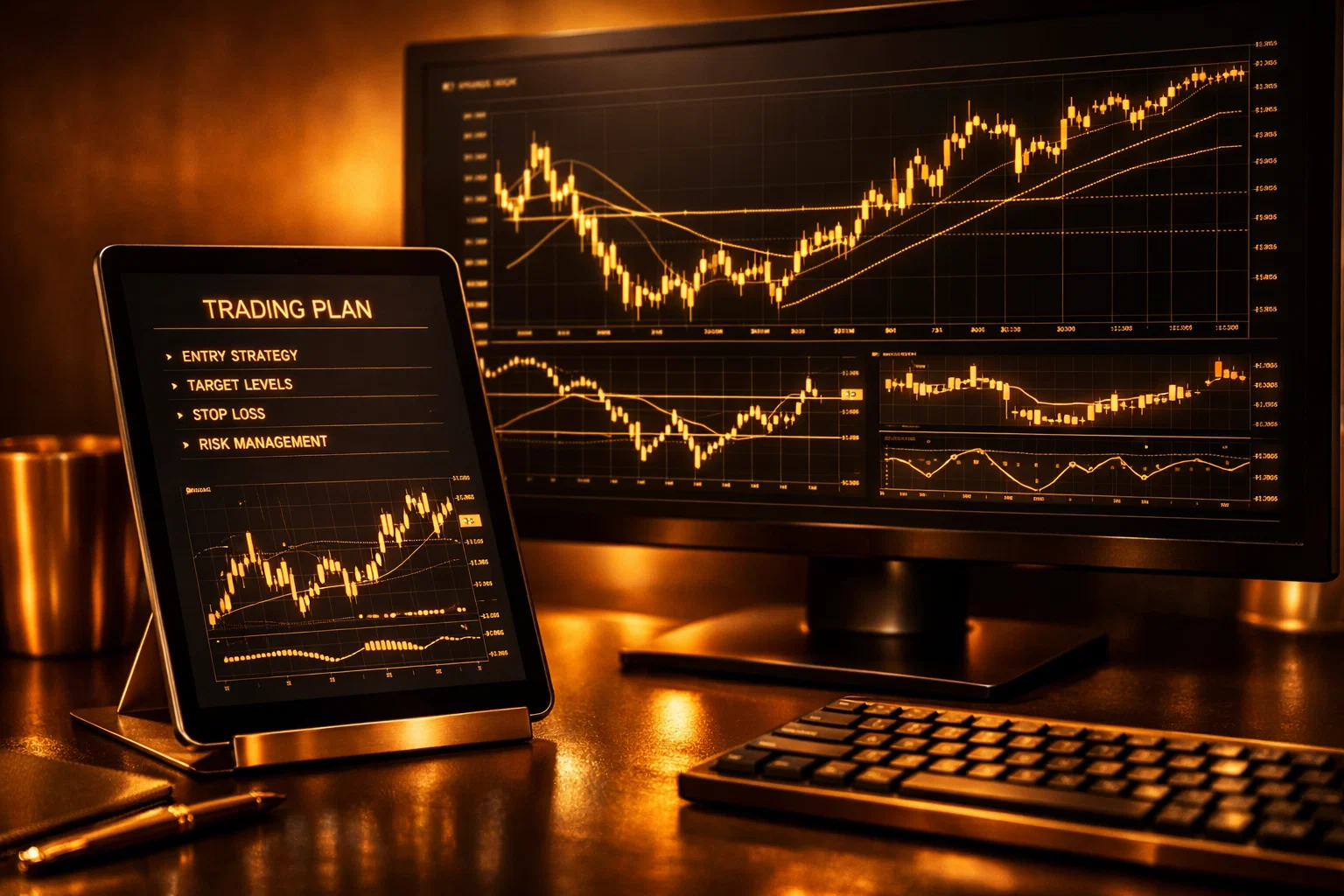
Success in the field requires more than just picking a direction. You need to master the mechanics of the deal.
Bid-Ask Spread and Transaction Costs
In every market, there are two prices: the Bid (what buyers are willing to pay) and the Ask (what sellers want). The difference between them is the spread. This is a primary cost of business. If the spread is wide, it is harder to make a profit because the price must move further just to break even.
Leverage and Margin Requirements
Leverage allows you to control a large position with a relatively small amount of money. For example, 10:1 leverage means you can control 1,000 units with only 100 units of capital. While this tool can magnify successful results, it also accelerates losses. Engaging in the market is inherently risky because of this magnification.
Order Types: Market, Limit, and Stop Orders
To manage your entries and exits, you use different orders:
- Market Order: Executes immediately at the best available current price.
- Limit Order: Executes only at a specific price or better.
- Stop Order: Becomes a market order once a certain price level is reached, often used for risk management.
Market Structure: Trends, Ranges, and Volatility
Markets generally move in one of three ways:
- Uptrend: Higher highs and higher lows.
- Downtrend: Lower highs and lower lows.
- Range: Moving sideways between support and resistance levels.
- Volatility: The speed and magnitude of price changes.
Technical vs Fundamental Analysis Methods
Market participants use two main schools of thought for analysis:
- Fundamental Analysis: Looking at economic data, earnings reports, and central bank policies.
- Technical Analysis: Studying charts, patterns, and indicators to predict future price movement based on historical data.
Popular Trading Style and Trading Strategies
Your chosen style should match your personality, risk tolerance, and time availability.
Day Trading: Short-Term Intraday Movements
Intraday deals involve buying and selling financial instruments with the goal of closing all positions within the same session. These participants look for high volatility and small, frequent price moves. It is a demanding approach that requires constant attention during business hours.
Swing Trading: Capturing Multi-Day Price Swings
This is a medium-term style where positions are held for several days or weeks. This is popular for those who have other jobs, as it doesn’t require staring at screens all day. These actors look for “swings” in market trends.
Position Trading: Long-Term Strategic Moves
This is a long-term approach where positions are held for months or even years. Such participants ignore short-term noise and focus on major economic shifts. This style is closest to traditional investing.
Scalping: High-Frequency Small Profit Gains
Scalping is a very short-term strategy where actors exit positions within seconds or minutes. The aim is to capture tiny price movements multiple times a day. It requires immense discipline and a very fast electronic platform.
Algorithmic and Automated Trading Systems
Many professional participants use software to execute orders based on pre-set rules. Automated systems remove human emotion from the equation and can execute tasks much faster than any human could.
Psychology, Risk, and Disadvantages of Trading
The biggest hurdle for most participants is not the math, but the mind. Recognizing the disadvantages of this activity is crucial before you risk capital.
Impact of Human Emotions on Decision Making
Fear and greed are the two dominant emotions in the market. Fear can make you exit a good position too early, while greed can make you hold a losing one for too long. Success in the market requires an almost robotic adherence to your rules.
Developing Disciplined Trading Plan
A detailed plan is your roadmap. It should specify:
- Which markets you enter.
- Your entry and exit criteria.
- The maximum amount you are willing to lose per deal.
- Your financial goals.
Stop-Loss Placement and Capital Preservation
A stop-loss is an order that automatically closes a losing deal at a certain level. This is the most important tool for risk management. Approximately 70-89% of retail investor accounts lose money when using CFDs, often because they fail to use stop-losses properly.
Risk-Reward Ratio Calculation
A common rule of thumb is to aim for a risk-reward ratio of at least 1:2. This means for every 1 unit you risk, you aim to make 2 units. With this ratio, you can be wrong more than half the time and still be profitable.
Calculation: Profit Target – Entry Price / Entry Price – Stop Loss = Risk Reward Ratio
Managing Overtrading and Psychological Bias
Opening too many positions happens when a person feels the need to be in the market at all times, leading to poor quality setups and high costs. It is often a result of trying to “win back” losses. Recognizing these biases is essential for long-term survival in the market.
How to Start Trading Journey for Beginner
If you are new to the world of finance, follow a structured path to minimize early mistakes.
Selecting Appropriate Broker and Trading Platform
Your intermediary should be regulated by a major authority (like the Financial Conduct Authority). Look for an online platform that is stable, offers the assets you want, and has transparent pricing. Avoid firms with unusually high fees or poor reviews.
Setting Up Demo and Live Trading Accounts
Most brokers offer a demo setup where you can practice with virtual money. This is the best way for a beginner to learn how the software works and test strategies without risking real capital. Only move to a live setup when you have a proven track record on the demo.
Analyzing Market Data and Price Action
Start by learning to read Japanese candlestick charts. These show the open, high, low, and close prices for a given period. Combining this with market analysis of economic news will help you understand why prices move.
Executing First Trade: Step-by-Step Process
- Research: Identify a setup based on your plan.
- Analyze: Check the risk-reward ratio.
- Set Orders: Place your entry, stop-loss, and take-profit orders.
- Execute: Click the buy or sell button.
- Detach: Let the outcome play out without interfering emotionally.
Monitoring Positions and Exit Strategies
Once a position is live, you must monitor it to see if the market conditions change. However, avoid “micro-managing” every small tick. Your exit strategy should be decided before the deal is even opened. Stick to your plan whether the outcome is a win or a loss.
Frequently Asked Questions
What is the primary difference between a bull and a bear market?
A bull market occurs when the financial market experiences a sustained period of rising prices, typically driven by investor optimism and strong economic growth. In contrast, a bear market is characterized by falling prices, usually a decline of 20 percent or more from recent highs, accompanied by widespread pessimism and a weakening economy. Understanding these market cycles helps a participant determine whether to focus on buying long or searching for short-selling opportunities.
How do economic indicators impact the decision of a professional trader?
Professional participants closely monitor economic indicators such as Gross Domestic Product (GDP), inflation rates, and employment data because these figures act as the heartbeat of the global economy. When a central bank releases interest rate decisions, it can trigger massive market moves in forex and stock prices as investors reassess the value of assets. By analyzing these data points, an individual can form a fundamental view of whether a currency or stock is undervalued or overvalued relative to current market conditions.
Is it possible to trade successfully on a part-time basis?
Operating successfully on a part-time basis is achievable, provided you choose a style that fits your schedule, such as swing methods or long-term position taking. Unlike day strategies, which require constant attention during specific hours like the New York or London Stock Exchange sessions, part-time approaches allow you to perform market analysis in the evenings or weekends. The key to part-time success is high discipline, a robust plan, and the use of automated orders like stop-losses to manage risk while you are away from the screen.
Which financial regulations protect retail clients from market manipulation?
Retail clients are protected by various regulatory frameworks, most notably those enforced by bodies like the Financial Conduct Authority (FCA) in the UK or the Securities and Exchange Commission (SEC) in the USA. These organizations require an intermediary to keep client funds in segregated accounts, ensuring that your money is not used for the company’s operational expenses. Additionally, regulations often limit the amount of leverage available to a beginner to prevent catastrophic losses and require firms to provide clear warnings about the risks associated with spread betting or cfd dealing.
What are the hidden costs associated with high-frequency day trading?
While many participants focus on commissions, high-frequency intraday work involves several “hidden” costs that can erode profits, such as the bid-ask spread and price slippage. Slippage occurs when an order is executed at a different price than expected, often happening during periods of high market volatility or low liquidity. Over time, the cumulative effect of these small costs, along with data feed subscriptions and platform fees, can significantly impact the net profit of an individual, making it essential to factor them into any detailed plan.