The silver market has delivered extraordinary returns in 2025, with prices surging over 93% year-over-year to reach approximately $61.84 per troy ounce as of December 10, 2025. This remarkable performance reflects fundamental shifts in global supply-demand dynamics that position silver for sustained appreciation through 2050.
For traders and investors evaluating precious metals exposure, understanding the structural forces driving silver prices becomes critical for portfolio allocation decisions. This comprehensive analysis examines three forecast scenarios through 2050, backed by institutional research and market data.
Current Silver Market Overview 2026
Silver’s 2025 rally represents more than speculative momentum—it reflects converging fundamental catalysts that distinguish this cycle from previous price spikes.
Key Market Drivers:
- Industrial demand acceleration: Solar photovoltaic applications consumed 232 million ounces in 2024, triple the 2015 consumption level
- Institutional positioning: Silver ETF holdings expanded 18% through November 2025, reaching approximately 1.1 billion ounces globally
- Monetary policy shift: Federal Reserve rate cuts reduced opportunity costs for non-yielding precious metals
- Supply constraints: Fifth consecutive year of supply deficits, with production growing only 2% to 944 million ounces in 2025
The current price of silver reflects recognition by institutional investors that structural supply-demand imbalances will persist for years, not months.
Silver Price Forecast: Three Scenario Analysis Through 2050
Professional forecasters utilize scenario planning to account for uncertainty in long-term commodity projections. The following analysis presents base, bull, and bear case scenarios derived from institutional research.
Base Case Scenario (Most Probable Outcome)
The base case assumes controlled growth driven by fundamental supply-demand dynamics without extreme shocks.
Timeline projections:
| Period | Price Range | Key Drivers |
|---|---|---|
| End 2026 | $75–$100/oz | Continued industrial demand, moderate ETF inflows |
| 2028–2030 | $150–$180/oz | Solar capacity expansion, EV production scaling |
| 2035–2040 | $250–$320/oz | Intensifying competition for limited supply |
| 2050 | $300–$350/oz | Compounded inflation effects, sustained green energy growth |
UBS recently upgraded its mid-term target to $55 per ounce, while Bank of America forecasts $65 per ounce by 2026 with an average price around $56.25 per ounce. These conservative institutional targets suggest room for upside surprise as supply deficits widen.
The base case projects silver reaches critical resistance at $100 per ounce within 12-18 months, breaking the 1980 historical high of $49.95 and establishing new all-time highs that attract momentum-based capital.
Bull Case Scenario (Optimistic Projections)
The bull case incorporates aggressive renewable technology adoption, accelerated central bank purchasing, and potential supply disruptions.
Accelerated timeline:
- 2026: Silver surges to $120/oz if ETF inflows exceed current projections
- 2030: Reaches $200-$250/oz as industrial users compete for scarce supply
- 2040: Approaches $400-$450/oz driven by exponential battery and semiconductor demand scaling
- 2050: Could reach $500-$550/oz if solar consumes 85-98% of annual production
Research from the University of New South Wales projects that solar applications alone could absorb between 85-98% of total silver supply by 2050 under current growth trajectories. Such concentration would require dramatic price increases to allocate remaining supply across competing industrial applications including electric vehicles, semiconductors, and medical devices.
Russia’s announcement of approximately $535 million in silver purchases over three years represents a historic shift in official reserve composition that could trigger additional central bank accumulation, adding monetary demand to already tight physical markets.
Bear Case Scenario (Conservative Outlook)
This scenario assumes economic contraction, technological substitution, or demand destruction from elevated prices.
Conservative timeline:
- 2026: Silver retreats to $55-$60/oz following profit-taking and economic weakness
- 2030: Recovers modestly to $80-$90/oz as deficits persist but growth moderates
- 2040: Reaches $150-$180/oz with considerable volatility
- 2050: Stabilizes around $200-$250/oz
Even in the bear case, silver appreciates substantially from current levels, though returns fail to compensate fully for cumulative inflation over 25 years. This scenario requires either successful substitution of silver in solar applications or significant global recession reducing industrial consumption.
Primary Drivers of Silver Price Appreciation

Structural Supply-Demand Deficit
The most compelling fundamental supporting higher silver prices is the persistent and widening supply-demand imbalance.
Global silver mine production remains constrained by structural factors independent of price incentives. Approximately 70% of global silver production occurs as a byproduct of copper, lead, and zinc mining. This byproduct nature means primary production decisions are driven by base metal profitability, not silver prices.
Supply constraints:
- Mexico, accounting for nearly 25% of global supply, experiences production declines as major mines approach end-of-life
- Declining ore grades across Peru, Bolivia, and other major producing regions
- Permitting challenges and social unrest limiting new project development
- Production growth in Chile, Canada, and Morocco insufficient to offset global declines
The supply deficit is projected to widen to approximately 600 million ounces by 2030 as industrial consumption accelerates while mine production remains essentially flat. This represents nearly two-thirds of current annual mine output—an extraordinary imbalance that historically resolves through sustained price appreciation.
Green Energy Industrial Demand Explosion
The renewable energy transition has fundamentally transformed silver’s demand profile from primarily monetary and jewelry applications to critical industrial commodity.
Solar photovoltaic manufacturing has emerged as the dominant industrial use, with silver demand for solar panels projected to reach 273 million ounces by 2030, representing nearly 40% of total forecast demand. With solar capacity expected to grow at approximately 17% annually through 2030, this demand trajectory appears sustainable.
Critical technical factors:
Silver’s unmatched electrical conductivity, solderability, and cost-effectiveness per unit of performance make substitution extremely difficult. Even as manufacturers develop more efficient N-type solar cells, these designs paradoxically require more silver per unit, not less.
Electric vehicle adoption amplifies demand across multiple applications including battery systems, charging infrastructure, and grid modernization. Combined demand from EVs and battery applications is projected to grow from 85 million ounces in 2025 to 240 million ounces by 2030.
Additional secular growth drivers include semiconductor manufacturing expansion and 5G infrastructure deployment, which require silver for circuit boards, connectors, and specialized components.
Monetary Policy and Currency Depreciation
Silver’s investment appeal has strengthened considerably as real yields approach zero or negative territory across developed markets. The U.S. Federal Reserve’s rate-cutting cycle initiated in mid-2025 eliminated much of the opportunity cost traditionally associated with holding non-yielding precious metals.
Central bank reserve diversification represents a structural shift in silver demand composition. Beyond Russia’s announced purchases, other nations exploring alternatives to dollar-denominated reserves may allocate to precious metals including silver. The U.S. designation of silver as a critical mineral in 2025 acknowledges its strategic importance and could support future price appreciation through supply security considerations.
De-dollarization trends provide additional monetary support as countries reduce reliance on dollar assets due to geopolitical tensions and concerns about U.S. monetary policy. Tangible precious metals offer wealth preservation outside traditional financial systems.
Institutional Investment Repositioning
Physical silver ETF holdings surged dramatically in 2025, with exchange-traded products now holding approximately 1.1 billion ounces globally—equivalent to nearly one year of global mine production.
This concentration effectively removes significant supply from industrial circulation and creates a structural price floor. Institutional holders rarely liquidate long-term positions during temporary weakness, providing price stability during corrections.
The inflows represent recognition by major asset managers that silver offers asymmetric upside potential relative to gold, combining industrial growth exposure with monetary hedge characteristics. Historical gold-to-silver ratios suggest silver remains undervalued relative to gold, supporting continued reallocation by portfolio managers seeking relative value opportunities.
Key Timeline Milestones

2026: Establishing Higher Price Base
The current trading level near $62 per ounce provides foundation for this decade’s bull market. Most institutional forecasts project silver reaches the $75-$100 range by end-2026, breaking decisively above the 1980 historical high.
This psychological milestone is critical for attracting additional capital, as new all-time highs typically trigger momentum-based buying and portfolio rebalancing by systematic funds. Technical resistance at round numbers including $70, $80, and $100 will require substantial volume to overcome but should yield to fundamental buying pressure.
2027-2030: Industrial Demand Acceleration Phase
By 2027-2030, solar installations reach critical scale globally, with cumulative photovoltaic capacity expanding more than fivefold from 2020 levels. EV production accelerates dramatically as battery costs decline and government subsidies drive adoption.
During this period, the forecast for 2025 and beyond suggests prices reach $150-$250 per ounce as supply-demand imbalances become impossible for markets to ignore. Supply deficits could exceed 300-600 million ounces annually, forcing industrial users to compete aggressively for available inventory through premium pricing.
2030-2050: Long-Term Structural Scarcity
The final twenty years to 2050 represent the critical test for silver’s structural bull thesis. If current solar growth trajectories continue and substitution efforts fail, silver prices must rise dramatically to ration available supply among competing industrial users.
Conservative assumptions suggest the future price of silver reaches $300-$350 by 2050, while aggressive scenarios incorporating continued institutional investment could see prices reach $500-$550 per ounce. These price levels would provide adequate incentive for primary silver project development and industrial recycling programs, potentially equilibrating supply and demand at much higher prices.
Critical Risk Factors for Silver Investors
Economic Recession or Demand Destruction
A significant global recession would reduce industrial demand across solar installations, EV production, semiconductors, and electronics. Industrial demand for silver proves more resilient than many commodities due to irreplaceable technical properties, but sustained economic contraction would still reduce overall consumption.
In recession scenarios, investment demand for silver as a safe-haven asset might partially offset declining industrial consumption, though net effects typically prove negative for commodity prices in severe downturns.
Technological Substitution
If researchers develop viable alternatives to silver in solar cells, batteries, or electronics, demand could moderate materially. Currently, no cost-effective, scalable substitutes exist, but technological breakthroughs always present tail risks to commodity bull theses.
Improving solar cell efficiency that consumes less silver per watt could partially offset demand growth from increased installations. However, historical data suggests efficiency improvements lag behind installation growth, resulting in net demand increases even as per-unit consumption declines.
Monetary Policy Reversal
If the Federal Reserve or other central banks return to restrictive monetary policy with sharply rising real yields, the investment thesis for precious metals would weaken substantially. Higher real interest rates increase opportunity costs of holding non-yielding silver, potentially triggering selling pressure from institutional investors.
This risk appears limited in the near term given persistent inflation concerns and political pressures against aggressive tightening, but medium-term policy shifts remain possible if inflation unexpectedly declines.
Supply Shock Resolution
If new silver mines develop more rapidly than currently expected, or if primary silver production becomes economically viable at elevated price levels, supply growth could narrow deficits faster than anticipated. This would reduce urgency to ration supply and could limit upside price potential.
Conversely, major supply disruptions from mines in Mexico, Peru, or other key regions could accelerate price appreciation beyond base case scenarios. Geopolitical instability in major producing regions represents asymmetric upside risk for silver prices.
Market Volatility and Near-Term Considerations
Silver exhibits significantly higher volatility than gold, with the ability to appreciate or decline 5-10% or more in brief periods. Current technical indicators suggest potential for near-term consolidation.
The relative strength index (RSI) above 70 typically signals overbought conditions, though during strong trending environments momentum indicators can remain elevated for extended periods. Support levels around $56.50-$57.00 (20-day moving average) and $54-$55 (previous consolidation zone) should contain minor pullbacks.
Technical outlook:
For traders employing technical analysis, resistance remains at psychological levels, including $70, $80, and $100. Breaking these levels decisively would likely trigger additional momentum buying and stop-loss orders from short positions.
Price swings in silver markets require careful position sizing and risk management. Traders should anticipate volatility and structure entries accordingly, using limit orders during consolidation periods rather than chasing momentum at resistance levels.
Investment Strategies for Silver Exposure
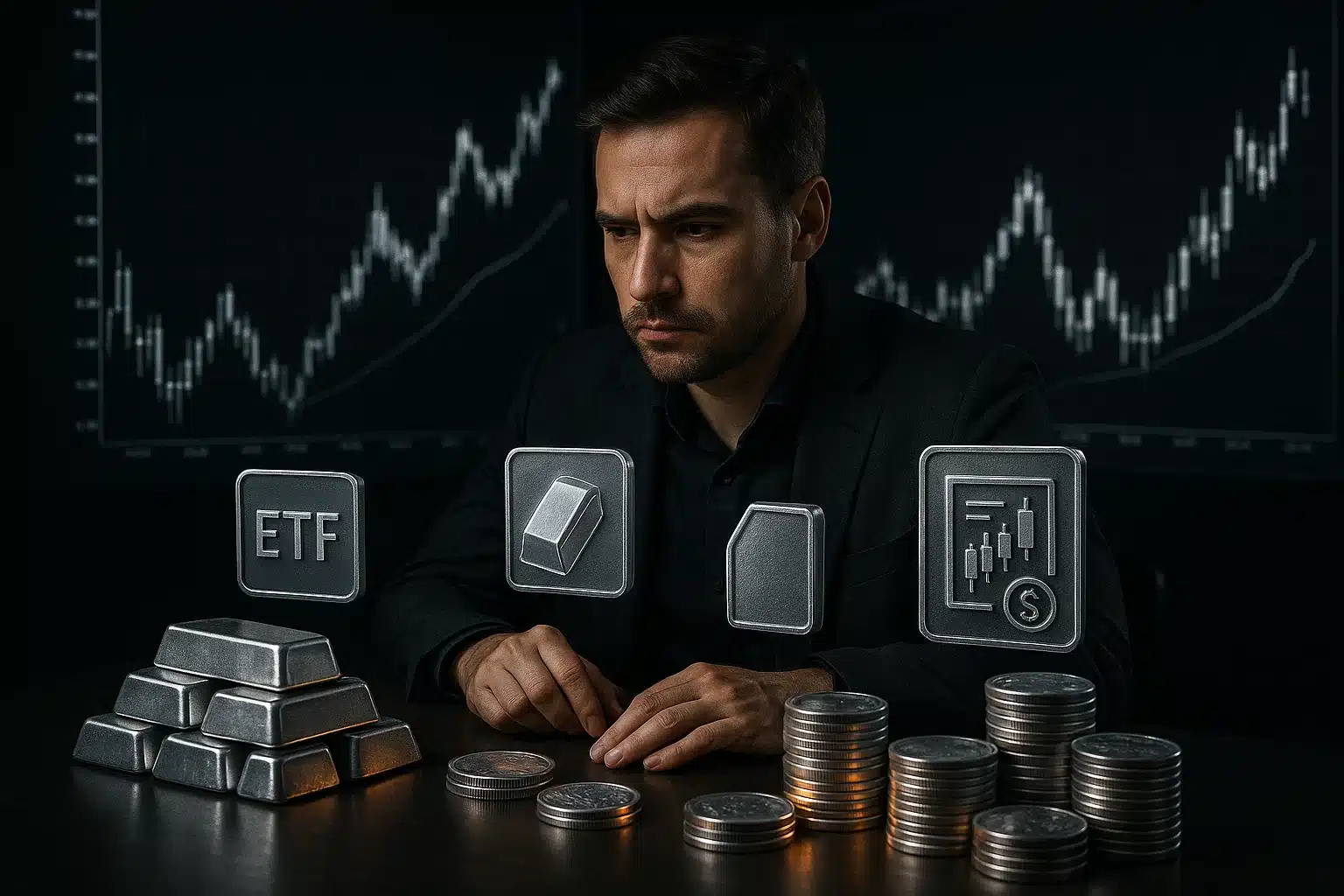
Physical Silver vs. Financial Instruments
Investors can gain silver exposure through multiple vehicles, each with distinct advantages:
Physical silver:
- Provides direct ownership without counterparty risk
- Requires secure storage and insurance
- Lacks liquidity compared to financial instruments
- Appropriate for long-term wealth preservation
Silver ETFs:
- Offer liquidity and ease of trading
- Eliminate storage concerns
- Carry management fees and counterparty risk
- Suitable for tactical allocation and portfolio diversification
Silver futures and options:
- Provide leverage and short-term trading opportunities
- Require active management and margin monitoring
- Appropriate for experienced traders with risk management protocols
Portfolio Allocation Considerations
Financial advisors traditionally recommend 5-10% precious metals allocation within diversified portfolios. Given silver’s dual characteristics as both industrial commodity and monetary asset, allocation decisions should consider:
- Investment horizon: Longer timeframes favor physical holdings; shorter horizons suit ETFs or futures
- Risk tolerance: Silver’s volatility requires higher risk tolerance than bonds or large-cap equities
- Correlation benefits: Silver provides diversification relative to traditional equity and fixed income holdings
- Inflation hedge: Precious metals historically preserve purchasing power during currency depreciation
Investors with medium to long-term time horizons and tolerance for volatility should view silver as strategic positioning to balance portfolio risk, hedge inflation, and gain exposure to the global clean energy transition.
Conclusion: Silver Price Outlook Through 2050
The forecast for silver through 2050 presents one of the most compelling fundamental cases for commodity appreciation, driven by converging forces of exploding green energy demand, structural supply constraints, institutional monetary repositioning, and central bank reserve diversification.
The base case scenario projects silver reaches $75-$100 by 2026, $150-$250 by 2030, and $300-$350 by 2050. Bull case scenarios incorporating continued supply-demand deficits and institutional accumulation could push prices toward $500-$550 by mid-century.
Key distinguishing factors:
Demand growth stems from megatrends—renewable energy transition, electrification, semiconductor expansion—with 20-30 year time horizons, while supply growth remains constrained by structural limitations including byproduct mining economics, declining ore grades, and permitting challenges. This mismatch is unlikely to resolve quickly, supporting elevated prices for decades.
Investors should anticipate considerable volatility in silver prices, with near-term corrections interspersed within longer-term uptrends. The next critical milestone—breaking above the 1980 high and establishing new all-time highs above $100—appears likely within 12-18 months based on current supply-demand dynamics and institutional positioning.
For traders and investors evaluating precious metals exposure, silver offers asymmetric risk-reward characteristics that merit serious portfolio consideration. Whether prices follow base, bull, or bear case trajectories, historical data suggests the structural bull thesis remains intact through 2050.
Frequently Asked Questions About Silver Price Predictions
What is the silver price forecast for 2026 and beyond?
The silver price forecast for 2026 and beyond suggests continued appreciation driven by structural supply deficits and industrial demand growth. Current prices around $61.84 per ounce are expected to reach $75-$100 by end-2026, with base case projections targeting $150-$180 by 2030 and $300-$350 by 2050. Bull case scenarios see silver reaching $200-$250 by 2030 and potentially $500-$550 by 2050 if solar applications consume 85-98% of annual production as research suggests.
How do silver price predictions compare to gold price movements?
Silver price predictions typically show greater volatility relative to gold, with silver exhibiting 5-10% price swings in brief periods compared to gold’s more stable movements. Historical gold-to-silver ratios suggest silver remains undervalued relative to gold, offering asymmetric upside potential. While both precious metals benefit from monetary policy shifts and inflation hedging demand, silver’s dual nature as both industrial commodity and monetary asset creates distinct price drivers. The gold bull market that began in recent years has supported silver’s appreciation, though silver’s industrial applications provide additional price support independent of gold price movements.
What factors influence the current price of silver and future price growth?
The current price of silver reflects multiple converging factors: industrial demand from solar panels consuming 232 million ounces in 2024, institutional ETF holdings reaching 1.1 billion ounces globally, Federal Reserve rate cuts reducing opportunity costs for precious metals, and five consecutive years of supply deficits. Future price growth depends on solar capacity expansion (projected 17% annually through 2030), electric vehicle adoption, semiconductor manufacturing growth, central bank reserve diversification, and structural supply constraints from byproduct mining economics. The live silver price responds to these fundamental drivers alongside technical factors and short-term price swings from trading activity.
Should investors buy silver now or wait for price corrections?
The decision to buy silver depends on individual investment horizons and risk tolerance. Current technical indicators with RSI above 70 suggest potential near-term consolidation, with support levels around $54-$57 potentially offering more attractive entry points. However, attempting to time short-term price movements in silver trading carries substantial risk given the metal’s volatility. For long-term investors focused on the structural bull thesis through 2030-2050, current price levels may represent reasonable entry points despite near-term overbought conditions. Dollar-cost averaging into physical silver or silver ETFs can mitigate timing risk while building strategic positions.
What are the price predictions for silver in 2030, 2040, and 2050?
Silver price predictions for these milestone years vary by scenario. The base case forecasts for 2030 target $150-$180 per ounce, with bull case projections reaching $200-$250 driven by industrial users competing for scarce supply. Forecasts for 2040 suggest $250-$320 in the base case and $400-$450 in optimistic scenarios as battery and semiconductor demand scales exponentially. By 2050, conservative estimates see silver reaching $300-$350, while aggressive forecasts incorporating solar demand consuming up to 98% of production project $500-$550 per ounce. These long-term silver price predictions reflect the potential of silver to benefit from megatrends in renewable energy and electrification over 20-30 year horizons.
How does the silver market compare to opportunities to invest in gold?
The silver market offers distinct advantages compared to opportunities to invest in gold, particularly for investors seeking industrial demand exposure alongside monetary hedge characteristics. Silver’s lower absolute price per ounce provides accessibility for investors with smaller capital allocations, while its higher volatility creates potential for amplified returns relative to gold. The silver market’s supply-demand dynamics differ substantially from gold, with industrial applications representing approximately 50% of silver demand versus less than 10% for gold. This industrial demand component from solar panels, electric vehicles, and semiconductors provides growth drivers independent of monetary factors that dominate gold demand. Both precious metals merit consideration in diversified portfolios, with silver offering higher risk-reward potential alongside gold’s stability and liquidity advantages.