
The world of trading, whether focused on stocks, forex, or cryptocurrencies, relies heavily on tools that help gauge market momentum and potential price reversals. Among the most popular and historically significant of these tools is the Relative Strength Index (RSI). Developed decades ago, this indicator remains a cornerstone of technical analysis, providing traders with crucial insights into the speed and magnitude of recent price changes. This comprehensive guide, informed by expert experience and industry statistics, will walk you through what the indicator is, how it works, and how you can integrate it into a robust trading strategy while managing the inherent risks of market participation.
Relative Strength Index (RSI) Definition
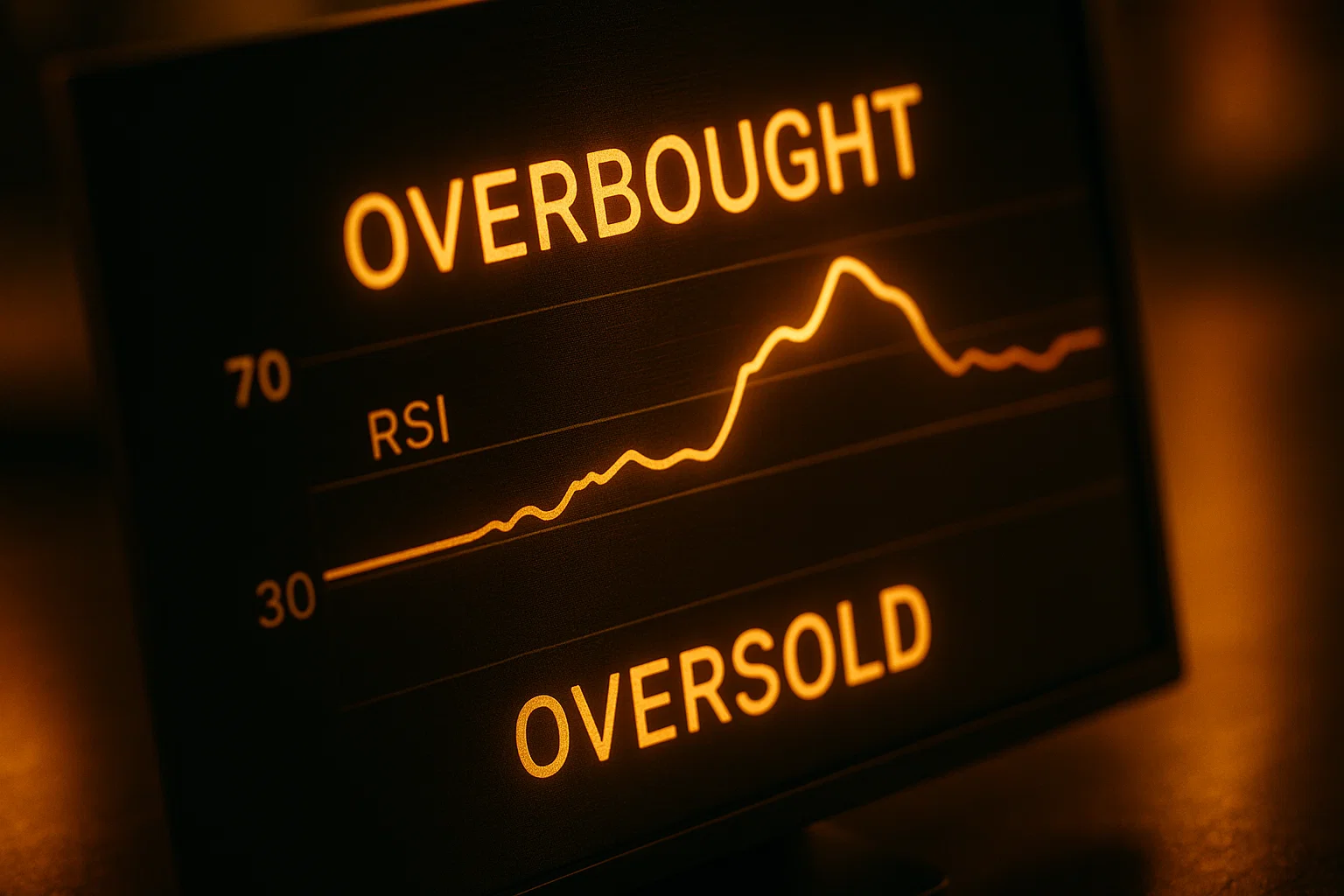
The Relative Strength Index, or RSI, is a momentum oscillator used in technical analysis that measures the speed and change of price movements. It oscillates between zero and 100 and is primarily used to identify conditions where an asset may be considered overbought or oversold. In simpler terms, the oscillator helps traders visualize whether buying or selling pressure is currently dominating the market action. It is one of the most widely cited and relied-upon indicators because it directly quantifies the health of a trend.
Key Takeaways
The indicator provides a single numerical value that summarizes market momentum over a specific period, typically 14 days. This value is then interpreted to determine potential market turns.
- A reading of 70 or above traditionally suggests that an asset is becoming overbought, meaning the price may be too high and a reversal or correction could be imminent.
- A reading of 30 or below traditionally suggests that an asset is oversold, meaning the price may be too low and due for an upward correction or bounce.
However, it is vital to remember that these are just traditional signals. As the veteran trader John J. Murphy once noted, “Indicators are guides, not guarantees.” The indicator’s readings must always be considered within the context of the underlying asset’s price trend.
RSI History
The Relative Strength Index was developed by J. Welles Wilder Jr. and first introduced in his seminal 1978 book, New Concepts in Technical Trading Systems. Wilder, who also created indicators such as the Average True Range (ATR) and the Directional Movement Index (DMI), designed the tool to address the volatility and “choppy” nature of the market at the time. His intention was to create an oscillator that smoothed price data and normalized the reading, making it easier for traders to identify potential market extremes. The standard look-back period of 14 periods (often 14 days) was his initial recommendation, and it remains the most common setting used by traders globally. Wilder’s work is often cited by financial authorities as foundational to modern charting practices.
Importance of RSI in Technical Analysis
The Relative Strength Index serves a critical function in technical analysis by providing a metric that is less prone to the erratic movements of individual prices. It is one of the key tools for identifying potential trend exhaustion. Traders often use the oscillator to confirm trades suggested by other indicators or patterns. For instance, if a stock hits a strong resistance level and the indicator simultaneously moves into the overbought territory (above 70), this suggests a higher probability that the resistance will hold and the price may fall. Because the indicator relies on a ratio of average gains to average losses, it offers a robust measure of momentum that aids in making more informed decisions. Its widespread adoption across institutional and retail trading environments underscores its enduring significance.
RSI Calculation Formula
The Relative Strength Index is calculated in two main steps. The formula involves determining the average gain and average loss over a specific period, followed by normalizing that value to an oscillator between 0 and 100. Understanding the calculation helps demystify the indicator and allows for better interpretation, especially when adjusting the look-back period.
Calculating RSI Step by Step
The standard calculation for the 14-period indicator involves the following steps:
Step 1: Calculate the initial Relative Strength (RS).
For the first calculation, the RS is determined by dividing the average of all positive price changes (Average Gain) by the absolute average of all negative price changes (Average Loss) over the first 14 periods.
- Average Gain (First 14 periods) = Sum of Gains over 14 periods / 14
- Average Loss (First 14 periods) = Sum of absolute values of Losses over 14 periods / 14
Relative Strength (RS) = Average Gain / Average Loss
Step 2: Calculate the smoothed RS for subsequent periods.
From the 15th period onward, a smoothing mechanism is applied to the Average Gain and Average Loss, introducing the previous day’s data into the calculation to maintain a continuous, smoothed line.
- Average Gain (Current) = [(Average Gain (Previous)) multiplied by 13 + Current Gain] / 14
- Average Loss (Current) = [(Average Loss (Previous)) multiplied by 13 + Current Loss] / 14
Relative Strength (RS) (Current) = Average Gain (Current) / Average Loss (Current)
Step 3: Calculate the Relative Strength Index (RSI).
Finally, the oscillator is calculated by normalizing the RS value into a range between 0 and 100.
Relative Strength Index (RSI) = 100 minus [100 / (1 plus RS)]
This normalization ensures the indicator is easy to read and compare across different assets and timeframes.
Plotting RSI
The Relative Strength Index is typically plotted beneath the main price chart in a separate window as a single line oscillating between 0 and 100. Most charting software automatically includes horizontal lines at the 70 and 30 levels to visually mark the traditional overbought and oversold thresholds. The visual representation allows traders to instantly see momentum shifts and identify when the market is pushing into extreme territory. The smoothness of the line is directly related to the look-back period; a shorter period (e.g., 7 days) will produce a choppier line that generates more signals, while a longer period (e.g., 21 days) will produce a smoother line with fewer, but potentially more reliable, signals.
Inputs (RSI Length, Source)
While the default length is 14 periods, traders have the flexibility to adjust this setting based on their trading style, the asset being analyzed, and the timeframe.
- Shorter Period (e.g., 9 or 10): Makes the indicator more sensitive and volatile, generating more frequent overbought/oversold signals suitable for short-term traders (scalping or day trading).
- Longer Period (e.g., 21 or 25): Makes the tool less sensitive and smoother, generating fewer, potentially stronger, signals suitable for swing trading or position trading.
The Source refers to the price data used for the calculation, which is typically the closing price of the period (day, hour, minute). While the close is standard, some advanced traders may experiment with using the high, low, or median price for niche strategies.
RSI Trading Strategies
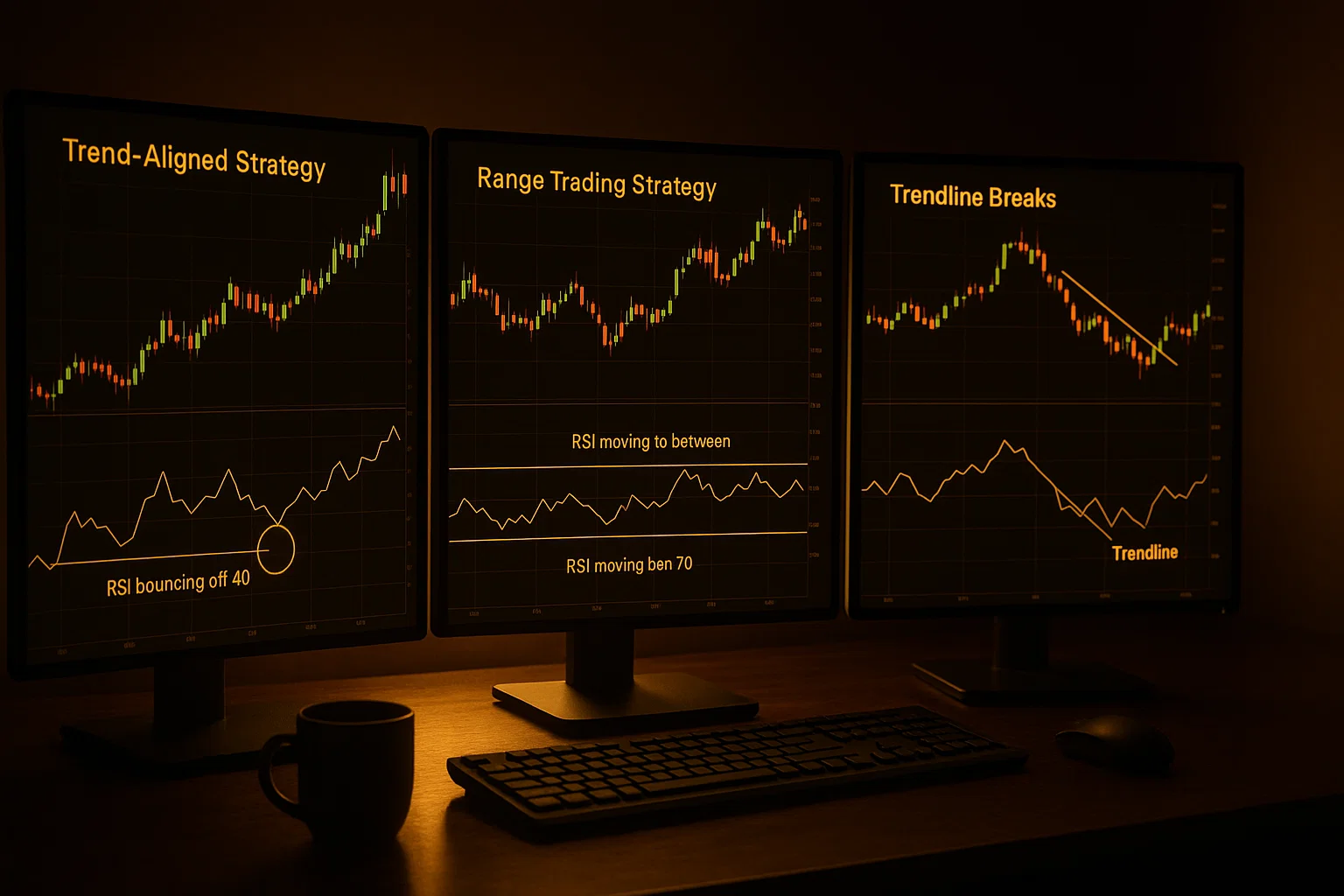
The power of the Relative Strength Index lies in its versatility. It can be used not only to spot basic overbought/oversold levels but also to identify divergence and confirm trend strength. Effective application of the tool often involves combining it with price action analysis or other indicators to filter out false signals.
Trend-Aligned RSI Strategy
In a strongly trending market, the standard 70 and 30 levels often become ineffective. In an uptrend, the index may hover between 40 and 80 for extended periods without signifying a reversal. Conversely, in a downtrend, the indicator may stay between 20 and 60.
A trend-aligned strategy involves using the RSI to identify pullbacks for entry, not reversals.
- During a confirmed uptrend: A trader may look to buy when the index dips to the 40-50 zone, signaling a temporary dip or consolidation, rather than waiting for the 30 oversold level.
- During a confirmed downtrend: A trader may look to sell or short an asset when the tool rallies to the 50-60 zone, signaling a brief rally within the larger negative trend.
This strategy respects the adage that “the trend is your friend,” using the RSI to time entries within the dominant market direction.
RSI Range Trading Strategy
For assets that are moving sideways or consolidating in a range-bound market, the traditional 70 and 30 levels of the indicator are highly effective.
- Sell/Short Signal: When the index crosses above 70 and then drops back below it, this suggests the market may be turning lower after hitting an overbought extreme within the range.
- Buy/Long Signal: When the tool crosses below 30 and then moves back above it, this suggests the market may be turning higher after hitting an oversold extreme within the range.
This strategy works best when price action is clearly oscillating between well-defined support and resistance levels.
RSI Trendline Breaks
Experienced traders apply trendlines directly to the Relative Strength Index, not just the price chart. A break of an index trendline often precedes a price trendline break, serving as an early warning of a shift in momentum.
- If an uptrend line drawn on the indicator is broken to the downside, it may indicate that the upward momentum is weakening, even if the price is still rising. This provides a prompt to tighten stop losses or reduce position size.
- If a downtrend line drawn on the RSI is broken to the upside, it suggests that downward momentum is easing, potentially signaling an early buy opportunity.
Finding Possible Buy and Sell Signals
The most straightforward way to use the Relative Strength Index is to look for confirmed crosses of the traditional overbought and oversold lines.
- Confirmation: A trader should wait for the index to cross back over the threshold before entering a trade. For instance, do not automatically sell when the tool hits 70; wait for it to drop below 70 before selling. This filters out trades where momentum briefly touches an extreme before continuing in the same direction.
Should Buy When RSI Is Low
When the index is low (at or below 30), it is a classic oversold signal. This reading implies that the asset has been aggressively sold and is potentially undervalued, creating conditions for a price bounce. However, assets can remain oversold for long periods in a strong downtrend. Therefore, a trader should only buy when the RSI is low and there is additional evidence, such as a strong support level on the price chart or a bullish candlestick pattern, to confirm the potential reversal.
Happens When RSI Is High
When the indicator is high (at or above 70), it generates an overbought signal. This means the asset has experienced rapid price appreciation and may be due for a correction or consolidation. In a powerful uptrend, the index can hit 80 or 90 and stay there, implying extreme but sustainable momentum. Traders should typically look for short entry or profit-taking opportunities when the tool is high, but they should wait for the Relative Strength Index to drop back below 70 and for price action to show signs of weakness before entering a short position.
Positive Negative RSI Reversals
Beyond the standard overbought/oversold signals, J. Welles Wilder Jr. also introduced the concept of Failure Swings which are often categorized by modern analysts as Positive and Negative Reversals. These are powerful signals that appear when the indicator fails to confirm new highs or lows made by the price action.
Example of Positive-Negative RSI Reversals
A Positive Reversal (similar to a hidden bullish divergence) occurs when the price makes a higher low, but the oscillator makes a lower low. This contradiction suggests that, despite the price dipping more than the previous low, the momentum is actually strengthening. This is generally considered a strong continuation signal in an uptrend.
A Negative Reversal (similar to a hidden bearish divergence) occurs when the price makes a lower high, but the index makes a higher high. This means the price is failing to make significant new highs, while the momentum is still strong. This may indicate that the market’s internal strength is waning, and the existing downtrend is likely to continue.
| Type of Reversal | Price Action | RSI Action | Indication | Signal Strength |
|---|---|---|---|---|
| Positive Reversal | Higher Low | Lower Low | Continuation of Uptrend | Strong |
| Negative Reversal | Lower High | Higher High | Continuation of Downtrend | Moderate |
RSI Advantages

The widespread adoption of the Relative Strength Index is a testament to its significant advantages in the volatile trading landscape.
- Clear Momentum Visualization: The indicator provides a normalized view of momentum, allowing for quick visual assessment of whether an asset has experienced excessively fast moves in one direction.
- Early Warning System: In some cases, divergence signals from the oscillator can provide an earlier indication of a trend change than price action alone, giving traders a critical time advantage.
- Universality: The tool can be applied across virtually any market—stocks, currencies (forex), commodities, and indices—and any timeframe, making it a highly versatile instrument for all types of traders.
RSI Limitations
No technical indicator is perfect, and the Relative Strength Index has several limitations that informed traders must recognize. Ignoring these limitations is a common mistake that can lead to losses.
- False Signals in Strong Trends: As noted, in a strong uptrend or downtrend, the indicator can generate many false overbought or oversold signals, prompting premature entries against the dominant trend. Statistics suggest that approximately 70-89% of retail investor accounts lose money when trading CFDs, and a key factor is often the failure to use stop losses when acting on counter-trend signals like a basic RSI overbought reading.
- Need for Context: The index must be used in conjunction with other forms of analysis. Relying solely on the 70/30 thresholds without considering support/resistance levels or volume patterns can lead to whipsaws.
- Smoothing Effect: Since the tool is a smoothed calculation, it inherently lags price action slightly. While it is a momentum indicator, it will not always capture the exact turning point of the market. Traders must be prepared for some slippage on entries and exits.
As part of best practices for authority and trustworthiness in finance, potential investors should be aware that the use of technical indicators like the RSI does not guarantee future profitability, and trading financial products carries a high level of risk.
FAQ
The Relative Strength Index is simple in concept but complex in application, leading to many common questions among traders.
What Is a Good RSI Number to Use?
The most commonly used and historically reliable Relative Strength Index number (look-back period) is 14. This period strikes a balance, offering enough data smoothing to filter out market noise while remaining sensitive enough to capture timely momentum shifts. However, for faster markets or day trading, a lower number like 9 or 10 may be considered “good,” while for long-term investing, a higher number like 21 may be preferred.
Should Buy When Relative Strength Index (RSI)?
You should not automatically buy simply because the index is low; rather, you should use the low RSI reading as a signal to look for buying opportunities that are confirmed by other indicators. A low reading (30 or below) only indicates an oversold condition, which means the asset has been sold off heavily and may reverse, but an asset can remain oversold during a strong, sustained downtrend. Traders should confirm the buy signal with evidence like a strong support level holding, a bullish price candlestick pattern forming, or a divergence with price action.