
Cryptocurrency trading presents a complex and high-risk opportunity for individuals looking to participate in the rapidly evolving digital asset markets. As a financial services and trading expert, I can tell you that succeeding here is less about luck and more about disciplined strategy, rigorous risk management, and a deep understanding of market mechanics. The primary goal of learning how to trade cryptocurrency is to profit from the volatile price movements of assets like Bitcoin and Ethereum. This guide breaks down the essential steps, from the basic concepts to advanced analytical methods, ensuring you approach the market with the experience and transparency required for this challenging financial domain.
Cryptocurrency Basics

Before placing your first trade, you must establish a solid foundation in the assets you are dealing with. Treating this step as optional often leads to poor decision-making and amplified risk.
What is Cryptocurrency
A cryptocurrency is a digital or virtual currency secured by cryptography, which makes it nearly impossible to counterfeit or double-spend. Crucially, cryptocurrencies are typically decentralized, meaning they are not subject to government or financial institution control, a concept pioneered by Bitcoin in 2009. This decentralized nature is both the market’s greatest attraction and its primary source of regulatory uncertainty and volatility.
How Cryptocurrency Markets Work
Cryptocurrency markets operate 24 hours a day, seven days a week, setting them apart from traditional stock exchanges. Trading occurs on various exchanges globally, where buyers and sellers place orders. Prices are determined by supply and demand dynamics, which are heavily influenced by news events, technological developments (like network upgrades), regulatory shifts, and overall market sentiment. These markets are essentially a global, continuous auction for digital scarcity.
Key Terminology
To navigate this landscape, you must speak the language. The blockchain is the fundamental, distributed ledger technology that records all cryptocurrency transactions across many computers, ensuring transparency and permanence. When you own crypto, you do not physically possess a coin; you own a record on the blockchain.
- Wallet: A digital tool used to interact with the blockchain. It stores the cryptographic information needed to access your funds.
- Public Key: Comparable to a bank account number, this address is public and used to receive funds.
- Private Key: The critical piece of information, like a wallet password, that proves ownership of your crypto and authorizes transactions. Never share your private key.
Crypto Trading vs Investing

The difference between trading and investing is rooted in goals, timelines, and strategy. Confusing the two is a common error for market newcomers.
Trading Goals vs Investing Goals
Investing typically involves buying and holding an asset for a long period—years, or even decades—based on the belief in the underlying technology or project growth. The goal is capital appreciation over the long run. Trading, conversely, aims to generate profits from short-term price fluctuations. Traders focus on market timing, technical patterns, and news events, often using strategies that involve buying and selling within weeks, days, or even minutes.
Short-Term vs Long-Term Trading
Short-term trading, encompassing day trading and scalping, requires constant market monitoring, high emotional control, and the ability to execute trades quickly. It relies heavily on technical analysis. Long-term trading, such as swing trading, requires patience and typically combines both technical analysis for entry/exit points and fundamental analysis to assess the asset’s longer-term value.
Risk Profiles Comparison
Trading generally carries a higher risk profile than long-term investing due to the frequency of transactions and the exposure to minor, unpredictable market movements. Furthermore, leveraged trading, often used in short-term strategies, can amplify both profits and losses significantly. A long-term investment strategy may smooth out some of the short-term volatility but remains subject to fundamental market risks.
- Investor Risk Focus: Project failure, macro-economic shifts, regulatory environment.
- Trader Risk Focus: Market timing, sudden liquidations, technical errors, short-term volatility.
Step-by-Step Guide to Trading Crypto
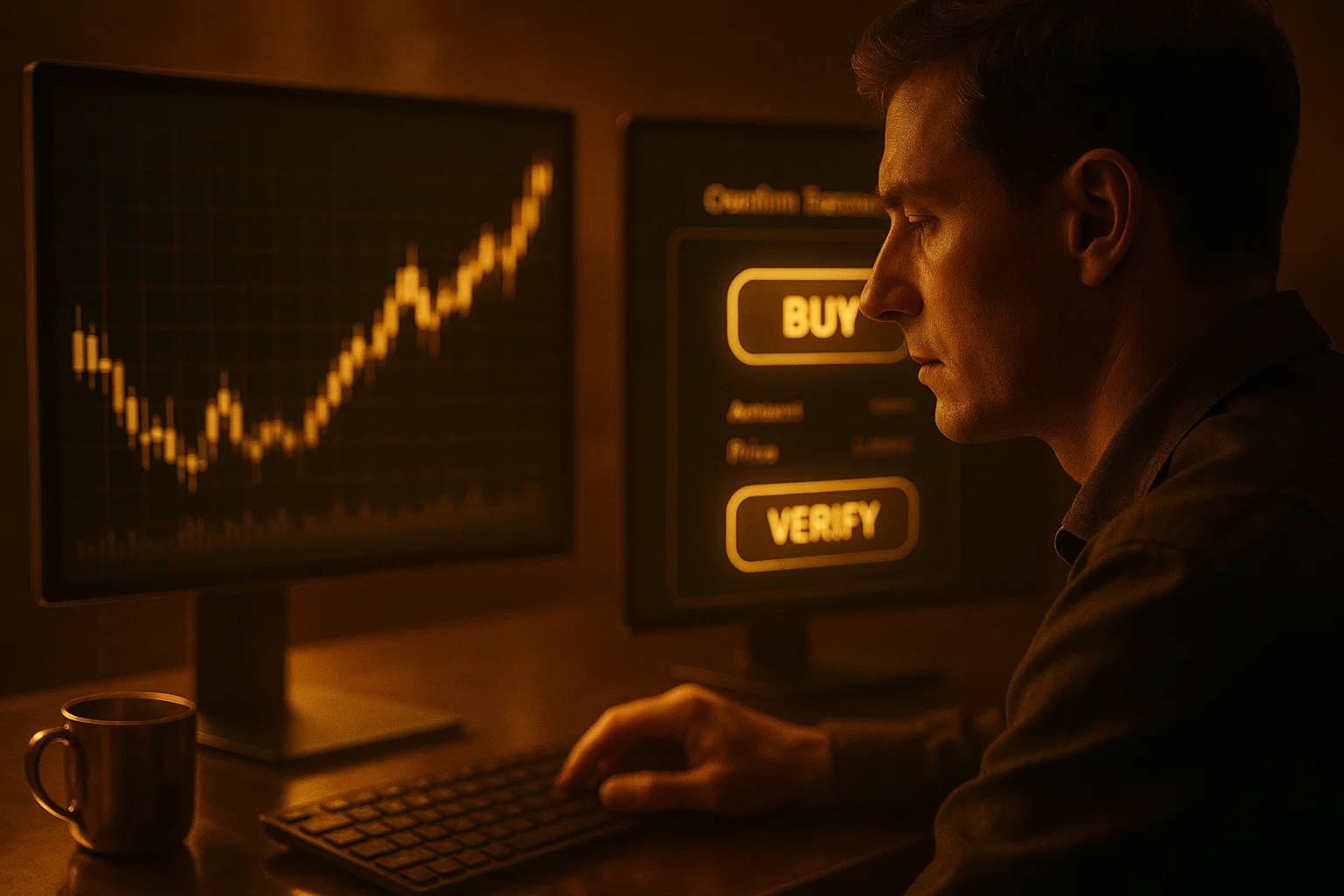
Once you understand the basic mechanics, you can proceed with the actionable steps required to begin trading. Following a structured process mitigates risk and ensures proper financial diligence.
Choose a Reputable Exchange
Your exchange is your primary gateway to the crypto market. Selecting a reputable exchange is perhaps the most important decision, as it dictates security, liquidity, and available trading pairs. Look for platforms with a strong track record, robust security measures (like two-factor authentication and cold storage for user funds), and transparent fee structures. Major, regulated exchanges are preferable, as they often comply with Know Your Customer (KYC) and Anti-Money Laundering (AML) standards, which may offer a degree of regulatory safety for users.
Create and Verify Account
Due to global regulations, you will need to create an account and complete the required identity verification process. This involves submitting personal identification documents. While it may seem cumbersome, this KYC process is a critical layer of security and is increasingly required for access to larger trading limits and advanced features. Your ability to trade cryptocurrency is directly tied to the security and compliance of the platform you choose.
Fund Trading Account (Fiat or Crypto Deposit)
You will need to deposit funds to start trading. Exchanges accept two main types of deposits:
- Fiat Currency: Government-issued money (e.g., USD, EUR) transferred from a linked bank account.
- Cryptocurrency: Funds transferred from an external wallet (e.g., Bitcoin from a private wallet).
Start with a small amount—an amount you are prepared to lose—to learn the platform interface and manage initial trading errors without major financial consequences.
Place Buy, Sell, and Swap Orders
Trading is executed through various order types:
- Market Order: Executes immediately at the best available current price. Best for quick entry/exit but may suffer from “slippage” during periods of high volatility.
- Limit Order: Sets a specific price at which you are willing to buy or sell. The order is only executed if and when the market reaches that price, allowing for greater control over entry and exit points.
- Stop Order: Used for risk management, setting a price that triggers a market or limit order to close a position, thereby limiting a potential loss.
A swap is a simple exchange of one cryptocurrency for another (e.g., Bitcoin for Ethereum) directly on the platform.
Monitor Positions and Trade History
Effective trading is impossible without constant, objective monitoring. Once a position is opened (a trade is placed), you must track its performance against your predetermined targets and stop-loss levels. Regularly reviewing your trade history allows you to identify patterns in your successes and failures, helping you refine your strategy and avoid repeating costly mistakes. This discipline is a core component of trading expertise.
Withdraw Crypto to Personal Wallet
For long-term security, it is highly recommended to withdraw significant crypto holdings from the exchange and store them in a secure private wallet (ideally a hardware wallet, known as cold storage). Exchanges are susceptible to hacking; keeping large sums there increases your risk exposure. When you move your crypto, you take custody of your private keys, shifting the responsibility for security from the exchange to yourself.
Trading Styles and Strategies
Successful traders do not merely guess; they employ defined strategies tailored to their time commitment, risk tolerance, and capital size. The chosen strategy dictates how you approach market analysis and risk.
Day Trading
Day trading involves opening and closing all positions within the same trading day. The goal is to capture profits from small, intraday price movements. This requires extensive focus, fast execution, and detailed knowledge of technical indicators. Day traders seek high-liquidity assets to ensure they can enter and exit positions quickly without impacting the market price significantly.
Swing Trading
Swing trading captures potential gains over a period of a few days to a few weeks, aiming to profit from the “swing” in price movement. This style is often less stressful than day trading, relying on identifying clear trends or chart patterns on daily or weekly timeframes. Swing traders typically spend a few hours on analysis each day but do not need to monitor charts constantly.
Scalping
Scalping is the fastest trading style, aiming to profit from tiny price changes, often closing trades within seconds or a few minutes. Scalpers must execute a large number of trades per day, relying on minuscule profits adding up over volume. This strategy is extremely high-intensity and generally only suitable for highly experienced traders with high-speed trading platforms and access to the lowest trading fees.
Arbitrage
Arbitrage involves profiting from the temporary difference in a cryptocurrency’s price across different exchanges. For example, if Bitcoin is trading for $\$60,000$ on Exchange A and $\$60,100$ on Exchange B, an arbitrageur would simultaneously buy on A and sell on B. These opportunities are fleeting and often require automated trading bots and significant capital to be profitable due to the small margins.
Futures Trading
Futures trading involves contracts where a trader agrees to buy or sell a cryptocurrency at a specific future date and price. This is often done using leverage, which means a small amount of capital can control a large position. While it offers high profit potential, the use of leverage significantly amplifies the risk of liquidation.
Range Trading
Range trading occurs when a cryptocurrency’s price moves consistently between a high price (resistance) and a low price (support). A range trader will attempt to buy near the support level and sell near the resistance level. This strategy is most effective in sideways, consolidating markets and requires a solid grasp of identifying key support and resistance zones.
Market Analysis for Trading
Market analysis is the toolkit that helps traders find opportunities and predict future price movements with a degree of probability. Combining multiple forms of analysis tends to yield the best results.
Technical Analysis (Charts, Indicators, Patterns)
Technical analysis (TA) is the study of historical price action and volume data on a chart to forecast future market direction. The core tenet is that all known fundamental information is already “priced in,” and price movements follow recognizable patterns and trends.
- Charts: Candlestick charts are used to visualize price over time, showing the open, high, low, and close for a period.
- Indicators: Mathematical tools applied to price data, such as Moving Averages (MA) to identify trend direction or the Relative Strength Index (RSI) to assess overbought/oversold conditions.
- Patterns: Formations on the chart, such as “head and shoulders” or “triangles,” that may indicate an imminent price reversal or continuation.
An experienced analyst may observe that the formation of a bearish engulfing pattern following a high volatility surge may indicate a short-term reversal, suggesting an opportunity to sell.
Fundamental Analysis (Tokenomics, Project Team)
Fundamental analysis (FA) evaluates the intrinsic value of a cryptocurrency by examining factors related to its underlying technology, adoption, and development potential. For crypto, this includes:
- Tokenomics: The supply, distribution, and incentive structure of the coin. A limited supply, like Bitcoin’s 21 million maximum, is a strong fundamental point.
- Project Team and Roadmap: The qualifications of the developers, community support, and the clarity of the project’s future plan.
- Real-World Use Case: The problem the blockchain solves and its current adoption rate.
While TA tells you when to buy, FA helps determine what to buy, and is crucial for assessing long-term holding viability.
Sentiment Analysis (News, Social Media Trends)
Sentiment analysis measures the general mood or “feeling” of the market toward a specific asset or the market as a whole. This is a crucial factor in the crypto space, given its heavy reliance on retail traders and public narratives. Significant news events, such as regulatory approvals, exchange hacks, or quotes from influential financial experts, can trigger massive price swings. Monitoring social media trends and major news outlets helps a trader anticipate potential surges in buying or selling pressure, which may then be confirmed by technical indicators.
Decide Direction (Go Long or Short)
After performing your analysis, you must decide your market direction:
- Go Long: You anticipate the price will rise. This involves buying the asset.
- Go Short: You anticipate the price will fall. This often involves borrowing the asset to sell now, with the intent to buy it back later at a lower price and return it (a common practice in derivatives trading).
The choice to go long or short should be a calculated risk based on a confluence of signals from your analysis, not merely a feeling or hope.
Risk Management Essentials
In the financial world, effective trading is less about maximizing gains and more about managing risk and minimizing losses. As the financial commentator Paul Tudor Jones famously said, “Don’t focus on making money; focus on protecting what you have.” This is especially true when you trade cryptocurrency due to the extreme price swings.
Volatility
Cryptocurrency markets are known for extreme volatility, meaning prices can change rapidly and unpredictably. You must factor this into your position sizing. A trade that might be considered low risk in the stock market can be high risk in crypto simply due to the speed and magnitude of potential price moves. Your risk model must account for the fact that a price swing of 10% to 20% in a single day is not unusual.
Liquidity
Liquidity refers to how easily an asset can be bought or sold without significantly impacting its price. Highly liquid coins like Bitcoin and Ethereum can absorb large orders smoothly. Less liquid assets (smaller altcoins) can experience sharp price drops or spikes with relatively small trades. Trading illiquid assets is inherently riskier because you may not be able to exit a losing position quickly enough or at the desired price, especially during a period of high volatility.
Setting Stop-Loss and Take-Profit Orders
These are the core tools of automated risk control:
- Stop-Loss Order: An instruction to automatically close a position when the price hits a predetermined maximum loss level. This is non-negotiable for sound trading. As experienced traders can attest, having a predetermined stop-loss ensures you “know where I’m getting out before I get in,” which is critical for discipline.
- Take-Profit Order: An instruction to automatically close a position when the price hits a predetermined profit level. This helps lock in gains and removes the temptation to hold onto a winning trade too long, hoping for more.
Portfolio Diversification
While trading is often focused on specific assets, traders should consider portfolio diversification across different asset classes or even different cryptocurrencies. By spreading capital across multiple, uncorrelated assets, you reduce the impact that a catastrophic event affecting a single asset or sector will have on your overall capital. This is essentially a hedge against the unique risks inherent in the digital asset space.