
Gold continues to play an important role in global financial markets, attracting both long-term investors and active traders. This article explores how the precious metals market functions and the factors that influence gold prices, with a focus on market mechanics rather than trading instructions.
It also examines the role of macroeconomic indicators, central bank policies, inflation expectations, and geopolitical events in shaping market sentiment. In addition, readers will find an overview of the instruments and structural characteristics commonly associated with the gold market.
Instruments Used to Gain Exposure to Gold

Market participants have access to several different vehicles when seeking exposure to gold. Each instrument carries distinct characteristics related to ownership, structure, and accessibility.
- Gold CFDs, which track price movement without conferring ownership of the underlying metal.
- Spot gold, traded for immediate delivery and referenced by the XAU/USD ticker.
- Gold futures and options, standardized contracts typically used by institutional participants.
- Gold ETFs, which provide exposure through a traditional brokerage account.
- Physical bullion, in the form of bars or coins.
Contracts for Difference and Leveraged Exposure
Gold CFDs (Contracts for Difference) are commonly described as one of the more accessible instruments for gaining exposure to the metal’s price movement without owning the underlying asset. These instruments are often structured with leverage, a mechanism that allows a position to be larger than the capital committed to it.
Leverage is generally understood to amplify both potential gains and potential losses relative to the capital involved. Industry data frequently cited in this context indicates that a substantial majority of retail CFD accounts experience losses, a pattern often attributed to volatility and the mechanics of leveraged exposure.
Spot Market Characteristics
In the spot market, gold is traded for immediate delivery. This is the origin of the XAU/USD ticker, which represents the exchange rate between one ounce of the metal and the US Dollar. Spot trading is generally associated with high liquidity, meaning prices in this market are typically influenced by real-time supply and demand among major banks and dealers.
Futures and Options Contracts
Gold futures are standardized contracts that obligate the buying or selling of the metal at a specified price on a future date. These are primarily traded on the COMEX exchange. Such contracts are often associated with institutional risk management or portfolio hedging activities. Options instruments, by contrast, confer a right rather than an obligation, and are generally considered more complex in structure.
Exchange-Traded Funds and Physical Bullion
Gold ETFs (Exchange Traded Funds) provide a way to gain exposure to the value of the metal through a traditional brokerage account. Funds such as the Sprott Physical Gold Trust (PHYS) or SPDR Gold Shares (GLD) are structured to track the price movement of the underlying asset, offering an alternative to physical storage.
Physical gold, in the form of bars or coins, remains associated with tangible ownership. However, considerations such as storage, insurance, and premiums over spot price are often cited as factors that distinguish it from more frequently traded instruments. Digital platforms have also emerged that allow fractional ownership backed by vaulted bullion.
| Instrument | Structure | Ownership | Common Association |
|---|---|---|---|
| Gold CFDs | Derivative contract | No (synthetic exposure) | Short-term price tracking |
| Spot Gold | Immediate delivery | No (contractual) | High liquidity |
| Gold Futures | Standardized contract | Obligation-based | Institutional hedging |
| Gold ETFs | Fund shares | No (share-based) | Brokerage-based exposure |
| Physical Gold | Tangible asset | Yes | Long-term holding |
Factors Influencing Gold Price Behavior

The gold market does not move in isolation. It is often described as a sensitive barometer for broader global economic conditions, reacting to a range of monetary, fiscal, and geopolitical inputs.
Why Gold Is Often Associated with Price Volatility
Gold’s price behavior is often attributed to the multiple roles it occupies: a commodity, a reserve asset, and a perceived safe haven. During periods of geopolitical tension, the metal’s price has historically shown rapid movement as capital flows shift across asset classes.
Central Bank Policy and Economic Conditions
Central banks are among the largest holders and traders of gold globally. When a major institution such as the Federal Reserve adjusts interest rates, this can influence the opportunity cost associated with holding a non-yielding asset like gold. Higher rates have historically been associated with reduced demand for bullion, as yield-bearing instruments such as bonds may become comparatively more attractive.
Relationship Between Gold and Treasury Yields
Historically, there is a frequently observed inverse relationship between gold prices and US Treasury yields. When real interest rates decline, gold prices have often risen, a pattern commonly attributed to the metal’s non-yielding nature. When yields on “safe” paper assets fall, gold’s relative appeal may increase.
Liquidity and Market Sentiment
Liquidity refers to how readily the metal can be bought or sold without materially affecting its price. Liquidity in the gold market is generally understood to peak during the New York trading session. Periods of reduced volatility have sometimes preceded larger price movements, though this relationship is not considered a reliable predictive pattern. Gold is often referenced in discussions of market sentiment during periods of financial uncertainty.
Seasonal and Supply-Side Considerations
Gold has historically shown seasonal patterns of demand toward the end of the calendar year and into the first quarter, often associated with cultural demand in regions such as India and China. On the supply side, the cost of extracting the metal is sometimes cited as a long-term reference point, since prices sustained below production costs have historically been associated with eventual supply tightening.
Strategic Approaches Referenced in Gold Markets
A range of conceptual approaches are commonly discussed in relation to gold market participation. These are described here for educational purposes and represent general categories rather than specific recommendations.
- Range-based approaches, which reference historical support and resistance levels.
- Trend-following approaches, which reference the persistence of established price direction.
- Approaches associated with institutional order flow and market structure.
- Short-duration approaches associated with high trading frequency.
- Longer-duration approaches associated with macroeconomic positioning.
Range-Based and Trend-Following Concepts
Range-based approaches are commonly discussed in relation to price levels where gold has historically encountered resistance to further movement in a given direction. This category of approach is generally associated with markets perceived to lack a clear directional trend.
Trend-following is based on the general concept that price movement in one direction can persist for a period of time. Tools such as Fibonacci retracement levels are commonly referenced in discussions of trend analysis, though their use is descriptive of a broader analytical framework rather than a specific method of execution.
Institutional Market Structure Concepts
Some market commentary references the concept of “liquidity pools,” referring to areas where concentrations of resting orders are commonly understood to exist. This category of discussion relates to market structure and the behavior of larger institutional participants, and is generally considered a more advanced area of market analysis.
Trading Frequency and Time Horizon
Approaches associated with high trading frequency are commonly discussed in relation to periods of overlapping trading-session activity, such as the convergence of London and New York hours, which is often associated with elevated trading volume. By contrast, longer-duration approaches are often discussed in relation to macroeconomic themes, such as gold’s historical association with inflation hedging, rather than short-term technical factors.
Technical Indicators Commonly Referenced in Gold Analysis
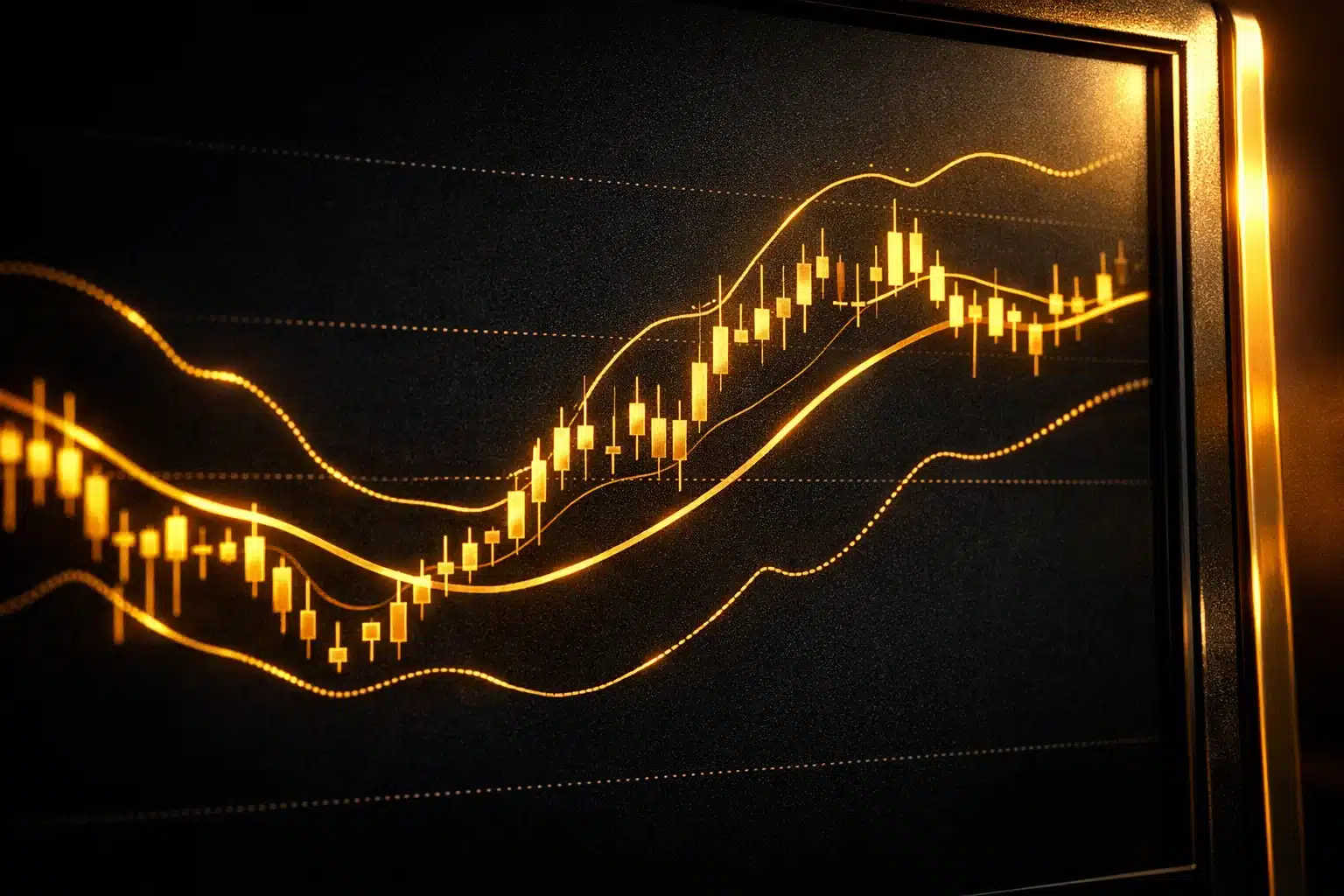
A number of technical indicators are frequently discussed in relation to gold price analysis. These tools are described here in terms of their general construction and conceptual purpose.
| Indicator | General Purpose | Common Interpretation |
|---|---|---|
| Moving Averages | Smooths price data over time | Crossovers are sometimes referenced in trend discussions |
| Bollinger Bands | Measures relative volatility | Narrowing bands are sometimes associated with reduced volatility |
| RSI | Measures momentum extremes | Often discussed in terms of overbought/oversold conditions |
| MACD | Measures momentum changes | Crossovers are sometimes referenced in momentum discussions |
| ADX | Measures trend strength | Higher values are often associated with stronger trends |
Moving Averages and Trend Indicators
Moving averages are among the most widely referenced tools in trend analysis. A commonly discussed pattern, sometimes called a “Golden Cross,” refers to a shorter-term moving average crossing above a longer-term moving average. This pattern is generally associated with shifts in trend sentiment, though outcomes following such patterns are not considered uniform or predictable.
Volatility and Momentum Indicators
Bollinger Bands consist of a moving average and two surrounding volatility-based lines. A narrowing of the bands is generally associated with periods of reduced volatility, which some market commentary links to subsequent volatility expansion, though this relationship is descriptive rather than predictive.
The Relative Strength Index (RSI) is commonly used to characterize momentum conditions, with readings above 70 generally associated with “overbought” characterizations and readings below 30 generally associated with “oversold” characterizations. The MACD (Moving Average Convergence Divergence) is similarly referenced in discussions of momentum shifts.
Trend Strength Measures
The Average Directional Index (ADX) is generally used to characterize the strength of a trend rather than its direction, with higher readings commonly associated with stronger trending conditions. The Commodity Channel Index (CCI) is similarly referenced in discussions of trend identification and extreme price conditions.
Risk Considerations in Gold Market Participation
Participation in markets involving leveraged or derivative instruments carries a range of risk characteristics that are commonly discussed in financial literature.
Margin and Leverage Mechanics
Margin refers to the collateral associated with maintaining a leveraged position. If the value of a position moves unfavorably relative to the capital held, this can result in a margin call, a mechanism through which a broker may close positions to manage exposure. This dynamic is generally cited as a core characteristic of leveraged trading rather than a specific outcome to be expected.
Historical Use of Predefined Exit Mechanisms
Predefined order types are sometimes referenced in discussions of risk management, generally described as mechanisms that can close a position automatically once a specified price level is reached. Such mechanisms are commonly discussed in financial literature as one of several tools associated with managing exposure to adverse price movement.
Backtesting as an Analytical Concept
Backtesting refers to the practice of applying a defined set of rules to historical price data in order to observe how it would have performed under past conditions. This is generally described as an analytical exercise rather than a guarantee of future performance, and historical results are commonly understood not to be indicative of future outcomes.
Broader Sentiment Classifications
Market commentary sometimes references “risk-on” and “risk-off” classifications of broader sentiment, generally associated with capital flows between asset classes such as equities and perceived safe havens like gold. These classifications are descriptive characterizations of observed market behavior rather than predictive frameworks.
Behavioral and Psychological Factors
Financial literature frequently discusses the role of psychological factors, such as fear and greed, in market participant behavior. These factors are commonly cited in discussions of why prices can deviate from what might be expected based on fundamental factors alone.
Commonly Referenced Characteristics of the Gold Market
Several structural characteristics are frequently cited in general discussions of the gold market.
- The price of gold is denominated in US dollars, and movements in the Dollar Index (DXY) are often observed alongside gold price movement.
- The US 10-Year Treasury yield is frequently cited as a closely watched reference point in gold market commentary.
- Trading volume has historically been observed to increase during the overlap of London and New York trading hours, generally between 13:00 and 17:00 GMT.
- Multi-timeframe analysis is a commonly referenced analytical concept, involving the comparison of price behavior across different time horizons.
- Demo accounts are sometimes referenced as an educational tool associated with becoming familiar with platform mechanics before committing capital.
Selecting a trading platform is also commonly discussed as part of market participation. Factors such as regulatory oversight, spreads, and the range of available instruments are often cited as considerations in this context.
FAQ: Common Questions About Gold Markets
Does inflation always cause gold prices to rise?
While gold is historically recognized as a reference asset in discussions of purchasing power, its price does not always move in direct correlation with consumer price indices. The relationship between the metal and inflation is often described as being mediated by central bank policy responses; if interest rates are raised aggressively in response to inflation, the resulting increase in real yields can place downward pressure on gold. Historically, the asset’s price behavior has often been associated with periods combining elevated inflation with low or negative real interest rates, rather than inflation in isolation.
What factors are generally associated with capital requirements for gold market participation?
The capital generally associated with gold market participation varies considerably depending on the instrument and the leverage structure offered by a given provider. Some CFD structures are commonly associated with lower minimum capital requirements, though lower capital levels are also frequently discussed in relation to higher relative leverage exposure.
How does gold market liquidity vary during different trading sessions?
Liquidity in the gold market has historically been observed to reach its highest levels during the overlap of London and New York trading hours, typically between 13:00 and 17:00 GMT. This period is generally associated with higher trading volume from European and American financial institutions, which has historically corresponded with narrower spreads and what market commentary often describes as more efficient price execution.
Is central bank gold reserve data generally considered useful for short-term analysis?
Data regarding central bank gold reserves is typically published with a considerable time lag and is generally understood to reflect long-term strategic positioning rather than short-term activity. While sustained central bank purchasing is often cited as a long-term fundamental factor, this data is generally not considered well suited to short-term analysis due to its limited frequency and transparency.
Why is gold sometimes discussed as having different liquidity characteristics than silver?
Gold is often described in financial commentary as exhibiting different liquidity characteristics than silver, generally associated with a larger and more consistently active market. Silver, while sometimes associated with higher percentage volatility, is generally linked to a comparatively smaller market, which commentary sometimes associates with wider spreads during periods of lower trading activity.