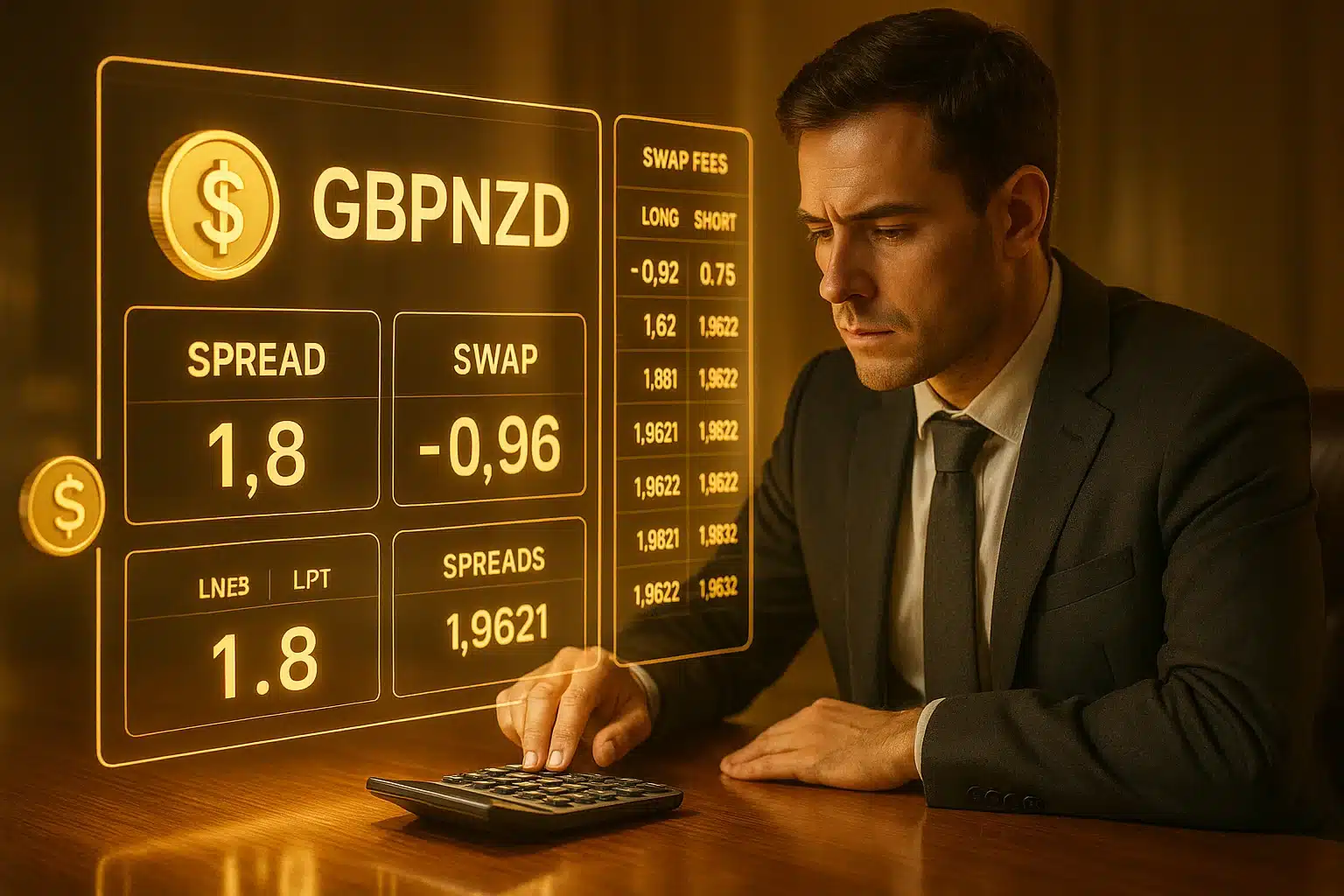
The GBPNZD forex pair, which represents the exchange rate between the British pound and the New Zealand dollar, is one of the most volatile and dynamic cross-currency pairs in the market. Often sharing the “Beast” or “Dragon” nickname with its Japanese yen counterpart for its large price swings, it pits the UK’s major financial economy against New Zealand’s commodity-driven one.
This creates unique trading opportunities driven by global risk sentiment and diverging economic forces. This comprehensive guide explores trading GBPNZD Contracts for Difference (CFDs) on INFINOX’s platforms, helping you navigate the policy dynamics of the Bank of England (BoE) and the Reserve Bank of New Zealand (RBNZ).
Learn to Trade the GBPNZD Forex Pair: The Basics
What is GBPNZD?
In the GBPNZD pair, the British pound (GBP) is the base currency, and the New Zealand dollar (NZD) is the quote currency. The exchange rate indicates how many New Zealand dollars are needed to purchase one British pound. As a cross-currency pair, its value is determined by the relative strengths of the UK and New Zealand economies, independent of the US dollar. Traders are drawn to GBPNZD for its potential for strong trends and significant price movements, making it a favorite for those with an appetite for volatility.
Key Market Drivers
The GBPNZD exchange rate is influenced by a specific set of powerful factors.
- Central Bank Monetary Policy: The divergent policies of the Bank of England (BoE) and the Reserve Bank of New Zealand (RBNZ) are a primary driver. Their stances on interest rates and inflation control create the fundamental backdrop for the pair’s trend.
- Commodity Prices: The New Zealand dollar is a major “commodity currency.” The price of New Zealand’s key exports, particularly dairy products, has a significant impact on the NZD’s value. The bi-weekly Global Dairy Trade (GDT) auction is a critical event.
- China’s Economic Data: As New Zealand’s largest trading partner, the health of the Chinese economy is a crucial driver for the NZD. Data such as China’s GDP and manufacturing PMI can cause significant movements in GBPNZD.
- Global Risk Sentiment: The NZD is considered a “risk-on” currency, meaning it tends to strengthen when global investors are optimistic. The GBP’s reaction is more mixed, making global risk appetite a key driver for the pair.
Market Characteristics
GBPNZD is renowned for its high volatility, often exhibiting some of the largest average daily ranges among all currency pairs. This high volatility presents opportunities for substantial price movements but also carries a correspondingly high level of risk. Due to its cross-currency nature, its trading volume is lower than major pairs, which can lead to wider spreads. A key characteristic is its tendency to form strong, sustained trends, often driven by commodity cycles or diverging central bank policies.
When to Trade GBPNZD – Best Trading Sessions

Optimal Trading Hours
The most liquid and active period for trading GBPNZD is the overlap between the London and Asian trading sessions. The London open at 08:00 GMT is critical, as it brings significant volume to the British pound. The Asian session is vital for the New Zealand dollar, as key economic data from both New Zealand and its main trading partner, China, is released during these hours. Trading during the London morning often provides the best balance of volatility and liquidity, which can translate to more reliable price action and tighter spreads.
Economic Calendar Events
To trade GBPNZD effectively, you must stay informed about key scheduled events for both economies.
- Central Bank Meetings: Interest rate decisions, policy statements, and press conferences from the BoE and RBNZ are the most important events.
- Global Dairy Trade (GDT) Auction: This bi-weekly event is a crucial driver for the NZD and can cause sharp volatility in the pair.
- Employment and Inflation Data: Jobs reports and CPI releases from both the UK and New Zealand are critical indicators of economic health.
- China’s Data: Key releases like Chinese GDP and PMI are essential for any GBPNZD trader to monitor.
Fundamental Analysis for GBPNZD
Central Bank Policies
The fundamental outlook for GBPNZD is heavily shaped by the policy divergence between the BoE and the RBNZ. The interest rate differential is a key driver, influencing the “carry trade.” For example, if the RBNZ adopts a more hawkish stance (raising rates) than the BoE due to strong domestic growth, it could strengthen the NZD and create downward pressure on GBPNZD. Conversely, a hawkish BoE focused on UK inflation could lift the pair, especially if the RBNZ is signaling a pause or rate cuts.
Economic Indicators
A comparative analysis of economic performance is vital. The UK’s economy is heavily reliant on its services sector, while New Zealand’s is driven by agriculture and commodity exports. Stronger UK retail sales could boost the pound, while a surge in New Zealand’s export prices (like dairy) provides a powerful tailwind for the NZD, which would weigh on the GBPNZD pair.
Political and Market Events
Political developments in the UK can have a significant impact on the pound’s value. Issues related to trade policy and domestic political stability are key factors. For the New Zealand dollar, the primary external drivers are the health of the Chinese economy and global commodity demand. A slowdown in China can reduce demand for New Zealand’s exports, weakening the NZD and causing GBPNZD to rise.
Technical Analysis and Trading Strategies
Chart Patterns and Indicators
Given GBPNZD’s significant volatility, technical analysis is crucial for timing entries and managing risk.
- Volatility Indicators: Using tools like the Average True Range (ATR) is highly recommended to help set appropriate stop-loss distances that respect the pair’s large daily movements.
- Moving Averages: Longer-term moving averages (e.g., the 50-day and 200-day) are popular for filtering out daily noise and identifying the underlying trend direction.
- Support and Resistance: Identifying key horizontal levels where the price has previously reacted is a foundational step.
- Momentum Oscillators: Indicators like RSI and MACD can help gauge the strength of a trend and identify potential exhaustion points.
Risk Management Strategies
Due to the high volatility of GBPNZD, disciplined risk management is not just important—it is absolutely essential. While leverage can amplify potential profits, it also magnifies potential losses. It is imperative to use a stop-loss order on every single trade. Because of the pair’s large swings, traders often need to use wider stops and, therefore, smaller position sizes to maintain a consistent risk-per-trade (e.g., 1-2% of account capital).
Trading Approaches
Your trading approach for GBPNZD should be based on a clear analytical view.
- Go Long (Buy): This strategy may be justified by anticipated pound strength (e.g., a hawkish BoE) or New Zealand dollar weakness (e.g., falling dairy prices or poor Chinese data).
- Go Short (Sell): This position could be warranted if you expect the NZD to strengthen, perhaps due to soaring commodity prices, strong domestic data, or a global “risk-on” mood.
- Trend Following: The pair’s tendency to form powerful, sustained trends makes it particularly suitable for swing and position trading strategies that aim to ride a trend for an extended period.
Selecting the Right Broker for GBPNZD CFD Trading
Finding a Reputable Broker
Choosing a reliable broker is the first step toward a secure trading experience. INFINOX is a trusted global broker that operates under stringent international regulatory standards, ensuring client funds are protected and trading is fair. We provide excellent conditions for trading volatile pairs like GBPNZD across various account types, with access to the world-renowned MetaTrader 4 (MT4) and MetaTrader 5 (MT5) platforms.
Account Setup Process
Getting started with INFINOX is a seamless process. You’ll need to complete the online application, satisfy the standard Know Your Customer (KYC) requirements by submitting verification documents, and choose an account type that suits your trading style. After funding your account via one of our secure payment methods, you can select your preferred platform and begin trading.
Comparing Platforms for GBPNZD CFD Trading
| Feature | MetaTrader 4 (MT4)2 | MetaTrader 5 (MT5) |
| Platform Type | Advanced trading terminal | Multi-asset advanced terminal |
| Trading Style | Manual + algorithmic | Manual + algorithmic |
| User Level | Intermediate to advanced | Intermediate to advanced |
| Execution Control | Full manual + EAs | Full manual + EAs, VPS |
| Mobile Access | iOS & Android app via MetaQuotes | iOS & Android app via MetaQuotes |
| Technical Tools | 30+ indicators, 9 timeframes | 38+ indicators, 21 timeframes, market depth |
| Fundamental Analysis | Basic news feed | Full macroeconomic calendar |
| Algorithmic Trading | Supported via Expert Advisors (EAs) | EAs + Virtual Hosting (VPS) |
| Risk Management | Manual SL/TP and trailing stop | Advanced SL/TP, hedging support |
| Customisation | Custom templates and charts | Full instrument profiling and execution modes |
Step-by-Step Setup for GBPNZD CFD Trading

Account Registration & KYC
- Complete the application online with your personal details.
- Submit required verification documents (ID, proof of address).
- Choose your platform(s): MT4 or MT5.
- Select an account type based on your trading experience.
Platform Access & Setup
Once your account is approved, platform access is straightforward. Install the MT4 or MT5 application on your desktop or mobile device and connect to the INFINOX server using your credentials. We highly recommend extensive practice on a demo account to get a feel for GBPNZD’s behavior and significant volatility before trading with real capital.
Adding GBPNZD to Your Instruments
Use the search function within your chosen platform to find the GBPNZD pair. Add it to your main watchlist for easy access and real-time monitoring. It is also wise to set up price alerts within your platform for significant movements or when the price approaches a key technical level.
Trading GBPNZD CFDs: Execution Options per Platform
MetaTrader 4 & 5
As the global standards for CFD trading, MT4 and MT5 offer a comprehensive and powerful suite of tools for analyzing and trading the highly volatile GBPNZD pair. These platforms empower you to place a variety of order types, from instant market orders to strategic pending orders like limits and stops. You can apply dozens of built-in technical indicators, draw trendlines, and use graphical objects to conduct in-depth chart analysis. For advanced traders, these platforms support the development and implementation of Expert Advisors (EAs) for fully automated, algorithm-based trading strategies.
Risk Management in GBPNZD CFD Trading
Risk Settings by Platform
Our platforms provide robust risk management tools. On MT4 and MT5, you can manually set precise stop-loss and take-profit orders for every position, which is a critical function for managing risk. Our web-based platforms also feature real-time alerts and performance dashboards to help you actively monitor your market exposure.
Leverage & Capital Control
INFINOX offers leverage options up to 1:1000. However, using high leverage on a pair as volatile as GBPNZD is extremely risky and not recommended for inexperienced traders. Leverage magnifies both potential profits and potential losses. A prudent risk management approach involves using lower leverage and risking no more than 1-2% of your trading capital on any single trade.
Market Risk Factors
When trading GBPNZD, be aware of several market risks. Extreme volatility can occur around central bank meetings or major data releases from China. As a cross-currency pair, its spreads are naturally wider than majors. Slippage can also be more common in fast-moving markets.
Advanced Trading Features and Tools
Economic Calendar Integration
Stay ahead of market-moving events with an integrated economic calendar. You can get real-time updates on key announcements from the BoE and RBNZ, see impact ratings for data releases, and set automated alerts for high-priority events, especially the bi-weekly Global Dairy Trade auction and key data from China.
Technical Analysis Tools
INFINOX equips you with a formidable arsenal of technical analysis tools. With access to advanced charting packages, numerous indicators, and strategy backtesting capabilities on MT5, you have everything you need to conduct a thorough analysis of the GBPNZD market.
Mobile Trading Features
Trade on the go with our powerful mobile apps. You can receive push notifications for price alerts, execute trades with one-touch functionality, and conduct detailed chart analysis from your smartphone, ensuring you are always connected to the markets.
Market Correlations and Cross-Asset Analysis
Currency and Commodity Correlations
- Commodity Correlation: GBPNZD has a strong negative correlation with the price of dairy. The Global Dairy Trade (GDT) price index is a key benchmark. When dairy prices rise, the NZD tends to strengthen, causing GBPNZD to fall.
- Positive Correlation: GBPNZD often moves in a similar direction to its counterpart, GBPAUD, as both pit the pound against a commodity currency from the Oceania region.
- Risk Sentiment Correlation: The NZD is highly correlated with global growth prospects. A rally in global stock markets often signals a “risk-on” mood that benefits the NZD, which can put pressure on GBPNZD.
Risk Sentiment Dynamics
This pair is a battle between two currencies that are both generally considered “risk-on,” but their sensitivities differ.
- Global Growth Optimism: When investors are optimistic about global growth, demand for commodities increases. This tends to strengthen the high-beta, commodity-linked NZD more than the GBP, often putting downward pressure on GBPNZD.
- Focus on Domestic Issues: When global sentiment is neutral, the focus shifts to domestic factors. A hawkish Bank of England could push the pair higher, while a hawkish Reserve Bank of New Zealand could push it lower.
- China’s Influence: A slowdown in the Chinese economy is a major risk factor for New Zealand and can lead to significant NZD weakness, causing a sharp rally in GBPNZD.
Trading Strategies for Different Market Conditions

Trending Market Strategies
Given GBPNZD’s tendency to form powerful trends, trend-following is a primary strategy. This can involve using moving average crossovers to confirm the trend direction, trading breakouts from long-term consolidation patterns, and using momentum indicators to add to positions. Trailing stops are essential for managing these trades.
Range-Bound Market Strategies
GBPNZD is less suited to range trading due to its high volatility. However, during periods of indecision in commodity markets or global sentiment, it may consolidate. In these cases, traders might use oscillators to identify overbought/oversold levels near well-defined support and resistance.
News-Based Trading
This approach focuses on trading around high-impact news, such as BoE/RBNZ meetings or crucial Chinese and GDT data releases. This strategy demands extreme caution and excellent risk management due to the potential for massive price swings.
Platform Recommendation by Trader Profile
| User Profile | Recommended Platform(s) | Key Features |
| New to forex trading | MT4/MT5 (on a Demo Account) | Practice with virtual funds, standard tools |
| Multi-asset trader | MT5 | Multi-asset capabilities, advanced tools |
| Technical analysis focused | MT4 or MT5 | Advanced charting, custom indicators |
| Algorithmic trader | MT5 | Expert Advisors, VPS hosting |
| Professional trader | MT5 | Full feature set, algorithmic capabilities |
Costs and Fees Structure
Spread Comparison
INFINOX offers competitive variable spreads on GBPNZD. As a volatile cross-currency pair, its spread is typically wider than for major pairs. We also provide commission-based accounts that feature access to raw spreads. You can view live spreads directly on our platforms.
Additional Costs
Other potential costs include overnight financing charges (swap rates), which are based on the interest rate differential between the UK and New Zealand. An inactivity fee may be applied to dormant accounts, and certain withdrawal methods may carry a fee. All potential costs are clearly disclosed.
Getting Started Checklist
Before You Trade
- Research the current monetary policies of the BoE and the RBNZ.
- Check the latest economic data from China.
- Note the date of the next Global Dairy Trade (GDT) auction.
- Practice on a demo account to get a feel for GBPNZD’s volatility and manage risk.
- Define your risk management rules, especially position sizing.
- Choose an appropriate (and likely low) leverage level.
First Trade Setup
- Select your preferred INFINOX trading platform.
- Add GBPNZD to your watchlist.
- Set your stop-loss and take-profit levels before entering the trade.
- Consider timing your trade during the liquid London session.
- Confirm your analysis by checking the commodity and Chinese data backdrop.
- Start with a small position size to manage risk effectively.
Common Trading Mistakes to Avoid
Risk Management Errors
- Using Tight Stops: Setting stop-losses that are too close to your entry is a common way to get knocked out of a trade prematurely on this pair.
- Over-leveraging: This is the fastest way to incur significant losses when trading a highly volatile pair like GBPNZD.
- Poor Position Sizing: Failing to reduce position size to account for wider stops will lead to inconsistent and oversized risk.
Market Analysis Mistakes
- Ignoring China: Forgetting to check Chinese economic data is a major oversight when analyzing the NZD.
- Ignoring Dairy Prices: Failing to track the results of the GDT auction means you are ignoring a primary driver of the pair.
- Treating it like a Major Pair: Applying risk parameters suitable for EURUSD to GBPNZD will not work due to the vast difference in volatility.
Frequently Asked Questions (FAQ)
Why is GBPNZD so volatile?
Its volatility stems from the clash between two relatively high-yielding currencies, one driven by domestic UK factors and the other by global risk sentiment, commodity prices (especially dairy), and the economic health of China. This creates many moving parts and the potential for large price swings.
What is the most important driver for the New Zealand dollar (NZD)?
The NZD’s value is hugely influenced by external factors: global risk sentiment, the price of dairy products (tracked by the GDT auction), and the economic health of its largest trading partner, China.
How does the Bank of England (BoE) affect the GBPNZD price?
The BoE’s monetary policy, particularly its stance on inflation and interest rates, directly impacts the value of the pound. A hawkish BoE (raising rates) tends to strengthen the GBP, pushing GBPNZD higher.
What is the best time of day to trade GBPNZD?
The London session (starting at 08:00 GMT) is generally the best time, as it provides high liquidity for the GBP side of the pair and overlaps with the late Asian session, making it active for both currencies.
How are China and GBPNZD connected?
China is New Zealand’s largest export market. Strong economic data from China signals higher demand for New Zealand’s commodities, which strengthens the NZD and tends to push GBPNZD lower. Weak Chinese data has the opposite effect.
Is GBPNZD a good pair for beginners?
Due to its extreme volatility, wider spreads, and complex drivers, GBPNZD is generally considered unsuitable for inexperienced traders. It is a pair best tackled after gaining significant experience and mastering risk management.
What is the Global Dairy Trade (GDT) auction?
The GDT is a bi-weekly global auction for dairy products. As dairy is New Zealand’s largest export, the price index from this auction is a key leading indicator for the NZD’s strength and can cause significant volatility in pairs like GBPNZD.
The information provided in this article is for educational and informational purposes only and does not constitute investment advice, financial advice, or a recommendation to buy or sell any financial instruments.