
As a trader navigating the vast and volatile Forex (Foreign Exchange) market, you will quickly encounter the term margin. It is one of the most fundamental concepts in leveraged trading, acting as the bedrock upon which your trading activity is built. For many, margin can seem complex, but at its core, it is a mechanism that allows you to control large positions with a relatively small amount of capital. Understanding how margin in Forex works is not merely academic; it is crucial for effective risk management and the longevity of your trading career. Without a clear grasp of this concept, you run the risk of premature position closures and significant financial loss, particularly given that retail investor accounts trading Contracts for Difference (CFDs) or similar leveraged products experience losses in a high percentage of cases—often cited in the range of 70% to 89%, according to disclosures from brokers regulated in various jurisdictions. This comprehensive guide will equip you with the expertise necessary to manage margin like a professional.
What is Forex Margin
Margin Definition
Margin is the collateral or good-faith deposit that a Forex broker requires from you to open and maintain a leveraged trading position. It is not a fee or a cost of the trade; rather, it is a portion of your funds that is set aside and “locked up” by the broker for the duration of the trade. This deposit serves as a guarantee against potential losses you might incur. Because the Forex market often uses high leverage—meaning you can control a large notional value of currency with a small amount of capital—the margin ensures that both you and the broker are protected from an immediate deficit should the market move against your position. Think of margin as the minimal amount of capital required to give you access to a much larger financial instrument.
Required Margin Calculation
The amount of margin you must post, known as the Required Margin, depends directly on the leverage offered by your broker and the size of the position you wish to open. Brokers express leverage as a ratio, such as 50:1, 100:1, or 400:1. The Required Margin is typically calculated as a percentage of the total notional value of the position.
The formula for calculating the Required Margin is:
Required Margin = (Notional Value of Trade) * (Margin Percentage)
Where the Margin Percentage is simply the reciprocal of the leverage ratio. For example, if the leverage is 100:1, the margin percentage is 1 / 100, or 1%.
- Case Study Observation: When a broker tightens leverage limits, especially during periods of high volatility or significant geopolitical events, they are effectively increasing the Required Margin percentage. This suggests they are mitigating their own risk exposure, which in turn demands more initial capital from the trader for the same position size. For instance, moving from 200:1 leverage (0.5% margin) to 50:1 leverage (2% margin) immediately quadruples the capital required to open a new trade. This is a common risk management practice that new traders must be aware of.
Why Margin Matters for Traders
Margin is the gatekeeper of your capital efficiency and a key component of your risk management strategy.
- Capital Efficiency: Margin allows you to utilize a small amount of capital to potentially generate returns on a large exposure. This is why Forex is so attractive.
- Risk Capacity: Your total free capital dictates how many positions you can open and how much room you have to absorb market movements. Effective margin management directly correlates with a trader’s ability to withstand volatility.
- Position Maintenance: If your account equity falls below the Required Margin (a situation we’ll discuss as a margin call), the broker will forcibly close positions. Therefore, maintaining sufficient free margin is critical to keeping trades open long enough to potentially turn profitable. Experienced traders will tell you that the margin you post defines your operational risk—it’s the fence around your trading activities.
Used Margin and Free Margin
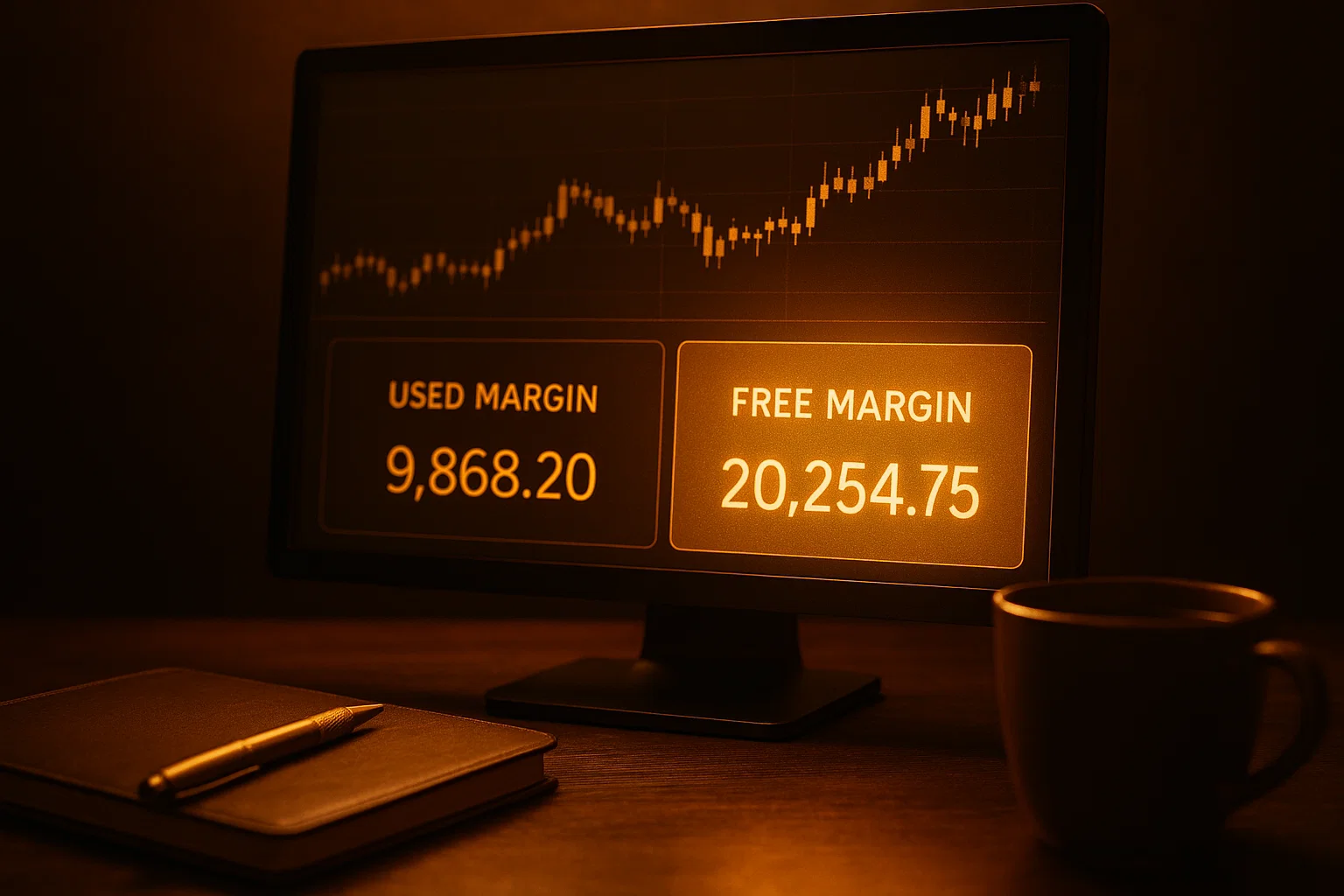
The distinction between Used Margin and Free Margin is arguably the most vital concept for day-to-day risk management in leveraged trading. They represent the two functional states of the equity in your trading account.
Used Margin Definition
Used Margin is the total amount of money currently tied up to maintain all open positions. It is the sum of the Required Margin for every trade you have running. Once a trade is open, this capital is no longer available for other purposes until the position is closed.
Free Margin Definition
Free Margin (or Usable Margin) is the equity in your trading account that is not currently tied up as Used Margin. This capital is freely available for two primary purposes:
- Opening new positions.
- Absorbing losses from existing open positions.
The health of your trading account is often judged by the size of its Free Margin. A large Free Margin suggests safety and flexibility, while a low Free Margin indicates that your account is heavily leveraged and vulnerable to market swings.
Relationship Between Used Margin and Free Margin
The relationship between these two types of margin, along with your Account Equity (the current value of your account, which is Balance plus any floating Profit/Loss), is fundamental.
Account Equity = Balance + Floating Profit/Loss
Free Margin = Account Equity – Used Margin
When your open positions begin to incur losses, your Account Equity decreases. Since the Used Margin remains constant (assuming no changes to your position size or leverage), your Free Margin shrinks by the same amount. If Free Margin approaches zero, your account is entering dangerous territory, signaling a high risk of a margin call.
Free Margin Example
Consider a scenario:
| Metric | Value |
|---|---|
| Account Balance | 10,000 USD |
| Leverage | 100:1 (1% Margin) |
| Open Position (EUR/USD) | 1 Standard Lot (100,000 EUR) |
| Required Margin (Used Margin) | 100,000 USD × 1% = 1,000 USD |
| Floating P/L (Initial) | 0 USD |
| Account Equity (Initial) | 10,000 USD |
| Free Margin (Initial) | 10,000 USD − 1,000 USD = 9,000 USD |
Scenario A: Trade is profitable by 500 USD
| Metric | Value |
|---|---|
| Floating P/L | +500 USD |
| Account Equity | 10,000 USD + 500 USD = 10,500 USD |
| Used Margin | 1,000 USD |
| Free Margin | 10,500 USD − 1,000 USD = 9,500 USD |
Scenario B: Trade is losing by 5,000 USD
| Metric | Value |
|---|---|
| Floating P/L | -5,000 USD |
| Account Equity | 10,000 USD – 5,000 USD = 5,000 USD |
| Used Margin | 1,000 USD |
| Free Margin | 5,000 USD – 1,000 USD = 4,000 USD |
As this example illustrates, the Free Margin is the shock absorber for your account losses. When that buffer is depleted, the account’s survival is at stake.
Margin Call in Forex
The margin call is one of the most feared phrases in leveraged trading, representing the moment a trader loses control over their open positions. It is a critical risk management mechanism designed to protect the broker from potential losses exceeding the client’s equity.
How Margin Calls Work
A margin call occurs when your Account Equity falls to a level that is equal to or dangerously close to your Used Margin. Most brokers set a Margin Level threshold (Equity / Used Margin * 100) at which this action is triggered, often around 100% or sometimes 50%.
- Trigger Mechanism: When the floating losses in your account erode your capital to the point that your remaining Account Equity is insufficient to cover the broker’s Required Margin (i.e., Margin Level approaches the critical threshold), the broker issues a margin call. Historically, this meant the broker would literally call the trader. Today, it’s an automated notification on the trading platform.
- Stop Out: The more serious action is the Stop Out. If the market continues to move against the trader after the margin call is issued and the Margin Level drops to an even lower, critical level (e.g., 50%, 30%, or 20%), the broker’s system will automatically begin to close your open positions, starting with the least profitable one. This is done to free up Used Margin and raise the Margin Level back above the Stop Out threshold, protecting the broker from an unrecoverable deficit.
Expert Quote: Dr. Peter Lisk, a risk management specialist, notes: “The Stop Out level is a non-negotiable line in the sand. It functions as the ultimate loss mitigation tool for the broker, but for the retail trader, it is often a final, painful realization of poor position sizing. The margin call isn’t the problem; it’s a warning signal that the initial risk taken was too high relative to the account capital.”
How to Avoid Margin Calls
Avoiding a margin call requires proactive risk control, not reactive decision-making.
- Lower Leverage: Use lower leverage ratios (e.g., 10:1 instead of 100:1). Lower leverage means a higher Required Margin, forcing you to use smaller position sizes, which, in turn, provides more Free Margin to absorb losses.
- Appropriate Position Sizing: Never risk more than 1% to 2% of your total account balance on any single trade. Small position sizes ensure the Used Margin is a minimal fraction of your total equity.
- Implement Stop-Loss Orders: A stop-loss order is the single most effective tool to prevent excessive losses from eating into your Free Margin. Setting a tight, but reasonable, stop-loss ensures that positions are closed before they trigger a margin call.
- Monitor Margin Level: Routinely check your Margin Level. If it consistently falls below 300% to 500%, it suggests that you may be over-leveraging your account. Keeping the Margin Level high (above 1000% is ideal for low-risk strategies) provides maximum buffer.
Trading on Margin
Trading on margin is synonymous with leveraged trading, and it offers both powerful opportunities and significant risks that must be managed with discipline.
How Margin Trading Works
Margin trading is the process of borrowing funds from your broker to trade financial assets. The margin you post acts as collateral for the borrowed amount.
- Borrowing Power: By posting a 1% margin, you effectively borrow the remaining 99% of the position’s value from the broker. This leverage amplifies both potential gains and potential losses.
- Transaction Process: When you execute a trade, the broker sets aside the Required Margin. If the trade is profitable, the profit adds to your Account Equity and, consequently, your Free Margin. If the trade loses, the loss is deducted from your Account Equity and Free Margin. The Used Margin remains fixed until the position is closed.
Advantages of Margin Trading
The primary benefits of margin trading are rooted in capital efficiency and amplification:
- Increased Market Exposure: You can take a position in a currency pair that has a value significantly greater than the capital you deploy. This allows smaller traders to access the volume necessary to make trading viable.
- Amplification of Returns: Margin can turn a small market movement (e.g., 0.5%) into a significant percentage return on the capital actually invested (the margin). For example, a 1% profit on a 100,000 USD position with 1,000 USD margin is a 10% return on your posted margin.
- Diversification: Margin can free up capital, allowing a trader to open multiple, smaller positions across different currency pairs or asset classes, which may help mitigate risk through diversification.
Risks of Margin Trading
The power of margin is a double-edged sword, and its risks are profound:
- Amplification of Losses: Just as profits are amplified, so too are losses. A small adverse market movement can wipe out a large portion of your equity very quickly due to the large notional value of the position.
- The Threat of Margin Call: The constant risk of a margin call or stop-out can force positions to be closed at the worst possible time, locking in losses that might have been recovered if the trader had more capital buffer.
- Compounded Risk with Volatility: In highly volatile market conditions, such as those accompanying central bank rate decisions or major economic data releases, price gaps may occur. In such cases, the stop-loss might not execute at the desired price, and losses can exceed the margin, potentially even leading to a negative account balance (though many brokers offer negative balance protection).
Common Mistakes Managing Margin
Based on experience and industry data, new traders often make predictable mistakes managing trading leverage and margin:
- Over-Leveraging: The most common mistake is using the maximum available leverage consistently. This leaves almost no Free Margin and makes the account highly susceptible to natural market volatility.
- Ignoring Correlation: Opening multiple, highly correlated positions (e.g., long EUR/USD and long GBP/USD). If the underlying US Dollar strengthens, both positions will lose simultaneously, depleting Free Margin twice as fast.
- Averaging Down Without Sufficient Margin: Adding to a losing position (“averaging down”) when Free Margin is already low. While this may feel like an attempt to rescue the trade, it doubles the Used Margin and halves the remaining buffer, accelerating the likelihood of a margin call.
- Failing to Adjust for Market Context: Not reducing position sizes or leverage when volatility in the markets is expected to increase (e.g., before major news events).
Forex Margin Calculation
While trading platforms automate the necessary calculations, understanding the manual formulas and using a dedicated Forex margin calculator can enhance a trader’s confidence and control.
How to Calculate Margin
The calculation is straightforward but requires knowing the notional position size, the margin rate, and the exchange rate of the currency pair if your account is in a different currency.
Step 1: Determine Position Notional Value (Size)
- E.g., 1 Standard Lot = 100,000 units of the base currency.
Step 2: Determine Margin Percentage (Based on Leverage)
- Margin Percentage = 1 / Leverage Ratio (e.g., 1 / 50 = 0.02 or 2%)
Step 3: Calculate Required Margin in the Base Currency
- Required Margin (Base Currency) = Position Size * Margin Percentage
Step 4: Convert to Account Currency (if necessary)
- If your account is in USD but you are trading a EUR/GBP pair, you must convert the Required Margin from EUR (the currency the margin is initially calculated in) to USD using the current EUR/USD exchange rate.
Margin Calculation Example
Assume you are trading a US Dollar account.
- Account Currency: USD
- Leverage: 50:1 (2% margin)
- Trade: Buy 1 Mini Lot (10,000 units) of USD/JPY
- Current USD/JPY Rate: 150.00
- Position Size: 10,000 USD (since USD is the base currency)
- Margin Percentage: 2%
- Required Margin (in USD): 10,000 USD * 2% = 200 USD
This 200 USD is the minimum required capital to open that 10,000 USD position. If you were trading a pair where USD was the quote currency (e.g., EUR/USD), the calculation would be slightly different, requiring conversion via the exchange rate.
FAQs
How to Calculate Required Margin for Trade?
Required Margin for a trade is calculated by taking the notional size of the position and multiplying it by the Margin Percentage, where the Margin Percentage is the reciprocal of the leverage offered by your broker. For example, if you open a position worth 10,000 units (notional value) and your broker offers 100:1 leverage, the margin requirement is 1 percent of 10,000, which equals 100 units of the base currency, serving as the collateral deposit.
Is Margin Same as Leverage?
No, margin and leverage are two sides of the same coin in Forex trading but are not the same; leverage is the ratio that determines the size of the position you can control relative to your capital, while margin is the actual capital (the good-faith deposit) required to activate that leverage, functioning as collateral for the borrowed funds necessary to open the position.
What Triggers Margin Call?
A margin call is triggered when the floating losses on your open positions cause your Account Equity to drop to a point where it is equal to or falls below a specific threshold relative to the Used Margin, which is set by the broker, typically between 100 percent and 50 percent of the Used Margin, signaling to the trader that their Free Margin is nearly exhausted and a stop out liquidation is imminent.
Base vs Quote Currencies?
In any currency pair like EUR/USD, the base currency is the first currency listed (EUR), and it is the asset you are buying or selling, while the quote currency is the second currency listed (USD), and it is the currency used to price the base currency, meaning the quote currency indicates how much of it is required to purchase one unit of the base currency.