In the modern financial landscape, the intersection of artificial intelligence and precious metals has created a new standard for the professional trader. Moving beyond simple intuition, the ability to build and backtest robust systems is what separates sustainable growth from speculative gambling. This guide provides a detailed roadmap for anyone looking to use ai to master the unique volatility of the gold market.
Risk Warning: Foreign exchange and derivatives trading carries significant risk and is not suitable for all investors. You do not own, or have any interest in, the underlying assets. Before you decide to trade foreign exchange and derivatives, we encourage you to consider your objectives, your risk tolerance and trading experience. ACY Securities Pty Ltd (Company number: 2610 LLC 2022) provides general advice that does not consider your objectives, financial situation or needs. The content of this article must not be construed as personal advice; please seek advice from an independent financial advisor if necessary. Additional information is available upon request or registration.
Purpose of Guide to Backtesting AI Gold Trading Strategies

The primary objective of this guide to backtesting is to empower you with a structured methodology for validating ai gold trading strategies. In an era where approximately 70-89% of retail investor accounts lose money when trading CFDs, rigorous verification is not optional. By the end of this text, you will understand how to transform a raw hypothesis into a statistically verified trading strategy.
Strategic Significance of XAUUSD Market Analysis for Every Trader
Gold, often traded under the symbol XAUUSD, represents a unique asset class that sits at the crossroads of commodities and foreign exchange. Unlike a standard forex pair, gold serves as a global hedge against inflation and geopolitical instability. For a trader, analyzing gold requires a multi-dimensional approach. According to historical data, gold often exhibits an inverse relationship with real interest rates; when yields rise, the opportunity cost of holding non-yielding gold increases, which may indicate a coming price drop.
Difference Between Manual and AI-Driven Backtest Methods
Manual backtesting involves a trader manually reviewing historical charts to mark entry and exit points. While this builds “screen time” and intuition, it is inherently limited by human speed and cognitive bias. On the other hand, ai strategies allow for the processing of decades of historical data in a fraction of the time. While manual testing might cover 50 trades in a day, ai models can analyze 5,000 trades across varying market conditions, providing a much broader perspective on a system’s resilience.
Weaponizing Edge Through Algorithmic Validation of Trading Strategy
An “edge” is simply a repeatable occurrence that has a positive mathematical expectancy. Algorithmic validation through backtests ensures that your edge is real and not just a product of a specific market regime. By using ai to backtest a trading strategy, you can stress-test your logic against high-volatility events, such as the 2008 financial crisis or the 2020 pandemic, to see how your risk management holds up.
Why Gold Trading Behaves Differently in Live Market Scenarios
Gold is notorious for its “stop hunts” and liquidity sweeps. Because it is a global asset, it is traded around the clock, but its behavior changes drastically depending on which session is active.
Impact of Global Economic Indicators on Trading Gold Price
The gold market is highly sensitive to macro data. The most significant movers are usually the Non-Farm Payrolls (NFP), Consumer Price Index (CPI), and Federal Open Market Committee (FOMC) meetings.
- Inflation Data: High CPI prints usually suggest that gold might rise as a hedge.
- Employment Data: Strong NFP results often boost the US Dollar, putting downward pressure on gold.
- Central Bank Activity: Gold is a key reserve asset; when central banks increase their holdings, it suggests long-term floor support.
Correlation Between US Dollar Index and Gold Backtesting Results
There is a long-standing negative correlation between the US Dollar Index (DXY) and gold. Research by financial analysts often shows a correlation coefficient below -0.80 during periods of monetary tightening. If your backtesting results show high profitability for a “long gold” strategy while the DXY was in a secular bear market, you must be careful; that strategy might not be as effective when the dollar is strengthening in the live market.
Volatility Expansion Patterns Unique to XAUUSD Backtests
Gold often experiences “volatility clusters.” This means that after a period of low-range movement, the subsequent breakout is usually more explosive than what you would see in traditional forex pairs. Backtesting gold requires specific attention to these expansion periods to ensure your stop-losses aren’t set too tight, causing you to be “wicked out” before the main move occurs.
Core Components to Build and Backtest AI Trading Strategy
To build a high-performance system, you need a combination of sound logic and advanced technology. You don’t necessarily need to be a programmer to use ai effectively today, but you do need to understand the underlying architecture.
Integration of Smart Money Concepts in AI Code
Smart Money Concepts (SMC) focus on where institutional traders are likely placing orders. By integrating concepts like Order Blocks, Fair Value Gaps (FVG), and Liquidity Sweeps into your ai code, you can train your model to identify high-probability reversal zones. Instead of simple moving average crossovers, your ai model learns to recognize the structural displacement that precedes a major trend change.
Selection of Technical Indicators for Gold Trading Systems
While ai can analyze raw price action, providing it with engineered features can improve its accuracy. Common indicators for gold include:
| Indicator | Purpose in Gold Trading | AI Integration Logic |
|---|---|---|
| ATR (Average True Range) | Volatility Measurement | Used for dynamic position sizing |
| RSI (Relative Strength Index) | Momentum/Overbought-Oversold | Detecting exhaustion in 15m/1h timeframes |
| Volume Profile | Identifying Value Areas | Finding where the most trading activity occurred |
| Correlation Matrix | Measuring DXY/Oil impact | Filtering trades based on external market strength |
Role of Large Language Models in Sentiment-Based Backtesting Gold
Modern ai can analyze more than just numbers. Using natural language processing, a powerful ai assistant can scan news headlines, Federal Reserve speeches, and X (formerly Twitter) sentiment to provide a “sentiment score.” This score can act as a filter for your technical trades. For instance, if the ai identifies a “hawkish” tone from central bankers, it might suggest that the probability of a gold rally is lower, regardless of the chart pattern.
Step 1: Define Trading Strategy Blueprint

Before you ever touch a backtesting tool, you must have your “rules of engagement” written down. Trading isn’t about guessing; it is about following a plan.
Setting Clear Entry Conditions and Breakout Rules for AI
Your ai needs specific parameters. For a breakout strategy, this might include:
- Price must be above the 200-period EMA on the 4-hour chart.
- A 15-minute candle must close above a previous daily high with a volume spike of 20% above average.
- The DXY must be showing signs of momentum loss on the RSI.
Establishing Exit Rules and Take-Profit Targets for Trading Gold
Exits are more important than entries for long-term survival. You should define whether you will use a fixed take-profit (e.g., 2:1 risk-to-reward) or a trailing stop based on market structure. In gold trading, many professionals exit at “Liquidity Pools”—levels where traders typically place their stop-orders, such as the previous week’s high.
Determining Risk-Reward Ratio for Gold Trading Contracts
Because gold has a high tick value, position sizing is critical. You should consider your objectives and never risk more than 1% of your account on a single trade. A standard 1:2 or 1:3 ratio is often preferred. This means that even with a 40% win rate, your account can still grow over time.
Step 2: Choose Right Tool to Backtest a Trading Strategy
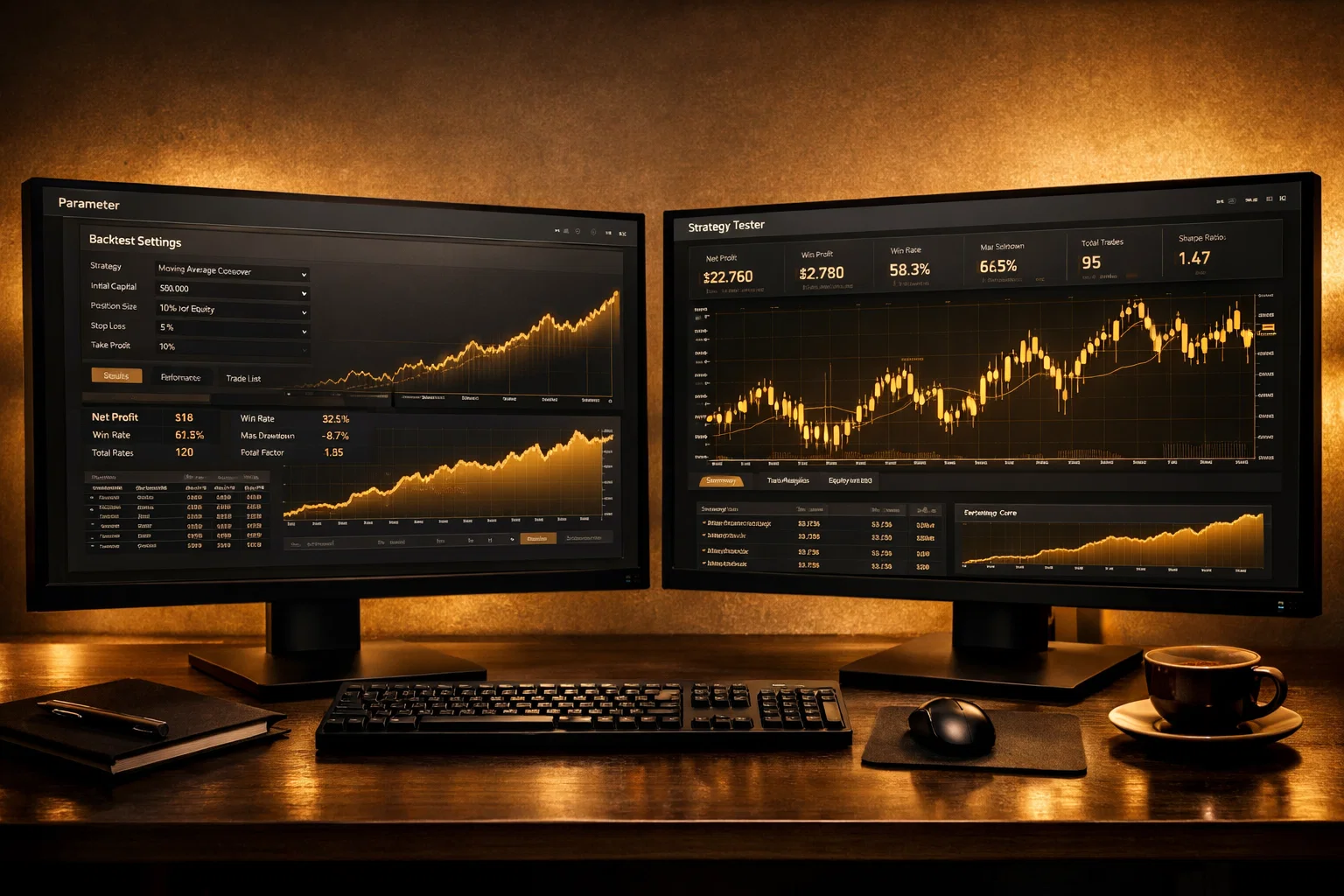
The tool you choose will determine the depth of your analysis and the accuracy of your backtests.
Comparison of TradingView and Python for Running the Backtest
- TradingView (Pine Script): Excellent for visual traders and those who want to see their strategy on the chart immediately. It is user-friendly and doesn’t require deep coding knowledge.
- Python (Backtrader/Zipline): The gold standard for professional quantitative traders. Python allows you to use ai libraries like TensorFlow or Scikit-learn to create complex machine-learning models. It handles much larger datasets and allows for Monte Carlo simulations.
Benefits of Cloud-Based AI Tools for Trader Success
Cloud platforms allow for 24/7 processing and high-speed optimization. They can run “genetic algorithms” that test millions of parameter combinations to find the “sweet spot” for a strategy. This is especially useful for gold, where the optimal settings for the London session might be completely different from those of the New York session.
Essential Features of Professional Software for Backtesting Gold
When selecting software, ensure it includes:
- Tick Data Support: Minute-level data is often not enough for scalping gold.
- Spread Simulation: Gold spreads can widen during news; your backtest must account for this.
- Slippage Controls: In the live market, you rarely get the exact price you want.
Step 3: Maintain Precise Record Keeping for AI Backtests
“Garbage in, garbage out.” If your records are sloppy, your results will be meaningless.
Logging Trade Parameters and Live Market Conditions
Every trade in your backtest should include the “Context.” Was the market trending or ranging? Was it during a high-impact news event? AI model learns best when it has context, not just price points.
Tracking Commission Costs and Spread Impact on Backtesting Results
Many traders ignore costs during backtesting, only to find their “profitable” strategy loses money in reality.
- Commissions: Fixed costs per lot traded.
- Swaps: The cost (or gain) of holding a position overnight.
- Spread: The difference between the buy and sell price.
Documenting Slippage During High Volatility Events
Slippage is a significant risk in gold trading. During an NFP release, you might place a stop at $2050, but it might not trigger until $2045. A realistic guide to backtesting should always add a “slippage buffer” to historical results to mirror the true live market.
Step 4: Setup and Running the Backtest Properly
Once the rules and tools are ready, it is time to execute.
Configuring Continuous Futures and Back-Adjusted Data for AI
If you are backtesting gold futures, you must use “back-adjusted” data. Futures contracts expire, and the price “gap” between contracts can distort your performance metrics. Continuous charts smooth out these transitions so your ai sees a consistent price flow.
Setting Up Strategy Settings for 100 oz Gold Trading Contracts
The “notional value” of gold is high. A standard lot is 100 ounces. Ensure your backtesting environment correctly calculates the margin requirements and the dollar value per tick. If your software thinks 1 point equals $1 but it actually equals $10, your drawdown calculations will be dangerously wrong.
Applying Time-of-Day Filters for Liquidity in Backtesting
The highest liquidity for gold is during the “overlap” between the London and New York sessions (typically 13:00 to 17:00 GMT). Running the backtest across a 24-hour period often shows that strategies perform poorly during the Asian session due to lower volume. Filtering for specific “Kill Zones” can significantly improve your win rate.
Step 5: Analyze Backtesting Results and Optimize with AI
The analysis phase is where you turn raw data into actionable intelligence.
Reviewing Profit Factor and Maximum Drawdown of Trading Strategy
The Profit Factor is the ratio of gross profit to gross loss. A factor above 1.5 is generally considered good, while above 2.0 is excellent. However, you must look at this alongside the maximum drawdown—the largest peak-to-trough drop in your account balance. If your strategy makes 50% a year but has a 40% drawdown, it may not be suitable for all investors due to the high emotional and financial stress.
Evaluating Sharpe Ratio and Win Rate Metrics for AI Gold Trading
The Sharpe Ratio measures your risk-adjusted return. It tells you if your profits are coming from smart risk-taking or just high volatility.
- Win Rate: The percentage of trades that are profitable.
- Average Win vs Average Loss: A 30% win rate can be profitable if the average win is 4 times larger than the average loss.
Using Machine Learning for Parameter Optimization After Backtest
After the initial run, you can use machine learning to “prune” your strategy. The ai can identify that the strategy fails whenever the ATR is below a certain level. By adding this as a new rule, you optimize the strategy for the future without “curve-fitting” to the past.
In-Depth Analysis of Performance Metrics for AI Trader
A professional trader looks beyond the final balance. You need to understand the “character” of your strategy.
Verifying Data Accuracy and Avoiding Overfitting in Backtesting Gold
Overfitting occurs when you make your strategy so specific to historical data that it cannot adapt to new price movements. To avoid this:
- Out-of-Sample Testing: Test your strategy on a period of data it has never seen before.
- Walk-Forward Analysis: Periodically re-optimize the strategy as time moves forward.
Generating Performance Reports with Claude AI
You can export your backtesting results as a CSV and use a powerful ai assistant to generate a narrative report. The ai can analyze the distribution of your losses and suggest whether they are “random” or tied to specific market conditions like a strengthening US Dollar.
Stress Testing AI Gold Trading Strategies Against Historical Crashes
How does your strategy behave during a “Black Swan”? By specifically running the backtest through the 2013 gold crash or the 2011 peak, you can see if your risk management prevents account blowouts.
Limitations of Automated Gold Trading Backtests
It is important to remember that backtesting is a simulation, not a crystal ball.
Challenges with Real-Time Data Feed Integration in Live Market
Latency is a real issue. In a backtest, your “order” is filled instantly at the historical price. In the live market, the milliseconds it takes for your signal to reach the server can result in a different entry price, especially during high-speed price movements.
Impact of Regional Trading Regulations on AI Backtesting
Different jurisdictions have different rules regarding leverage and “hedging” (holding long and short positions simultaneously). If your ai strategies rely on high leverage that isn’t available in your region, your backtesting results are irrelevant.
Blind Monkey vs Backtesting Monkey Analogy for Modern Trader
There is an old saying that a blindfolded monkey throwing darts at a newspaper could perform as well as an expert. A “Backtesting Monkey” is a trader who just keeps changing settings until the backtest looks good, without understanding the underlying logic. This leads to a “false edge” that disappears the moment you go live.
FAQ
How Much Historical Data Is Required for Reliable Gold AI Training?
Most quantitative analysts suggest using at least 5 to 10 years of data for gold. This timeframe is necessary because gold moves through long cycles of “secular” trends and years of consolidation. Using only 6 months of data might lead you to believe a strategy is invincible just because it worked during a single trending period, whereas a decade of data exposes the strategy to various interest rate environments and geopolitical shifts.
Which Programming Languages Work Best for XAUUSD Bot Development?
Python is widely considered the best language for bot development due to its extensive ecosystem of data science and machine learning libraries. It allows traders to easily integrate complex ai models and handle large datasets. For those specifically using the MetaTrader platform, MQL5 is the required language, while Pine Script is the standard for TradingView. However, for true AI integration and statistical modeling, Python’s flexibility remains unmatched.
Can AI Account for Central Bank Interventions in Gold Markets?
AI can account for central bank actions by incorporating “fundamental features” into its dataset, such as interest rate changes, balance sheet expansions, and official gold reserve reports. While an ai model cannot predict a surprise intervention with 100% certainty, it can learn to recognize the “pre-intervention” market conditions, such as extreme price deviations or unusual volume clusters, and adjust the strategy’s risk profile accordingly.
What Is Difference Between Walk-Forward Optimization and Standard Backtesting?
Standard backtesting runs a strategy over a fixed set of historical data to see how it performed. Walk-forward optimization is a more dynamic approach where you split the data into multiple “train” and “test” segments. You optimize the strategy on the first segment and then test it on the following unseen segment. This process is repeated throughout the entire dataset, which helps ensure the strategy’s parameters are robust and can adapt to changing market regimes.
How Do Transaction Costs Affect Scalping Strategies in Metal Trading?
In scalping, where profit targets are small, transaction costs like spreads and commissions can consume a significant portion of your gross profits. For gold, the bid-ask spread is often wider than major currency pairs during low-liquidity hours. If your backtest assumes “zero cost,” a strategy that looks highly profitable might actually be a net loser in the live market. Always include a realistic spread and commission fee in your simulation to ensure your profit factor remains viable.