The CADCHF forex pair, representing the exchange rate between the Canadian dollar and the Swiss franc, offers a pure and powerful expression of global risk sentiment. This cross-currency pair pits a classic commodity-linked currency (CAD) against a premier safe-haven currency (CHF), creating a clear “risk-on” versus “risk-off” dynamic. This makes it a fascinating pair for traders who follow global economic trends and energy markets.
This comprehensive guide explores trading CADCHF Contracts for Difference (CFDs) across INFINOX’s platforms, helping you navigate the key drivers, including the policies of the Bank of Canada (BoC) and the Swiss National Bank (SNB).
Learn to trade the CADCHF Forex Pair: The Basics
What is CADCHF?
In the CADCHF pair, the Canadian dollar (CAD) is the base currency, and the Swiss franc (CHF) is the quote currency. The exchange rate indicates how many Swiss francs are needed to purchase one Canadian dollar. It is a cross-currency pair that provides a clear gauge of the market’s appetite for risk. The CAD is closely tied to global growth and energy prices, while the CHF is a traditional refuge during times of uncertainty. This inherent conflict is what makes the pair so compelling.
Key Market Drivers
The valuation of CADCHF is driven by a distinct set of fundamental forces.
- Global Risk Sentiment: This is the most crucial driver. The pair tends to rise in “risk-on” environments (when investors are optimistic) and fall in “risk-off” environments (when fear prevails).
- Crude Oil Prices: The Canadian dollar is a major “commodity currency.” As Canada is a leading global oil exporter, the price of crude oil (WTI and Brent) has a strong positive correlation with the CADCHF pair.
- Central Bank Policy Divergence: The monetary policies of the Bank of Canada (BoC) and the Swiss National Bank (SNB) are fundamental. The BoC’s focus on Canadian inflation contrasts with the SNB’s mandate to ensure price stability while also preventing excessive CHF appreciation.
- Economic Data: Key releases from Canada (especially employment and GDP) and Switzerland (such as manufacturing data and inflation) can cause significant price movements.
Market Characteristics
CADCHF is known for its clear trending nature, which often aligns with broader market themes. It can be quite volatile, especially during shifts in risk sentiment or large moves in the oil market. As a cross-currency pair, its trading volume is lower than that of major pairs, which can result in wider spreads. Its most defining feature is its strong positive correlation with both crude oil prices and major global stock indices, making it a powerful tool for traders looking to express a view on the global economy.
When to Trade CADCHF – Best Trading Sessions

Optimal Trading Hours
The most effective time to trade CADCHF is during the overlap of the London and New York trading sessions (08:00 to 12:00 EDT). This window provides peak liquidity and volatility. The New York session is particularly important as it is the most active trading period for North American oil markets and the time when key Canadian and US economic data is released. The European session, which precedes this overlap, is important for any news or data releases from the Swiss National Bank.
Economic Calendar Events
To trade CADCHF effectively, you must stay informed about key scheduled events for both economies and the energy sector.
- Central Bank Meetings: Interest rate decisions and press conferences from the BoC and SNB are critical.
- Oil Market Reports: The weekly crude oil inventory reports from the Energy Information Administration (EIA) are a major catalyst for the CAD.
- Economic Data: Employment and inflation (CPI) data from Canada, and inflation and manufacturing data from Switzerland are key reports to watch.
- Global PMI Data: Purchasing Managers’ Index data from major economies can provide a good read on global growth and risk sentiment.
Fundamental Analysis for CADCHF
Central Bank Policies
The fundamental direction of CADCHF is heavily influenced by the policy divergence between the BoC and the SNB. The BoC typically follows a data-dependent approach to controlling inflation. The SNB has a dual mandate of ensuring price stability and supporting the economy, which has often led it to intervene to prevent the franc from becoming too strong. A hawkish BoC (raising rates) combined with a neutral or dovish SNB can create strong upward momentum in CADCHF.
Economic Indicators
A comparative analysis of economic data is crucial, but it must be viewed through the lens of risk and commodities. Strong Canadian employment figures can boost the CAD, but that strength might be amplified if oil prices are also rising. Conversely, weak Swiss manufacturing data might weaken the CHF, but that weakness could accelerate if global markets are in a “risk-on” mood, further reducing demand for the safe-haven franc.
Political and Market Events
- Global Risk Sentiment: This is the dominant market event for CADCHF. A major geopolitical event, a financial crisis, or fears of a global recession can trigger a “flight to safety,” where investors dump risk-sensitive assets like the CAD and flock to the CHF, causing CADCHF to fall sharply.
- Oil Price Shocks: Any event that causes a sharp move in crude oil prices, such as an OPEC+ meeting or supply disruptions, will have a direct and immediate impact on the CAD and, therefore, on the CADCHF pair.
Technical Analysis and Trading Strategies
Chart Patterns and Indicators
Technical analysis is highly effective for CADCHF, especially when used to confirm the fundamental picture.
- Correlation Analysis: This is a vital technique. Charting CADCHF alongside a crude oil chart (WTI/Brent) and a major stock index (like the S&P 500) can provide powerful, real-time confirmation for trade ideas.
- Moving Averages: The 50-day and 200-day moving averages are excellent for identifying the primary trend, which is often very strong in this pair.
- Support and Resistance: Identifying key horizontal levels where the price has previously reacted is fundamental.
- Trendlines: Given its clean trending nature, drawing trendlines and channels can be very effective for timing entries and exits.
Risk Management Strategies
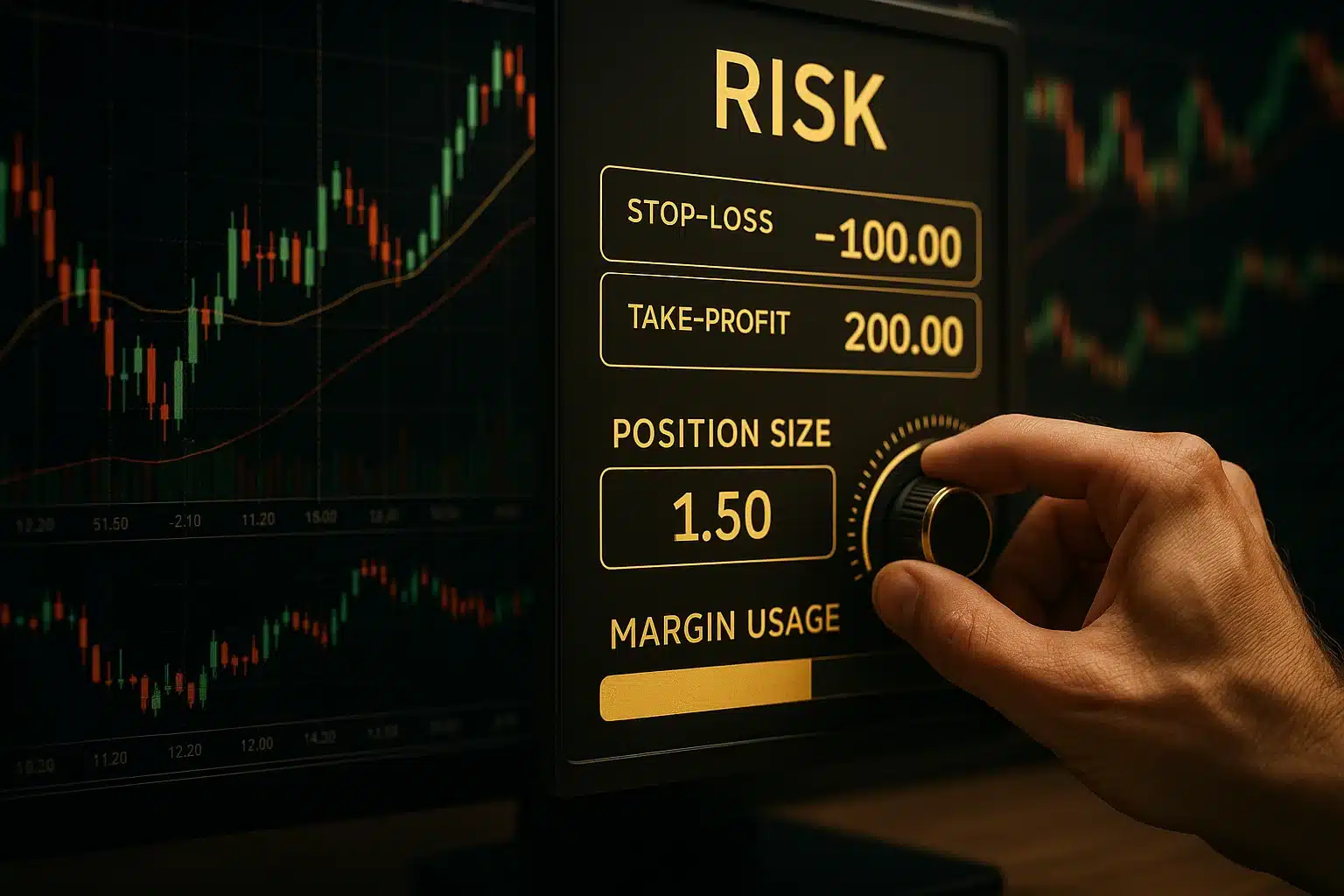
Given CADCHF’s potential for volatility, disciplined risk management is paramount. While leverage can amplify potential profits, it also magnifies potential losses. It is crucial to use a stop-loss order on every trade. Due to the pair’s potential for wide swings during risk events, traders may need to use wider stop-losses, which must be compensated for with smaller position sizes to maintain a consistent risk-per-trade.
Trading Approaches
Your trading approach for CADCHF should be based on a clear view of oil prices and global risk sentiment.
- Go Long (Buy): This is a classic “risk-on” trade. It is best implemented when oil prices are rising, stock markets are bullish, and investors are optimistic about global growth.
- Go Short (Sell): This is a classic “risk-off” trade. It is most effective when oil prices are falling, stock markets are bearish, and investors are seeking the safety of the Swiss franc.
Selecting the Right Broker for CADCHF CFD Trading
Finding a Reputable Broker
Choosing a trustworthy broker is the foundation of your trading career. INFINOX is a globally recognized broker committed to providing a secure and professional trading environment. We adhere to stringent international regulatory standards, ensuring client funds are protected. We offer excellent trading conditions for pairs like CADCHF, with reliable execution and access to the world-renowned MetaTrader 4 (MT4) and MetaTrader 5 (MT5) platforms.
Account Setup Process
Getting started with INFINOX is a straightforward process. You will need to complete the online application, fulfill the standard Know Your Customer (KYC) requirements by submitting verification documents, choose an account type that aligns with your trading style, and fund your account using one of our secure payment methods.
Comparing Platforms for CADCHF CFD Trading
| Feature | MetaTrader 4 (MT4) | MetaTrader 5 (MT5) |
| Platform Type | Advanced trading terminal | Multi-asset advanced terminal |
| Trading Style | Manual + algorithmic | Manual + algorithmic |
| User Level | Intermediate to advanced | Intermediate to advanced |
| Execution Control | Full manual + EAs | Full manual + EAs, VPS |
| Mobile Access | iOS & Android app via MetaQuotes | iOS & Android app via MetaQuotes |
| Technical Tools | 30+ indicators, 9 timeframes | 38+ indicators, 21 timeframes, market depth |
| Fundamental Analysis | Basic news feed | Full macroeconomic calendar |
| Algorithmic Trading | Supported via Expert Advisors (EAs) | EAs + Virtual Hosting (VPS) |
| Risk Management | Manual SL/TP and trailing stop | Advanced SL/TP, hedging support |
| Customisation | Custom templates and charts | Full instrument profiling and execution modes |
Step-by-Step Setup for CADCHF CFD Trading
Account Registration & KYC
- Complete the application online with your personal details.
- Submit required verification documents (ID, proof of address).
- Choose your platform(s): MT4 or MT5.
- Select an account type based on your trading experience.
Platform Access & Setup
Once your account is approved, platform access is simple. Install the MT4 or MT5 application on your desktop or mobile device and connect to the INFINOX server using your credentials. We highly recommend practicing on a demo account first to understand CADCHF’s unique behavior and its strong correlation with commodities before committing real capital.
Adding CADCHF to Your Instruments
Use the search function within your chosen platform to find the CADCHF pair. It is highly recommended to also add a crude oil instrument (like WTI) and a major stock index (like the SPX500) to your watchlist for direct, side-by-side correlation analysis.
Trading CADCHF CFDs: Execution Options per Platform
MetaTrader 4 & 5
As the global standards for CFD trading, MT4 and MT5 offer a comprehensive and powerful suite of tools for analyzing and trading CADCHF. These platforms empower you to place a variety of order types, from instant market orders to strategic pending orders like limits and stops. You can apply dozens of built-in technical indicators, draw trendlines, and use graphical objects for in-depth chart analysis. For advanced traders, these platforms support the development and implementation of Expert Advisors (EAs) for fully automated, algorithm-based trading strategies.
Risk Management in CADCHF CFD Trading

Risk Settings by Platform
Each INFINOX platform provides robust risk management tools. On MT4 and MT5, you can manually set precise stop-loss and take-profit orders for every position to control your trade parameters. Our web-based platforms also feature real-time alerts and performance dashboards to help you monitor your overall market exposure and make informed risk decisions.
Leverage & Capital Control
INFINOX offers leverage options up to 1:1000. However, using high leverage on a volatile pair like CADCHF is extremely risky. Leverage magnifies both potential profits and potential losses. A prudent risk management plan involves using low leverage and risking no more than 1-2% of your trading capital on any single trade.
Market Risk Factors
When trading CADCHF, be aware of several market risks. Volatility can spike dramatically during oil inventory reports or major shifts in global risk sentiment. As a cross-currency pair, its spreads are wider than majors. Slippage is a real risk during fast-moving markets.
Advanced Trading Features and Tools
Economic Calendar Integration
Stay ahead of market-moving events with an integrated economic calendar. You can get real-time updates on key announcements from the BoC and SNB, see impact ratings for data releases, and set automated alerts for high-priority events, especially the weekly EIA crude oil inventory reports.
Technical Analysis Tools
INFINOX equips you with a formidable arsenal of technical analysis tools. With access to advanced charting packages, numerous indicators, and strategy backtesting capabilities on MT5, you have everything you need to conduct a thorough analysis of the CADCHF market.
Mobile Trading Features
Trade on the go with our powerful mobile apps. You can receive push notifications for price alerts, execute trades with one-touch functionality, and conduct detailed chart analysis from your smartphone, ensuring you are always connected to the markets.
Market Correlations and Cross-Asset Analysis
Currency and Market Correlations
- Commodity Correlation: CADCHF has a strong and historically reliable positive correlation with crude oil prices (WTI, Brent). When oil prices rise, CADCHF tends to rise. When oil prices fall, CADCHF tends to fall.
- Stock Market Relationship: The pair has a strong positive correlation with major global stock indices like the S&P 500. A rising stock market signals a “risk-on” environment, which is bullish for CADCHF.
- Negative Correlation: The pair often has a negative correlation with safe-haven assets like Gold (XAUUSD). During a “flight to safety,” gold may rise while CADCHF falls.
Safe-Haven Dynamics
This pair is the ultimate expression of the “risk-on vs. risk-off” dynamic.
- Risk-On: In this environment, investors are optimistic. They sell the safe-haven CHF and buy growth-sensitive assets like stocks and oil. Since the CAD is tied to oil and growth, it strengthens. This combination of CAD strength and CHF weakness pushes CADCHF sharply higher.
- Risk-Off: In this environment, fear dominates. Investors sell stocks and oil and seek the safety of the Swiss franc. The CAD weakens due to its risk and commodity links, while the CHF strengthens. This combination causes CADCHF to fall sharply.
Trading Strategies for Different Market Conditions
Trending Market Strategies
CADCHF is an ideal pair for trend-following strategies. When a clear risk-on or risk-off trend is established (often driven by oil and stock markets), strategies using moving averages, trendlines, and breakout systems can be very effective.
Range-Bound Market Strategies
This pair does not range often. When it does, it typically coincides with periods of consolidation in both oil and equity markets. Trading ranges in CADCHF is risky due to the potential for a sudden, violent breakout when the underlying trend resumes.
News-Based Trading
This approach focuses on trading around BoC/SNB meetings or, more importantly, the weekly EIA oil inventory reports. This is a high-risk strategy due to the intense volatility these releases can create.
Platform Recommendation by Trader Profile
| User Profile | Recommended Platform(s) | Key Features |
| New to forex trading | MT4/MT5 (on a Demo Account) | Practice with virtual funds, standard tools |
| Multi-asset trader | MT5 | Web & mobile, advanced tools, multi-asset |
| Technical analysis focused | MT4 or MT5 | Advanced charting, custom indicators |
| Algorithmic trader | MT5 | Expert Advisors, VPS hosting |
| Professional trader | MT5 | Full feature set, multiple platforms |
Costs and Fees Structure
Spread Comparison
INFINOX offers competitive variable spreads on CADCHF. Due to its cross-currency nature, its spread is typically wider than for major pairs. We also provide commission-based accounts that feature access to raw spreads. You can view live spreads directly on our platforms.
Additional Costs
Other potential costs include overnight financing charges (swap rates), which are based on the interest rate differential between the Bank of Canada and the Swiss National Bank. Holding a long (buy) CADCHF position can often result in a positive swap payment.
Getting Started Checklist
Before You Trade
- Check the current price trend of crude oil (WTI).
- Assess the current global risk sentiment (are stock markets bullish or bearish?).
- Research the current monetary policies of the BoC and the SNB.
- Practice on a demo account to understand the pair’s volatility.
- Define your risk management rules with care.
- Choose a conservative leverage level.
First Trade Setup
- Select your preferred INFINOX trading platform.
- Add CADCHF, WTI crude oil, and the S&P 500 to your watchlist.
- Set a calculated stop-loss and a take-profit level before entering the trade.
- Consider timing your trade during the New York session.
- Confirm your trade idea with the oil and stock market trends.
- Start with a small position size.
Common Trading Mistakes to Avoid
Risk Management Errors
- Underestimating Volatility: Setting stops too tight for the pair’s normal daily range.
- Over-leveraging: Using too much leverage on a volatile pair like CADCHF is extremely risky.
- Ignoring Risk Management: Failing to have a plan for where to exit if the trade goes against you.
Market Analysis Mistakes
- Ignoring Oil Prices: This is the single biggest analytical mistake a CADCHF trader can make. The positive correlation is fundamental to the pair’s behavior.
- Ignoring Risk Sentiment: You cannot trade CADCHF in a bubble. You must know what the broader markets are doing.
- Fighting the Trend: Trying to pick a top in a strong “risk-on” rally or a bottom in a “risk-off” decline is a very low-probability strategy.
Frequently Asked Questions (FAQ)
Why is CADCHF considered a pure “risk barometer”?
Because it pits a currency tied to global growth and commodities (CAD) directly against a classic safe-haven currency (CHF). Its direction, therefore, provides a very clear signal about whether investors are currently seeking risk or safety.
How do oil prices affect CADCHF?
There is a strong positive correlation. When crude oil prices rise, Canada’s economy benefits, strengthening the CAD. In a risk-on environment, this is combined with CHF weakness, causing CADCHF to rise. The opposite is true when oil prices fall.
What is a “flight to safety” and how does it impact CADCHF?
A “flight to safety” (or flight to quality) is when investors, fearing an economic downturn or crisis, sell risky assets (like stocks and the CAD) and buy safe assets (like the CHF). This action causes the CADCHF pair to fall sharply.
What is the best time of day to trade CADCHF?
The New York session (starting 08:00 EDT) is often ideal because it’s the most active time for both the Canadian dollar and the North American oil markets, leading to high liquidity and significant price movement.
Is CADCHF a good pair for beginners?
Due to its high volatility and its dependence on external factors like oil prices and global risk sentiment, CADCHF is generally considered more suitable for intermediate to experienced traders.
How is CADCHF related to stock markets?
It generally has a strong positive correlation. When major stock indices like the S&P 500 are rising, it signals a “risk-on” environment, and CADCHF tends to rise too. When stocks fall, it signals “risk-off,” and CADCHF often falls with them.
What is the difference between the Bank of Canada (BoC) and Swiss National Bank (SNB) mandates?
The BoC has a primary focus on controlling inflation in Canada. The SNB also targets price stability but has a long history of actively intervening in currency markets to prevent the Swiss franc from becoming too strong and harming the Swiss economy.
The information provided in this article is for educational and informational purposes only and does not constitute investment advice, financial advice, or a recommendation to buy or sell any financial instruments.